
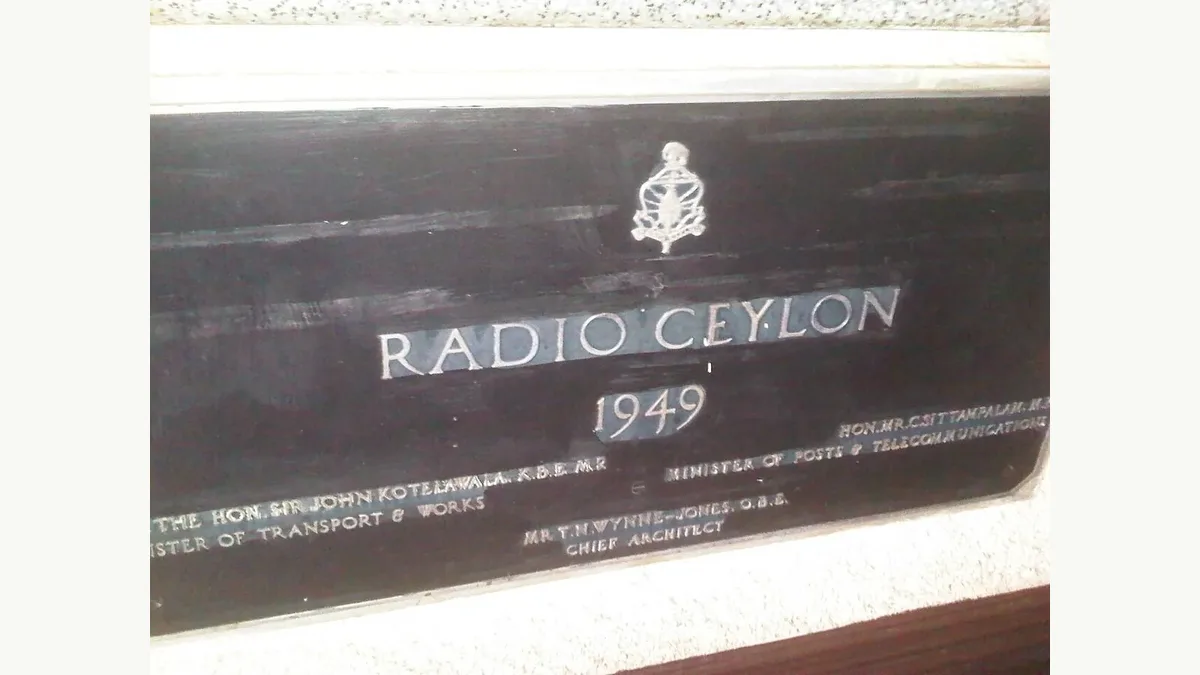
Seven hundred and sixteen people applied. That is the number Radio Ceylon put through a set of auditions in 1949, when the station decided that the men and women who sang and played on the national airwaves ought to be sorted, formally, by grade — A, B, C — with pay and airtime to match. Singers came in off the street, off the stage, off the temple circuit. Five of them walked out with an A.
The five were Lionel Edirisinghe, Ananda Samarakoon, Devar Surya Sena, S. Amarasinghe, and a thirty-four-year-old from Ja-Ela named Sunil Santha, who three years earlier had recorded the song that everyone in the building could hum.
Three years after that, Radio Ceylon called the musicians back to be graded again. Sunil Santha did not go. He was, by then, the most commercially successful Sinhala recording artist in the country — and he gave up his A grade rather than sit the test. This is the part of the story that is usually told wrong. He did not fail an audition. He refused one.
The examiner had been his own teacher
The man Radio Ceylon hired to do the grading was Shrikrishna Narayan Ratanjankar, principal of the Marris College of Music in Lucknow, one of the most respected Hindustani musicologists alive. He came in 1949 and the station brought him back in April 1952.
There is a sharp irony in that arrangement, and it is not an accident of history — it is the whole point. Sunil Santha had studied at Marris College himself. Born Baddeliyanage Joseph John, a Catholic schoolteacher, he had been swept up by Rabindranath Tagore's 1934 staging of the opera Shapmochan in Ceylon, borrowed money from his brother, staged a Sinhala Hamlet to raise the rest of the fare, and reached Bengal in 1939. From Santiniketan he went on to Lucknow. Ratanjankar was his principal there.
By his own later account, he came back Indian. "While in North India I transformed into a North Indian in my dress, language, customs, ideas, and every other facet," he wrote. "Even when I was back in Sri Lanka, I behaved as though I were still in North India. I felt proud to forget all my Sinhalese ways… When singing Sinhala songs, I would pronounce the words as though they were Hindi words. I considered the Hindi accenting of Sinhala words to be a great thing."
Then he stopped considering it a great thing.
A quarrel about how to say a Sinhala word
The turn shows up in the music. In 1946 he released ඔලු පිපිලා (Olu Pipila, "the lilies have blossomed") — words, melody and voice all his own, which at the time was three jobs, not one. It became the first song Radio Ceylon ever cut to a disc of its own.
What made it sound strange was what it left out. The musicologist Sunil Ariyaratne put it plainly: Santha's voice had been trained from childhood in the Catholic music of the church, and unlike the Sinhalese singers who had trained in North India, "he rarely used these ornamentations. He moved straight from note to note. He also pronounced the words better." No kan svara, no meend — none of the sliding grace-notes that were the audible signature of a Hindustani education. Sinhala words came out sounding like Sinhala words.
Behind that choice stood Munidasa Cumaratunga's Hela Havula, the Pure Sinhala Fraternity founded in 1941 to reform the modern language back toward its classical literature. Santha's uncle, Father Moses Perera, was a member and had put Cumaratunga's writing into his hands. And the Hela Havula had a specific grievance ready-made for this moment: in 1938 the German philologist Wilhelm Geiger had published A Grammar of the Sinhalese Language, and the Royal Asiatic Society had leaned on foreign expertise for the Sinhala dictionary — which the poet Rapiyel Tennakoon had satirised in 1939 in a long poem called Vavuluva, "Bat Language."
Santha and Tennakoon were collaborators. One of their songs, Dudan'oda Binda — Garrett Field translates the title as "Kill this cruel creep" — came out of the second chapter of Tennakoon's long poem Havilla, and it was at the centre of the row.
So when a foreign professor arrived to certify who was fit to make Sinhala music, Santha had a sentence waiting.
"Just because we brought a German"
He boycotted the April 1952 auditions. Then, on 5 May 1952, the newspaper Lankadipa carried an article by him on page 8, under the title "Ape Desiya Sangitaya Kumakda?" — "What is our national music?" In it he wrote:
I do not believe that we should wish for a foreigner to come to Sri Lanka to advise us on how to create a national music just because we brought a German to advise us on the Sinhala language.
He went further, and attacked Ratanjankar's competence to judge on the specific ground that he had never lived in a Sri Lankan village and therefore did not know how ordinary people behaved or sounded. Santha's own example was oddly concrete: he knew, he said, what village women do when they lose something valuable — they curse the gods and take vows. A grading panel in Colombo could not hear that.
It is worth being fair to the other side. Ratanjankar was not in Ceylon to impose raga on anybody. During the same visit he gave a lecture at the Royal Asiatic Society, "The Place of Folk Songs in the Development of Music," in which he told his Sinhalese audience that "the proper DESHI SANGEET of Lanka is in its villages. The Vannams, Astakas, the Sivupadas, the Stotras, the Pirits." That lecture is generally credited with launching sarala gee, the light-song genre that produced Amaradeva. The examiner and the boycotter were, in a strange way, arguing for the same thing from opposite chairs.
Fifteen years off the air
Accounts differ on exactly how the break happened. Field, working from Sinhala sources, says Santha boycotted the auditions and then "controversially quit his post as an A-grade musician." The Sunday Times, in a 2015 centenary piece, says his services "were terminated in 1952 after he refused to audition." Wikipedia says he was banned. The versions disagree about who ended it; they agree entirely that he was never graded down and never failed.
What is not in dispute is what followed. Between 1946 and 1952 he had composed and recorded more than a hundred songs for Radio Ceylon, with a ten-piece orchestra of his own that included violins, bamboo flutes, guitar, cello and the young W. D. Amaradeva. From 1952 he was largely absent from national radio for fifteen years, at home in Ja-Ela, cooking, and fixing things — he had wanted to be an inventor as a boy and never lost the habit.
He did not vanish. Lester James Peries called him in to write the songs for Rekava in 1956, to lyrics by Fr. Marcelline Jayakody, and again for Sandeshaya in 1960. In 1955 the journalist D. B. Dhanapala ran a campaign in Lankadeepa about his situation and raised money by subscription. He came back to the national service only in 1967, after a change of government brought Neville Jayaweera in as director-general — and then, with some relish, he was put on the panel that auditioned other artists.
The late songs are the odd ones. Gum Gum Gum, about the movement of bumble bees, is built almost entirely on a single note, and most listeners never notice.
What we know, and how we know it
The spine of this story — the two Ratanjankar visits, the 716 applicants, the five A grades, the boycott, and the Lankadipa article of 5 May 1952 with its line about the German — comes from Garrett Field's Modernizing Composition (University of California Press, 2017), which is open access and footnotes each of these claims to Sinhala-language sources, including D. M. Colombage's Guvan Viduli Vansaya for the list of the five. The account of his recording career, the fifteen-year absence and the 1967 return follows Tony Donaldson's centenary article in the Sunday Times.
What remains genuinely unsettled is the mechanism of the break: resignation, termination, or ban, depending on which source you read. What is settled, and worth saying loudly because the opposite is so often repeated, is that Sunil Santha never failed a voice test. He was graded A and gave it back.