
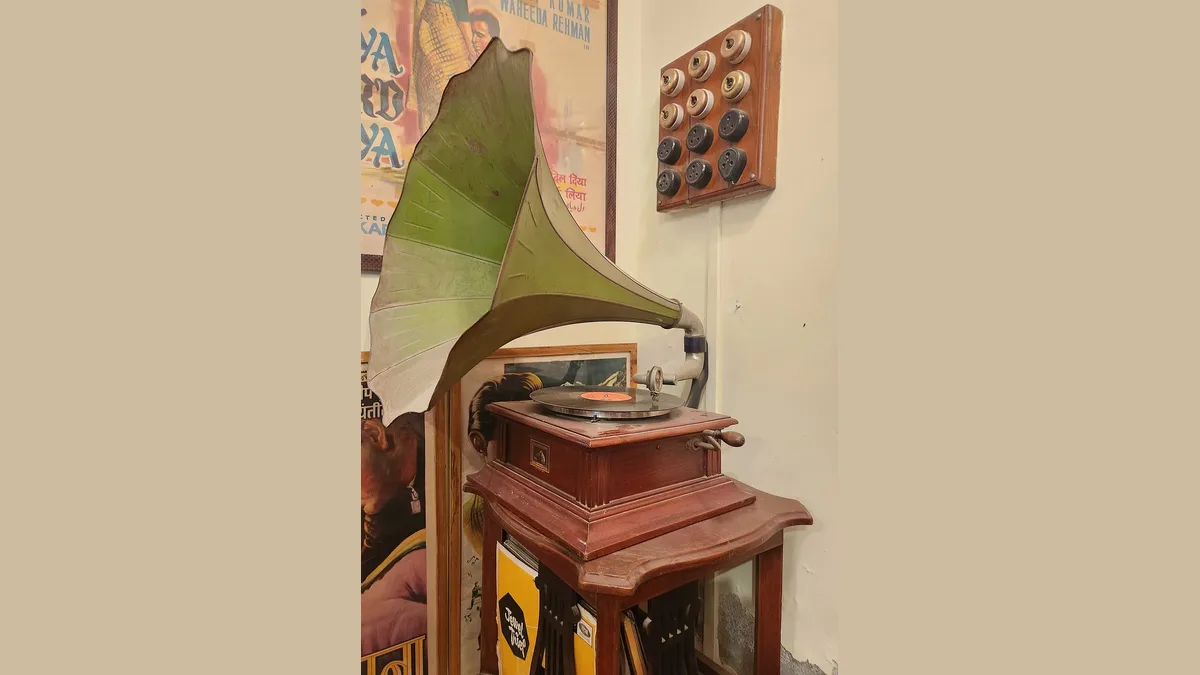
In 1940 the Hindi film Bandhan opened in Colombo. It had been the second highest-grossing Hindi picture of the year in India, and its best-loved number was a marching, patriotic song called "Chal Chal Re Naujawan" — "walk on, walk on, young one." Within a short time the Columbia record label had a Sinhala record on the market built on exactly that melody. A composer was paid to arrange it and a lyricist was paid to write new words over it, words aimed squarely at the Sinhalese Buddhist record-buyer. The result was දුල් සල් වනේ ලකල් Dul Sal Vane Lakal, "the shining and beautiful sal tree in the forest" — a song about the tree under which Queen Maya gave birth to the Buddha.
The lyricist had done the job well. He had matched the short and long syllables of the Hindi text almost beat for beat. His name was not printed on the label.
That was the industry. For roughly forty years, the quickest route to a Sinhala hit ran through a cinema showing an Indian film, and the practice was so routine that Sinhala had a phrase for it — one that its practitioners could not have enjoyed hearing.
"Putting words"
The phrase was vacana danava, literally "putting words." As the musicologist Garrett Field explains it, the term carried the suggestion that a Sinhalese songwriter merely had to put words onto an Indian film song's text "like an unskilled mason clumsily puts one brick on top of another." The lyricist Chandrarathna Manawasinghe, who lived inside the practice and despised it, defined it flatly: vacana danava "was a term used to describe how lyricists would take the words of a Hindi-language song and replace them with Sinhala-language words that sounded somewhat the same."
The economics were brutal and simple. Columbia and HMV paid Sinhalese lyricists five to ten rupees to fit new words to a popular Hindi or Tamil film tune. The labels did not print lyricists' names on the discs, which is why the authorship of a great many gramophone-era Sinhala songs is now simply unknown. The moment a Hindi- or Tamil-language film premiered in a Colombo theatre, producers at HMV or Columbia took note of which numbers the audience came out humming.
There is a small linguistic fossil of all this. Because imitation was the normal source of new melody, the Sinhala word that came to mean "tune" was anunada — "echo."
The habit did not begin with cinema. From about 1930 the labels had been selling a genre they called alut sindu, "new music," whose themes came out of the Buddhist revival but whose melodies came out of Indian films. Writing in the Sunday Times in 1998, Gerald Wickramasuriya — who had studied under Ananda Samarakoon as a young man in the late 1930s — put it without ceremony: "Upto that time what passed for Sinhala music was just a collection of Hindi tunes with Sinhala words superimposed on them."
Brass, and shiny foil
Manawasinghe's attack on the practice is the best-written thing anyone produced about it. In 1957, in the preface to his collection of lyrics Komala Rekha, he set out three separate charges: the words were hackneyed, the tunes were imported, and — worst — the words and the tunes did not even fit each other.
On the words, he was merciless. "A lyricist cannot create a powerful song just by playing around with stock words like 'gentle,' 'shiny,' 'moon,' 'sky,' 'beautiful,' 'fascinating,' 'lovely,' 'love,' or 'wonderful.' Words like this are just decorative material like shiny metal foil. We import brass" — the Indian melodies — "and apply our shiny foil to it." Such songs, he wrote, were "a nuisance to the ear like the scare-away clappers that drive birds out from lands that farmers cultivate."
On the mismatch, he was more technical, and more damaging. "Sinhalese lyricists do not consider whether or not their lyrics have any connection with the tempo, melody, or rhythm of the tune. In Indian songs we find that the rhythm mirrors the joyful words… However, Sinhalese lyricists put sad words to a happy melody. Or let's say a sad song was popular in India. Our musicians write a love song to that sad melody."
Underneath the aesthetics sat a status problem. Because song was made this way, most Sinhalese songwriters did not think of song as an elevated form of expression at all. That is why the best radio lyricists of the 1950s fought so hard to get their texts printed in books: print carried the power to make a lyric count as poetry.
The receipts, title by title
Sinhala cinema arrived in 1947 and inherited the habit whole. The first films were made in South Indian studios with Indian directors, technicians and musicians, and the songs came with the package. A modern survey by Roar Media laid out specific pairings that anyone can still check by ear.
කොළොම්පුරේ ශ්රියා Kolompure Shriya — "the beauty of Colombo," sung by Eddie Jayamanne in Umathu Wishwasaya (1952), a cheerful catalogue of Pettah shops, tram cars and double-decker buses — runs on the melody of "Kusoor Aap Kaa" from the Hindi film Bahar (1951). මැවිලා පෙනේවි රූපේ Mavila Penewi Rupe, sung by Rukmani Devi in Kalaa Handa (1953), uses "Mera Qarar Leja" from Ashiana (1952). H. R. Jothipala, the most popular playback singer the island has produced, was routinely criticised for the practice: his Ninda Nene Rathriye takes "Chaudhvin Ka Chand," and his Sobava Hanga Mey Lo Thale, from the 1972 film Mey Daasa Kumatada?, takes "Aulad Walon" from Ek Phool Do Mali (1969).
It is worth saying plainly that these songs were loved. Jothipala was "Hadawatha Rathran Jothipala" — golden-hearted Jothipala — to millions of people who did not care where the tune came from, and the critics who despised the borrowing never dented his popularity.
The other side of the argument
The revolt against vacana danava did not stay in the letters column. It produced institutions. The songwriter Wimal Abeysundara later described the invention of the Sinhala radio opera in 1955 as a direct answer to it: "Until very recently our singers were accustomed to singing lyrics set to already-composed melodies found in Hindi films. Composing original lyrics, or original music was a rare phenomenon… Having their primary objective to create a song form with national features, Radio Ceylon suspended the following of Hindi film songs and inaugurated a new form of Sinhala music."
That is a partisan account by a man describing his own side's victory, and it should be read as one. Radio Ceylon's Sinhala service did steer hard toward original composition through the 1950s, but Hindi-tune borrowing continued for decades in film music, where the money and the deadlines were.
The most telling change was not aesthetic but legal. In 2007 the pop duo Bathiya and Santhush released මීදුම් සෙලෙන් පාවී Meedum Selen Pawee, built on "Sawan Ka Mahina" from the Hindi film Milan (1967) — and said so, sampling the Hindi song directly and calling it a Sri Lankan-Hindi remix inside the lyric itself. What had been an unmentionable trade secret in 1940 had become a credit line.
The irony arrived shortly after. When the producer Iraj built a remix on the 1957 Sinhala song Aloke Genadevi Sansaraye, the widow and son of its writer, Herbert M. Seneviratna, sued him for infringement — and that 1957 song had itself been set to "Mera Chhota Sa" from the Hindi film Bhai Bhai (1956). Three generations of borrowing, and only the last one went to court.
What we know, and how we know it
The term vacana danava, Manawasinghe's quoted attacks, the five-to-ten-rupee fee, the unprinted lyricist credits and the Bandhan example all come from Garrett Field's Modernizing Composition (University of California Press, 2017), which is open access and footnotes these claims to Sinhala-language sources including Manawasinghe's own 1957 preface and Sunil Ariyaratne's 1983 study of Hindustani imitation in Sinhala song. The film-song pairings come from a 2018 Roar Media survey, and the 1998 recollection is from the Sunday Times.
What cannot be established is scale. Nobody has published a count of how many Sinhala gramophone and film songs were built on Indian melodies, and because the labels left lyricists' names off the discs, in most cases nobody can say who wrote the words. The individual pairings above are verifiable by listening; the overall proportion is, for now, an impression rather than a figure.