
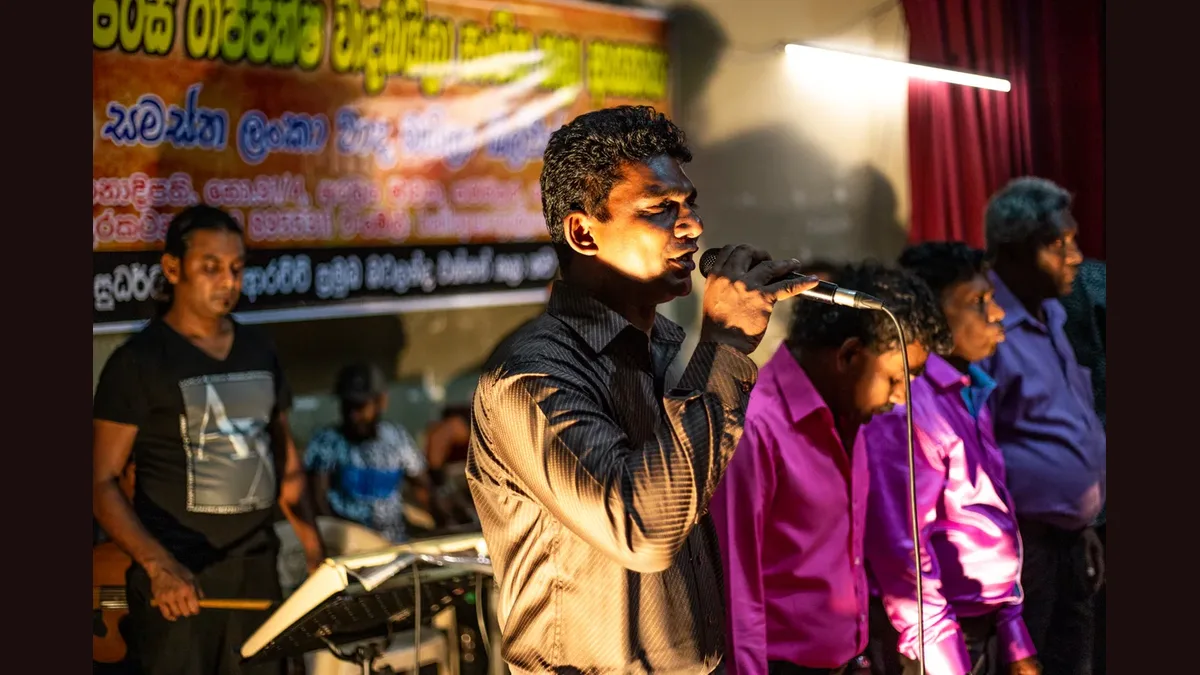
Somebody in the audience shouts a subject. The band is already playing — 6/8, a viola, a mandolin, a rabana, sometimes a harmonium and tabla. The singer has the length of an instrumental phrase to think. Then he has to answer: in metre, in rhyme, on the beat, and well enough that the judges give him the medal and not the man standing beside him.
This is vaada baila — argument-baila, sung debate — and Sri Lanka has been doing it for well over a century. It is a form nobody planned and almost nobody wrote down, and there are now perhaps thirty or forty people left who can do it properly.
Faith, parents, teachers, and then war
A vaada baila contest is not a free-for-all. It has an order, and the order is a courtesy.
The first round is about faith: each contestant sings about the religion he believes in. The second round pays respect to parents. The third pays respect to teachers — and in this world "teacher" is not a figure of speech, since aspiring singers travelled to study under particular masters and were expected to name them, with respect, in their own lyrics.
Only after all three is the field cleared for combat. From that point the contestants are set against each other, the audience throws subjects at them, and they go at it until the judges have seen enough. Medals go to the winners. Marks are given for quick-wittedness, for meaning, for flow and for rhyme, which is a set of criteria that would be perfectly familiar to anyone who has watched a rap battle.
The nineteenth-century observers of coastal music noticed this competitive habit early. Writing about baila in 2006, Tony Donaldson recorded that the best singers were sometimes called "baila captains," able to sing thirty or more songs in an evening, and that baila "is also sometimes performed in a competitive style of singing between two singers in which each singer strives to outwit the other." The heartland of the form is the western coast — Modara, and the Moratuwa–Galkissa stretch south of Colombo.
What people did before there were shows
It is easy to underestimate what these contests were, because there is nothing quite like them now.
Long before musical shows in the modern sense, vaada baila sessions were what people went to. They were ticketed. They were partisan. And, according to Sunil Ariyaratne's study of baila and kaffrinha, they were corrupt in the way that only genuinely popular events are: it was not unusual for a competitor's backers to buy tickets in bulk in order to pack the hall and swing the vote. Sometimes an evening ended in a stabbing.
That is worth sitting with for a moment. A poetry competition, in Sinhala, judged by a paying crowd, with enough at stake that people bought the vote and occasionally drew a knife. It is not the picture of literary culture that the twentieth century liked to present, and it may be a truer one.
"The Cart or the Car?"
By the early 1960s the form had reached the state broadcaster. Sri Lanka Broadcasting Corporation programmes split popular baila singers into teams and set them to debate the questions of the day in verse.
The surviving subjects are wonderful, because they are exactly the arguments a country modernising in a hurry was actually having. The cart, or the car? The Western doctor, or the Sinhala weda mahaththaya? These are not novelty topics. In 1962 the question of whether you took your child to a physician or to a traditional practitioner was a real household decision with real consequences, and here it is being fought out, extempore, in rhyme, on national radio.
The performers of that era took their neighbourhoods into their names, so that a bill read like a map of Colombo: Maradana W. A. Ruban Perera, Modara Justin, Ratmalana T. D. Gunathilake, Dematagoda B. Don Richard, Rajagiriya Marshall, Punchi Borella T. S. D. Siriwardena, Welikada Sunil Atapattu. Several of them — Siriwardena, Don Richard, Marshall, and J. D. Sumanapala — were known as Baila Masters, and singers came from across the country to learn from them.
A stage name that is a place name tells you something about how the form worked. You did not represent yourself. You represented a street.
Thirty or forty left
The person who has carried the form furthest into the present is Percy Rajapaksha, four decades in the circuit and by common consent its champion. He runs a vaada baila school in Ratmalana.
"It's easier for me when they come to us with the ability to put together some rhymes in their head," he told Roar Media. "But we can still teach even if they don't."
His two daughters, Shashira and Shishara, are believed to be the first women to perform vaada baila on stage in Sri Lanka. Shashira began at eleven, Shishara at seven; their mother wrote their early stanzas, and at the start they worked from prompts scribbled on paper. Shishara has described the transition frankly: "When we were on stage, people would come up and give us topics to sing about. We would be very helpless then, and stumble through it. That way, with time, we were able to develop an ability to sing live." Both now tour abroad, mostly in Europe. It was their mother, initially, who backed the career — their father was worried about how audiences would react to two young girls on a vaada baila stage.
Rajapaksha's own assessment of the state of the art is bleak. He remembers hundreds of vaada baila singers in the country. Now there are, by his count, thirty or forty who perform sporadically. Few events, fewer new performers, and a mainstream media that has moved on. "It would be a shame to lose such a dynamic and unique art," he said.
There is one obvious reason for the decline, and it has nothing to do with taste. Vaada baila cannot be recorded in advance. It has no repeatable product. A song can be pressed, broadcast, licensed and streamed; an argument that only exists because this particular audience shouted this particular subject on this particular night cannot. Every commercial change in Sri Lankan music since 1970 — the record, the cassette, the television spot, the streaming platform — has favoured the fixed object over the live event. Vaada baila is all live event.
Which makes the school at Ratmalana, and the four generations of one family who have now stood on that stage, the whole of the transmission line.
What we know, and how we know it
The structure of a contest, the round order, the judging criteria, the SLBC debate topics, the Baila Masters and their place-names, and Percy Rajapaksha's account of the present state of the form all come from Roar Media's report on vaada baila, which draws on Professor Sunil Ariyaratne's An Inquiry into Baila and Kaffrinna for the historical material and interviews Rajapaksha and his daughters directly. The instrumentation and the geography of the form — Modara and the Moratuwa–Galkissa coast — are from Wikipedia's baila article; the note on competitive two-singer baila is from Tony Donaldson's 2006 Sunday Times essay.
Very little of this is firmly dated. Nobody can say when vaada baila began; the "early 1960s" for the radio contests is Ariyaratne's, and we have not been able to check it against a broadcast schedule. The claim that Shashira and Shishara Rajapaksha were the first women on a vaada baila stage is reported as a probability rather than a certainty, and should be treated that way. The performers' repertoire, being improvised, is largely unrecorded — which is precisely the problem the Ratmalana school exists to solve.