
In a small workshop in Mathara run by two brothers, cow skins are pegged flat in the sun to dry, the flesh side rubbed with ash so it will not rot, the hair scraped off afterwards with a knife. Goat skins get the same treatment. But the skin that actually gets struck on a low-country drum is not bought as a hide at all. It is cow stomach-lining, and it comes ready to use, straight from a butcher.
That detail is the whole subject in miniature. Sri Lankan drums look similar from the audience. They are not similar. They differ by region, by playing hand, by the animal they are made from, and — as it turns out — by which of them the country decided to call its national instrument.
Four drums, three regions
The island's traditional music divides into three regional traditions, and each has an instrument that stands for it.
ගැට බෙරය geta beraya represents the up-country, or Kandyan, tradition. It is a barrel-shaped double-headed drum played with the hands on both sides, worn on the waist, about 27 inches long. Crucially, the two heads are made of different animals: cow skin on the side that produces the bass, and monkey or goat skin on the other, which produces the sharp, high, ringing stroke that drummers call jim. That asymmetry is the sound of Kandyan dance.
යක් බෙරය yak beraya — literally "demon drum" — represents the low country, meaning Galle, Matara and Hambantota. It is cylindrical rather than barrel-shaped, also 27 inches, also played with both hands, but both of its heads are cow stomach-lining, which is thin enough to break fairly often and thin enough to be very loud. It goes by several other names, including devol beraya after the god Devol and his ritual, ruhunu beraya after the southern kingdom, pahataraṭa beraya — simply "low-country drum" — and, memorably, gōśaka beraya, the noisy drum. The low-country drummer Sandhoris Jayantha explained its purpose to the researcher Sumuditha Suraweera in terms that have nothing to do with entertainment: its low, powerful, resonant sound is what allows the ritual specialist to communicate with supernatural beings.
දවුල davula represents Sabaragamuwa. It is shorter and wider — around 15 to 17 inches long, 12 to 14 across the heads — with goat skins, and it is played asymmetrically: a carved stick called kaḍḍippuva on one side, the bare hand on the other. Its tone is more piercing than the geta bera's and it has no comparable bass.
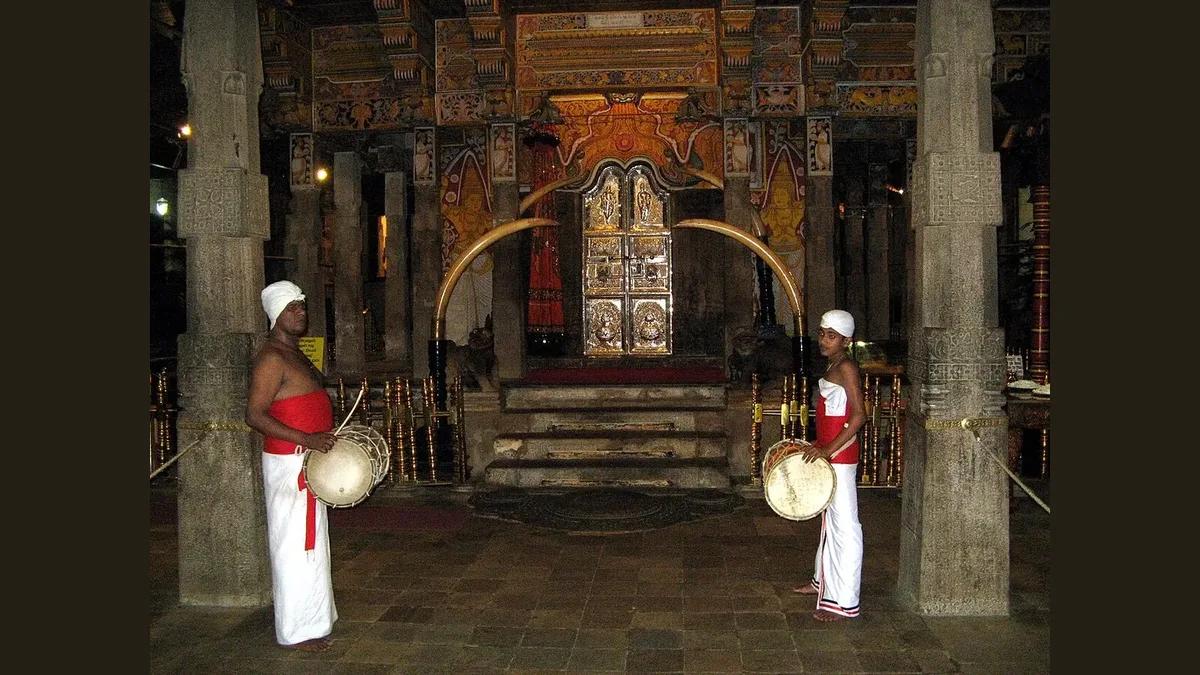
තම්මැට්ටම thammattama belongs to no single region. It is a pair of vessel-shaped kettle drums lashed together, covered in cow hide, one slightly larger and lower than the other, and struck on their upper faces with a pair of cane sticks with curved, circular ends. It is the drum of the Buddhist temple. Together with the davula and the horanǟva — a conical-bore quadruple-reed oboe — it forms the හේවිසි hevisi ensemble that plays at temple ceremonies and processions.
The classification behind all of this is old. The Mahavamsa, the chronicle written around the sixth century, sorts instruments into a fivefold scheme, pañcatūrya nāda, whose first two categories are both drums: ātata, single-headed, and vitata, double-headed. A later reading by J. E. Sedaraman proposes something more practical — that the categories really distinguish instruments played by hand, by stick, and by both.
Inside the low country: three towns, three schools
Zoom in and the divisions keep going. Suraweera's 2009 Canterbury doctorate — the most detailed account of low-country drumming in English — documents three recognised sub-traditions within it, named after the settlements of Raigama, Bentara and Mathara.
To a novice they are indistinguishable, and Suraweera says so plainly. To practitioners they are not, and the geography explains why. Mathara and Raigama are the furthest apart, and their playing is the most stylistically contrasting. Bentara sits between them and shows the influence of both, though its sound leans towards Raigama.
Raigama is now the dominant school, for two unromantic reasons: the clarity of its technique, and the fact that it borders Colombo, where most low-country artists now live.
The differences reach right down into the hardware. Low-country drums are tuned by hitting the woven rim, bera gäṭiya, with the palm — upwards to tighten, sideways to loosen. Mathara drummers cannot do this, because the outer skin layer on their drums, the häkma, is too thick and too tight. So they carry a wooden wedge shaped like a traditional door stopper and use that instead.
How you make one
Older accounts of instrument making read like a ritual, because they were one. Trees growing near temples or waterfalls, or brought down by lightning, were preferred; trees near cemeteries were unsuitable. The ground beneath the chosen tree was cleaned and offerings made to ask permission. Verses and prayers were recited for up to seven days before the felling, which happened at an astrologically determined hour. The carved body was then left under running water for around seven days, dried in shade, and coated inside with heated resin — to keep out malevolent influences of exactly the sort the drum would later be used to expel.
The drum was measured against its owner's own body. Dimensions were given in viyat — the span from thumb to little finger — and aňgul, the length of the index finger above the palm; a long drum was three viyat and three aňgul, one viyat across the head. Commentaries suggest that making your own instrument was once the norm.
Today, at the largest of the three workshops Suraweera visited, at Udugampola near Gampaha, a log is cut to length with an electric chainsaw and shaped on an electric lathe. The interior is hollowed with a long chisel until the shell is about half an inch thick and deliberately left rough, because a rough surface is believed to give the right resonance. Hard-cored woods are preferred — ähäla, milla, kohoḿba, jak, kitul — but felling restrictions mean cheaper drums are now made from coconut wood, which professionals will not play and which mainly ends up in schools and tourist shops.
One stage keeps a wonderful name. Before the drumheads go on, a soaked cowhide is roped temporarily over each end and pulled tight through sixteen pierced holes, so that it dries into the shape of the drum. This provisional rigging is called boruvara ädīma — "fake strapping."
The old relationship survives too. An elderly Sabaragamuwa musician, M. K. Babanis, told Suraweera that he sleeps beside the davula he inherited from his father, out of respect. Drummers commonly put their palms together in a brief salute to the instrument before and after playing, and there is a specific pattern associated with the gesture.
Why one drum became the national one
Ask most people which is the important Sri Lankan drum and they will say the geta bera. That answer has a history.
Suraweera, drawing on the ethnomusicologist Anne Sheeran, points out that the effort to consolidate a coherent up-country tradition during the independence struggle had the side effect of treating everything Kandyan — including its instruments — as the purest and oldest expression of Sinhala culture. The consequence is a widespread misconception that the geta bera outranks the others, and, Suraweera argues, one more way in which low-country drumming is marginalised even within traditional music.
There is a visible trace of the older arrangement in how drums are painted. The geta bera and yak bera were left plain. The davula, thammattama, uḍäkkiya and rabāna were coloured with natural paints matched to the wall paintings of Buddhist temples — the instruments of the temple looking like the temple.
What we know, and how we know it
The instrument descriptions, the sub-traditions of Raigama, Bentara and Mathara, the making process and the Mathara tuning wedge all come from Sumuditha Suraweera's 2009 University of Canterbury doctoral thesis, which is based on fieldwork with named drummers and instrument makers and is freely available online; the regional framework is corroborated by Simpson and de Silva's 2025 study of the Berava caste and by a 2021 comparative paper in the International Journal of Culture and Art Studies. Sources disagree on details of construction — Suraweera explicitly corrects the Garland Encyclopedia's claim that the geta bera is covered with cow intestine — and on measurements, where published figures for the geta bera's widest diameter differ by a factor that suggests one of them is a circumference. The ritual account of tree-felling is drawn from Sinhala-language monographs describing traditional practice, not from observation of it.