
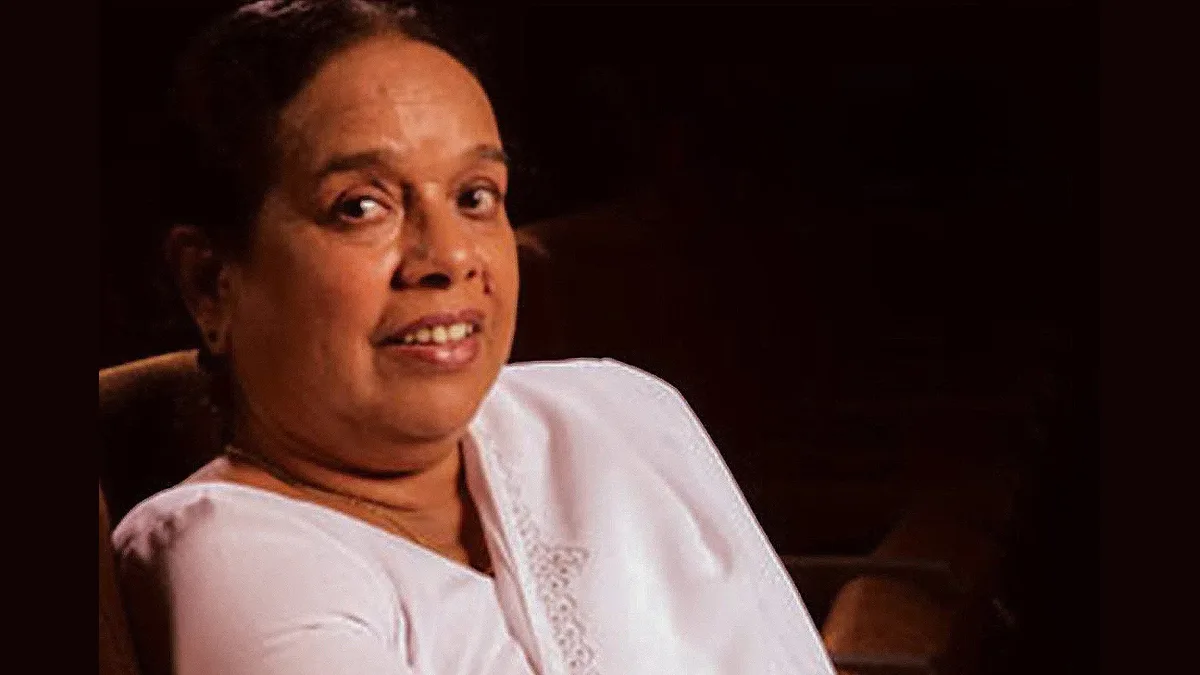
In June 1987 a woman in a white sari walked onto a stage in Sri Lanka and sang a programme of songs about unemployment, injustice and rage. She did it again the following week, and the week after that. The series ran eighteen months and two hundred and five performances, straight through the bheeshanaya — the years of terror between 1987 and 1990, when the second insurrection of the Janatha Vimukthi Peramuna and the state's counter-campaign left bodies on the roads and nobody counting.
The singer was Nanda Malini. The lyricist was Sunil Ariyaratne. The programme was Pavana. Nearly forty years later it is still the most politically explicit body of work in Sinhala music — and one of the most heavily mythologised. Separating the two is the point of this article.
Two hundred and five nights
Nanda Malini, who died on 20 August 2026 at eighty-two, built her career on the solo concert series — a form that let a singer assemble an argument across a whole evening rather than a single three-minute song, and take it around the country herself.
Her first solo series began in 1973 and closed on 22 May 1979 after 530 performances. A second, Sathyaye Geethaya, ran from August 1981 to August 1984, some 500 shows. Pavana came next: June 1987, eighteen months, 205 shows.
Those numbers say something the mythology obscures. Pavana was not a suppressed artefact circulating in whispers. It was a touring stage production, performed publicly two hundred and five times, at the height of the worst violence in the country's history.
Was it an album or a concert?
Sources genuinely disagree about what Pavana was. Its Wikipedia entry lists it as a solo concert series begun in June 1987. The Sunday Observer's 2007 profile calls it "a cassette containing songs with strong messages against the period of terror in 1989." The essayist Uditha Devapriya, writing in 2021, calls it "the most politically explicit of her albums" and dates its debut to roughly thirty-five years earlier, placing it in the mid-1980s.
Most likely all of these are partly right — songs that existed both as a stage programme and as a tape, which is how Sri Lankan artists worked once the cassette had broken the broadcaster's monopoly. But no source reconciles the dates, and anyone giving Pavana a release year is choosing between accounts rather than reporting a settled fact.
What is documented about the ban, and what is not
The story everyone knows is that Pavana was banned and that owning the cassette was an arrestable offence. Here is what stands behind it.
The Sunday Observer's 2007 profile, drawing on the singer's own account, reports that as a result of Pavana her songs were kept off the state broadcaster and the state television service, that the concert too was stopped, and that she and Sunil Ariyaratne received death threats and left the country for a period. In the same piece she gives her view of censorship: banning a work of art deprives the artist of a living and violates the audience's right to hear serious work. It is, she said, a way of killing an artist.
That is a singer's testimony reported twenty years after the events. But it is not a gazette notification, a court record or a contemporaneous news report, and no such document has been produced.
The larger claim — that the government banned the cassettes and arrested anyone caught with one — has a thinner basis still. Its usual source is a single sentence in Uditha Devapriya's 2021 essay: "The government of the day saw it fit to not just ban Pavana cassettes, but also arrest anyone caught possessing them." The essay cites nothing for it. No gazette, no case, no arrest report, no contemporaneous account has been found to support it, and it should not be repeated as fact.
There is a related and larger absence. People often speak of an SLBC list of banned songs, from 1971 or from the terror of 1988 and 1989. No such list has been located. What is documented is different and more revealing: not a blacklist of songs, but the removal of individual people from the payroll, and the rationing of whole genres by airtime. The state did not need a list of forbidden songs when it employed most of the singers.
Kapuge's file
If Pavana's treatment is murky, the other great protest singer of the period leaves a paper trail, and it shows how an artist was disciplined.
Gunadasa Kapuge joined the national broadcaster in the late 1960s, worked as an operational assistant from 1969 and as a programme producer from 1975, and was graded an A vocalist after his 1973 release දෑස නිලුපුල් තෙමා (Daasa Nilupul Thema).
Then: invited to an international youth conference in Havana, he applied for leave and was refused, for reasons his biographers call political. He went anyway, on 22 July 1978. When he landed back at Bandaranaike International Airport, officials of the corporation handed him a letter there telling him he had left the service.
He got the job back in 1979 and was arrested the same year, on a charge of insulting the then Prime Minister, Ranasinghe Premadasa; he was released while the allegation was investigated. He was expelled again, then re-employed through the intervention of the corporation's chairman, Eman Kariyakarawana — and transferred out of Colombo to the Rajarata Service, where from 1981 he headed the music division and later the service itself. During the violence of 1988 and 1989 he did not change his line, and on 29 January 1990 he was sent on compulsory leave.
That is what happened instead of a ban: no gazette, no prohibited-songs list, just a career taken apart and reassembled until the man was outside the building.
It did not work. On 25 August 1990 Kapuge staged a one-man show at Colombo's Lumbini theatre called Kampana, released it as a cassette under the same name, and over roughly two years performed it close to a thousand times — sometimes stretching a two-hour programme to three because the audience would not let him stop.
The songs, and the argument about them
The songs are less quoted than the legend around them, and the two singers were doing different things.
Nanda Malini's political work did not begin with Pavana. සකුරා මල් පිපිලා (Sakura Mal Pipila), an early collaboration with Ariyaratne, is a catalogue of impossibilities — cherry blossom in the open, the sun up at night, the sky falling — and was reportedly kept off the air for what officials read into it. By Pavana the irony had burned off: songs like "Mongoliyanuwane" and "Mugurak Awasi Thana Mugurak" are direct calls to fight, and Devapriya's criticism is that the polemical won out over the poetic.
Kapuge's route was different. උතුරු කොනේ (Uthuru Kone, "in the northern corner"), addressed across the ethnic divide to Tamils in the north; අහස උසට නැග ගියාට (Ahasa Usata Naga Giyaata), about workers who climb high on construction sites and stay where they are in the social order; සුදු නැන්දා ඇයි (Sudu Nanda Ai), where a lover's lament is really about class. All keep the poetry inside the polemic.
Both were doing something the scholarship has barely touched. Garrett Field, whose history of twentieth-century Sinhala song is the most rigorous in English, notes that the 1971 insurgency "inspired radical forms of Sinhala song and poetry, which future studies will need to address" — and leaves it there. The protest song of 1971 and 1988–89, including the insurgency's own repertoire, remains one of the great unwritten chapters of Sri Lankan music.
What we know, and how we know it
The concert chronology — 530 shows to May 1979, 500 for Sathyaye Geethaya, 205 for Pavana from June 1987 — comes from Nanda Malini's Wikipedia article, citing Sinhala-language interviews; her death on 20 August 2026 was reported by News 1st. The account of her songs being kept off the state broadcaster and television, of the concert being stopped, and of the death threats that sent her and Sunil Ariyaratne abroad comes from the Sunday Observer's profile of 21 October 2007, based on her own testimony. Kapuge's dismissals, the Havana trip, the airport letter, the 1979 arrest, the Rajarata posting and the thousand performances of Kampana are set out in his Wikipedia article, sourced to Daily News, Divaina, Lankadeepa and Roar Media.
What is not established is the ban. No gazette, court record or contemporaneous report has been found showing that Pavana was prohibited or that possessing the cassette was an offence; the arrest claim rests on one uncited sentence in a 2021 essay. Nor has any SLBC list of banned songs from 1971 or 1988–89 been located. Both may yet be documented — much of the relevant material sits in Sinhala-language newspaper archives that are not online — but until then, what can honestly be said is that the state broke careers rather than issuing prohibitions, and that both singers went on singing anyway.