
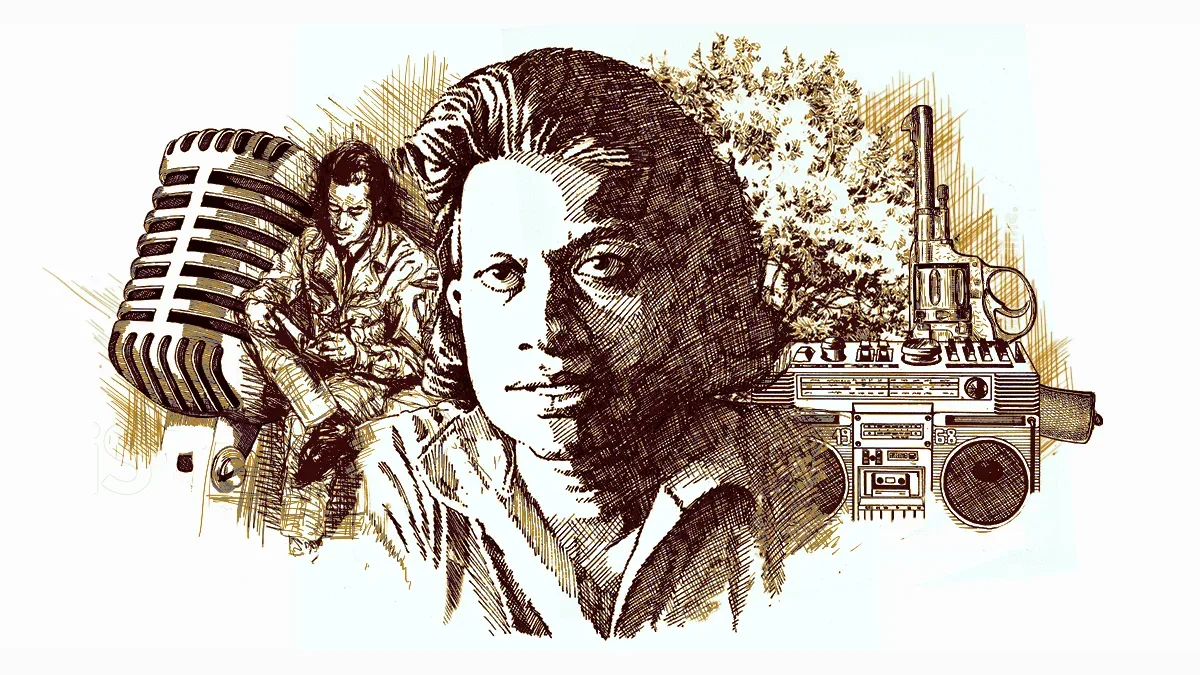
At about half past eight on the evening of Monday 31 July 1989, armed men came to a house in Homagama, on the road out of Colombo towards the hills. The man they wanted was forty-two years old. He was one of the most familiar voices in the country — the announcer of Shanida Sadaya, the Saturday-night programme, and before that of the children's hour — and he had written the words to songs for more than a hundred and fifty films.
He tried to leave by the back door. More men were waiting in the garden. His wife pleaded with them, and was told that they only wanted to question him. They took him out of the house and shot him. His body was found about two hundred yards away.
The Tamil Times carried the killing the following month under the flat headline "TV Broadcaster Shot Dead". The armed men are attributed in the standard accounts to the Deshapremi Janatha Viyaparaya, the armed wing of the Janatha Vimukthi Peramuna. Premakeerthi de Alwis was cremated at the General Cemetery, Kanatte, on 7 August 1989.
The man who could not sing
He had arrived in broadcasting by failing at it. In 1961 he auditioned to sing on Radio Ceylon and was turned down. Somebody at the station heard something else in the recording — not the singing, the speaking — and he was put on the children's programmes Lama Pitiya and Lama Mandapaya instead. He joined Radio Ceylon as a freelance announcer on 17 December 1967, became permanent in June 1971, and rose to Grade Two announcer and programme producer. When television came he moved into that too.
The songs were the other half of the life, and they were everywhere. හෙට දවසේ Heta Dawase ("tomorrow") for Priya Sooriyasena; තනි තරුවේ Thani Tharuwe ("lone star") and ආදරයේ උල්පත වූ අම්මා Adaraye Ulpatha Wu Amma ("mother, the wellspring of love") for Victor Rathnayake; the Buddhist devotional දෙවුරම් වෙහෙරේ Dewram Wehere; Eda Re Guwan Thotupoledi, Me Nagaraya, Sanda Midulata Enawa, Mannaram Piti Welle, Adaraneeya Neranjana. He wrote for Mohideen Baig, Milton Mallawarachchi, J. A. Milton Perera, Mervyn Perera, Malini Bulathsinhala and Freddie Silva. The veteran lyricist Rathna Sri Wijesinghe has recorded that critics called him the bard of Sinhala music, for the speed at which he could produce a finished lyric.
None of that is why this article exists. He has a full profile elsewhere on this site. What follows is about the evening, and about what that evening meant for everyone else who worked in Sinhala music.
The years without a name that stuck
Sri Lankans call the period the bheeshanaya — the terror. Between 1987 and 1989 an insurrection by the JVP and the counter-insurgency mounted against it killed somewhere between thirty-five thousand and eighty thousand people; the range itself is the most honest thing that can be said, because nobody counted and the estimates from European delegations, from the government and from human-rights organisations do not agree.
The mechanism that reached ordinary working people was the chit: a short handwritten memo delivered to a house or a workplace, instructing the recipient to strike, to close, to stop, to comply. Close to fifty school principals were killed in 1988 and 1989 for disregarding them. So were doctors, engineers, estate owners, businessmen and journalists.
Performers were not outside this. Vijaya Kumaratunga — film star, politician, and a playback singer with more than a hundred recordings to his name — was shot in the head outside his own house on the outskirts of Colombo on 16 February 1988. The newsreader Sagarika Gomes was killed. And the pressure did not have to be lethal to be effective: shows were cancelled because nobody could travel after dark, halls stood empty during enforced hartals, and a musician on the state payroll could be transferred, suspended or sent home on compulsory leave without a reason being given. The composer Gunadasa Kapuge, who had already been expelled and reinstated more than once, was sent on compulsory leave in January 1990 and answered by building a one-man show he went on to perform a thousand times. Nanda Malini's Pavana, with Sunil Ariyaratne's lyrics, ran for 205 performances over eighteen months from June 1987 — straight through the worst of it.
That is the setting in which a lyricist was taken out of his own back garden and shot: a country in which being publicly audible had become, for a season, a category of risk.
What is not known
The killing is documented. The motive is not.
No investigation established why Premakeerthi de Alwis was chosen, and no reason has ever been shown. A scan of Colombo High Court papers recording a conviction in the case has been uploaded to Wikimedia Commons by a private contributor; it is a court document about the murder, not an explanation of it. Everything else in circulation — that it was about his broadcasting, or his supposed politics, or a private quarrel, or a mistake — is speculation, and this article declines to choose among guesses about a man who cannot answer.
Even the attribution has been contested. Sinhala-language accounts record that in 2009 his widow publicly disputed the identification of the killers with the JVP. That report is itself thinly sourced, and it is set down here for completeness rather than settled. A road in Colombo was renamed for him in July 2014 — a stretch of Independence Square Mawatha, the road that runs up to the broadcasting headquarters where he had worked.
How the stories about the songs formed
There is a coda worth telling, because it shows how quickly a country turns a dead songwriter into folklore.
The most repeated anecdote about de Alwis concerns Heta Dawase. As it is normally told, Priya Sooriyasena turned up at the lyricist's house with a bottle of his favourite drink to ask for a song, found him hurrying out on urgent business, and was given two scribbled lines telling him to come back tomorrow just as he had come today. Those lines opened the finished song. It is a perfect story.
Sooriyasena himself denied it. In a television interview, recorded by Roar Media in 2018, he said the meeting was at the Sri Lanka Broadcasting Corporation, arranged through the announcer Elmo Fernando; that de Alwis pulled a piece of paper from his pocket at the reception desk, wrote the first two lines and promised the rest tomorrow; and that Sooriyasena came back the next day, all the way from Narammala, whereupon de Alwis asked for the paper and finished the song on the spot.
Two others hold up better. Thani Tharuwe is said to have begun with de Alwis lying on a beach one evening among friends from the music industry, looking up and calling out the two words as a single bright star appeared. Adaraye Ulpatha Wu Amma came from a reproach: his mother, who listened to everything he wrote, told him he had written songs for stilt-walkers and puppets and everyone else and never one for her. He laughed. About a year later, while she lay in hospital too ill to recognise him, he wrote it and asked for it to be recorded quickly.
The pattern is instructive. The prettiest version of a story is the one that travels; the singer who was actually in the room is the one who can flatten it. In a subject this thick with affectionate invention, that is the whole methodological problem in miniature — and it applies with much more force to the question of why armed men came to Homagama than it does to a song about a star.
What we know, and how we know it
The sequence of the evening — the time, the back door, the plea, the body two hundred yards away — comes from contemporaneous reporting in the Tamil Times of August 1989 and from Sri Lankan press retrospectives collated on Wikipedia; the conviction is attested by court papers scanned onto Wikimedia Commons by a private uploader rather than published officially. The song origins, including Priya Sooriyasena's on-record contradiction of the best-known one, come from Roar Media's 2018 feature. The casualty figures for the bheeshanaya are contested ranges, not counts.
What no source supplies is a motive, and no responsible account of this killing supplies one either. The 2009 report that his widow disputed the attribution to the JVP rests on thin Sinhala-language sourcing and remains unresolved.