
Before any of it happened, there was a motorbike. Satheeshan Rathnayaka lived in Anuradhapura and the studios were in Colombo, so when there was music to be made he rode down — a journey he puts at over five hours each way. "My hard work had now proved triumph," he told the Sunday Times afterwards, in the flat, slightly formal English of a young man being interviewed for the first time about the biggest song his country had ever exported.
The song is මැණිකේ මගේ හිතේ Manike Mage Hithe — roughly, "precious one, in my heart". Almost everything the world knows about it is about a version that was not the first one, sung by someone who did not write it, released ten months later. That is not a scandal. But the record is worth setting straight, because a great deal of nonsense has been written about it.
31 July 2020
The original went up on YouTube on 31 July 2020, made during Sri Lanka's COVID-19 lockdown.
It was produced and composed by Chamath Sangeeth at his C Music studio. The lyrics were written by Dulan ARX — Dulanja Alwis — who also rapped on it. The vocal was Satheeshan's. The music video was directed by Hasith Aryan (Hasitha Vithanage) and shot by the Aryans Music production company, with Madushi Soysa, Kasun Tharaka and Ruwan Priyadarshana on screen.
Those five names are the song. Satheeshan, who had been writing and producing as well as singing, called it his first hit.
22 May 2021
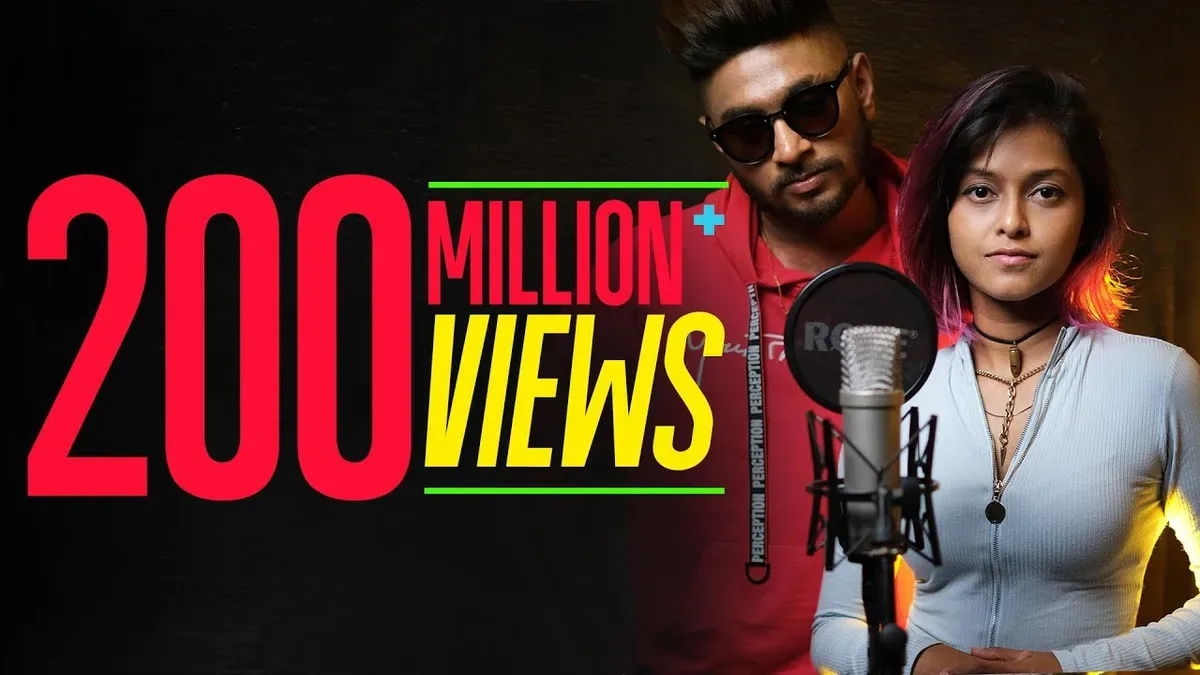
Chamath Sangeeth then produced an official cover of his own song, and released it on 22 May 2021 — Sri Lanka's Republic Day. The new lead vocal was Yohani de Silva, a young Colombo singer and songwriter who already had a following for her acoustic covers; Satheeshan is in the video with her, singing underneath.
What happened next has no real precedent in Sinhala music. The video went from a domestic hit to an Indian phenomenon in a matter of weeks. Amitabh Bachchan posted a clip of himself dancing to it. It was dubbed into Telugu, Kannada, Tamil, Malayalam, Marathi, Hindi, Punjabi, Bengali, Bhojpuri, Assamese, Kokborok and Gujarati, and beyond India into Nepali, Portuguese, German, Spanish, Somali and English. Yohani recorded the Tamil and Malayalam versions herself, published on 28 August 2021. On 19 October the director Indra Kumar announced that she would sing a Hindi version for his film Thank God, recomposed by Tanishk Bagchi with new words by Rashmi Virag.
The verifiable milestone is this: on 24 September 2021 the song entered the Official Charts Company's Asian Music Chart Top 40 in the United Kingdom at number eight. A Sinhala-language song had reached a British chart.
The view counts are less reliable than the chart position, and they are worth handling carefully, because they were reported live and inconsistently. The Sunday Times wrote in October 2021 that the cover had passed 150 million views in three months, and separately that it crossed 100 million in September; Wikipedia's article says 190 million in three months and, elsewhere, 232 million. Nobody was auditing. What is safe to say is hundreds of millions, faster than anything Sri Lanka had put on the internet before, and that the campaign around it is now routinely described at home as the country's first real viral-marketing success.
The feud that did not happen
Here is the story you will find in most places: that the original artists were sidelined, that Yohani took the credit, and that there was a bitter dispute over rights.
Satheeshan says otherwise, on the record, in the same interview.
"This is a major achievement and it became success only because we worked as a team," he told the Sunday Times in October 2021. "That is the main reason for his success." He then addressed the rights question directly — the paper prints it as "We had not issues on 'Rights' over the songs" — before adding: "Several times this song was in the breaking news. Yohani becoming popular with this song is not an issue for me or our team and since I am new to the music scene, even Yohani helps me in many ways, many a times."
He was equally direct about who ran the project: "It is Chamath who is the big strength behind the screen. The entire process is managed by Chamath and it is because of his management that the song became so successful."
And he thanked the whole crew, in a sentence worth quoting in full: "I must thank everyone who was behind this song. From music director, lyrics writer, recorders, players and even those provided a bottle of water to us is part of the success of this song."
That is the original singer, three months into the storm, saying there was no dispute. The "feud" appears to be an artefact of the way the story travelled — a global audience discovering the cover first, then discovering that an earlier version existed, and assuming a grievance that the people involved were not expressing. Two things can be true at once: that the original credits deserve to be known, and that nobody involved was cheated.
What actually moved
There was a commercial transaction, and it is more interesting than the imagined quarrel.
Because of the song's popularity in India, Satheeshan told the Sunday Times, the copyright in the Indian-language versions was bought by Indian parties; Chamath, as owner of the song, retained the right to release it in any other language. That is a normal music-publishing arrangement, and it is also, in miniature, the entire economic story of Sinhala song in the streaming era. A song made in a home studio in a locked-down country, with no label behind it, reached a market of a billion people and was then licensed into that market on terms negotiated by its composer.
It was not quite the first Sri Lankan viral cover — the Sunday Times noted that DeepSounds' "Shape of You — Sri Lankan Mashup" had gone massively viral at home before it. It was the first to travel.
Satheeshan went back to work almost immediately, announcing a follow-up and a set of India–Sri Lanka collaborations. Yohani was invited into Hindi film playback within months. Chamath Sangeeth's studio credit is now, quietly, the most consequential production credit in modern Sinhala pop.
What we know, and how we know it
The credits, the two release dates, the rights arrangement and every quotation above come from the Sunday Times interview with Satheeshan Rathnayaka published on 17 October 2021, cross-checked against the English Wikipedia article on the song and its cited reports. The chart position — number eight on the Asian Music Chart Top 40, dated 24 September 2021 — is from the Official Charts Company's own listing.
Two things remain genuinely unsettled. The view counts differ between sources by tens of millions and none of them is auditable, so this article gives no single figure. And the terms of the Indian-language rights sale — who bought them, for how much — have not been published anywhere we could find; Satheeshan's remark that "the copy rights of any Indian language version have been brought over by India" is the only account of it on the record, and it is a summary, not a contract.