
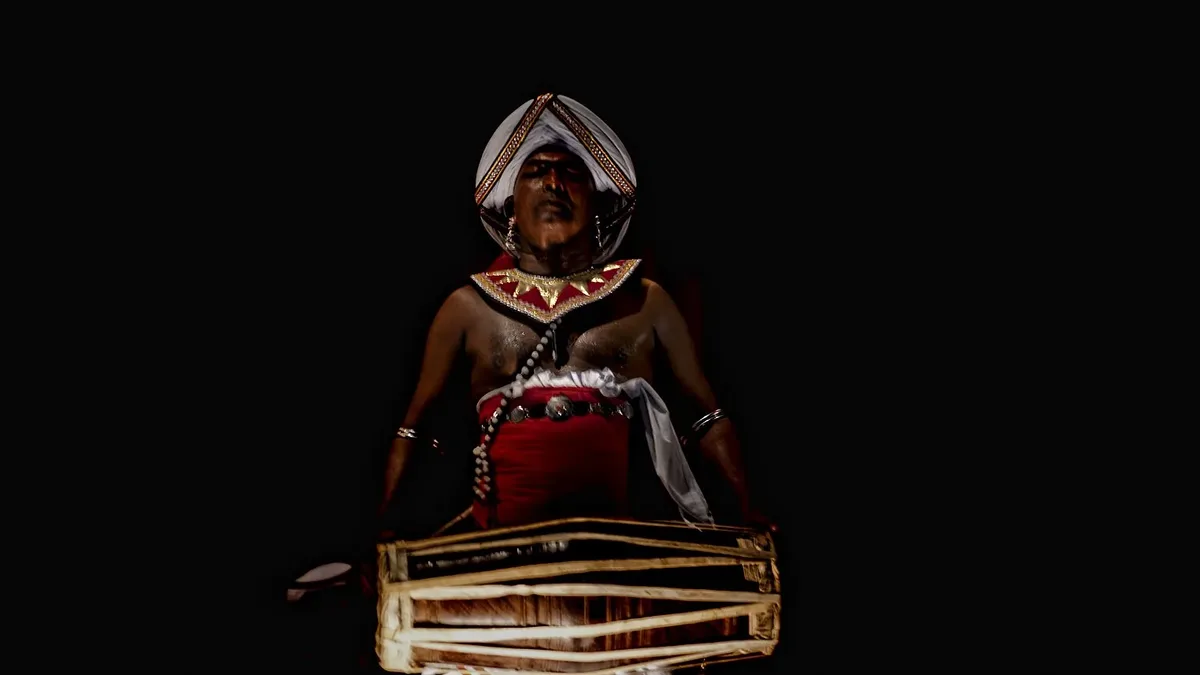
The drummer stands at the edge of the arena with the ගැට බෙරය geta beraya slung across his hips, one head under each palm. Behind him the villagers have built a ranga madala out of split coconut fronds and banana stems, and hung it with young palm leaf; oil lamps are lit; it is early evening and nobody will sleep. What he is about to play is not accompaniment. In කොහොඹා කංකාරිය Kohomba Kankariya the drum is the text. It calls the deities, it times the recitation, it tells the dancers which of a dozen named episodes has begun, and it will not stop for something like sixty of the old Sinhala hours — from dusk, through the whole night, and on into the next day's afternoon.
Almost everything an audience now recognises as Kandyan dance came out of this rite. The costume did. The drum did. The steps did. What is less often said is that the music came out first, and that the extraction was neither gentle nor accidental.
A rite for a village, not for a patient
The Kankariya is unusual among Sinhala rituals in whom it is for. Low-country tovil is commissioned by a family for a sick person; the Kankariya is commissioned by a village, to avert a drought or a general calamity and to ask prosperity for everyone in it. The anthropologist Susan Reed, quoted in Sudesh Mantillake's Maryland dissertation on colonial-era Sri Lankan dancers, calls it "a thanksgiving, a forgiving, and a post-harvest celebration". It belongs to a particular stretch of country — Satara Korale, Sath Korale, Udunuwara, Yatinuwara, Hewaheta, Pathadumbara, Harispattuwa — and carries an older name, the hatapas mangalya, the sixty-five ceremony.
Its origin story is a chain of misfortune. Prince Vijaya breaks his promise to Kuveni and drives her and their two children away; she curses him; the curse falls on a later king, Panduvasdeva, who sickens. Only Malaya Raja, born from a flower, can lift it, so the demon Rahu takes the shape of a boar and wrecks his pleasure garden to lure him into the chase. The hunt crosses the sea and runs up to Hanthana above Kandy, where the boar is shot and turns to stone. Malaya Raja then goes to the ailing king, has a decorated arena built in his garden, performs the sixty-five ceremony, and the king recovers.
That story is not background. It is recited inside the rite. The third act of the night, the asna — literally the seat, or the account — is where a dancer sings the history of the ceremony itself, including Kuveni and her children lost in the forest. The rite carries its own footnotes.
The order of the night
The Sinhala Wikipedia entry, one of the few descriptions of the sequence available online in any language, lists it plainly. The night opens with hangala yedima, asking the gods' permission after the performers have bathed and washed their heads with lime. Then sangala ædima, when the yakdessas — the ritual officiants — enter the arena in the silver-ornamented වෙස් ves costume. Then the asna. Then, in order: dalumura, guruge malawa, yaktum padaya, malappuwa and kolpaduwa, awandum, weddan giwissima, dana paha, mala netima, thalaya netima, yakkam paha and katha paha. It ends at muwamala widima, an arrow shot into a planted banana trunk to carry off every misfortune the night has gathered up.
Three of those are proper interior dramas: the guruge malawa, the weddan giwissima, and the yakkam paha, the five yakkam. The five are the cobra, the boar, the Vedda, the mirror and Sita. The ඌරා යක්කම Ura Yakkama, the boar episode, is the most theatrical: the hunt is staged with a costumed mock-buffalo and a bow, and at the end the animal's carcass is divided in song and dialogue among the eighteen castes. A ritual whose whole point is the welfare of the village also, in passing, sings the village's social order out loud.
What the drum is actually doing
The geta beraya is played on both heads with bare hands, and Kandyan drumming is built on spoken syllables before it is built on skins: takundat jin jin, taku taka jin jin is not a description of a rhythm but the rhythm itself, learned as speech and transferred to the hands. In the yak anuma, the invitation to the deities, dancers move to exactly that pattern in four steps — right, left, right, left.
Writing in Ceylon Today in May 2025, Manoj Jinadasa makes the point that the interest of this drumming is not in a single line but in the interference between two: when two drummers interlock, a third rhythm appears that neither is playing. He calls it a kind of polyphony, against the largely single-line textures of South Asian classical music — and sets the geta beraya's round, mid-range tone against the sharper, higher yak beraya of the low country.
The drummers and dancers came, for the most part, from the Berava caste, for whom drumming was a hereditary obligation rather than a career. Under the Kandyan rajakariya system this was service owed to the king and the temple, and it was supported accordingly. When the British abolished rajakariya in the 1830s, that support went with it. Mantillake's argument, in short, is that ritual dance was reclassified as unproductive labour, and that its practitioners were then made available for a different kind of work.
How the rite was taken apart
The best-documented moment of that transfer is the special perahera staged for the Prince of Wales at Kandy in 1875, when ves dancers appear on the street for the first time in the record; Mantillake finds no evidence of them performing outside the Kankariya or the valiyak mangallaya before it.
The musically interesting consequence is what the dancers did next. A perahera moves; a ritual arena does not. Facing the relic casket and the aristocrats, dancers could not turn their backs and could not safely walk backwards in the dark. What they did was reach into the rite for a step that already solved the problem: the four-count yak anuma pattern, which lets a line of dancers travel sideways while still facing inward. Mantillake identifies that appropriation as the origin of the goda sarambaya, the first hand-and-leg exercise taught to every Kandyan dance student in the country today. A movement invented to invite the gods became a way to travel down a Kandy street without giving offence, and then became lesson one.
The costume travelled the same way. Ves means disguise, and the name comes from the silvered headdress, the vestattuwa, held to represent the sacred dress of King Malaya himself. Ritual ves dancers also wear a frilled waist garment, the hangala, which is itself worshipped during the Kankariya. On stage and on tourist brochures, on stamps and banknotes, it is the headdress that survived.
The verses came back, on the radio
There is a coda that belongs to music rather than to dance. Two centuries after the arena, the Kankariya's verse was mined for Sinhala radio song. In 1964 the lyricist Madawala Ratnayake and the composer W. D. Amaradeva broadcast බමරෙකු ආවයි Bamareku Avayi ("a bee came") on Ratnayake's programme Swara Varna. Garrett Field prints the ritual stanzas Ratnayake reworked beside the finished song:
Did you go hide in the sky? Did you go hide under the earth? Did you go hide under a wave in the sea? Deity of sickness, where did you go?
Field identifies the source precisely: the guruge malawa, the comic interval in which one performer plays a teacher from South India speaking Sinhala with a Tamil accent while another feeds him straight lines. Ratnayake kept the interrogative shape and threw away the meaning: his song is about a woman stung by a man who leaves. It is as clean an example as exists of how village ritual material was refitted for radio — and of how completely the new song could bury the old one.
What we know, and how we know it
The structure of the rite here follows the Sinhala Wikipedia entry on the Kankariya, which is unsourced and should be read as a summary of the standard Sinhala accounts rather than as an authority; there is no English Wikipedia article on the ritual at all. The colonial argument, the 1875 perahera, the goda sarambaya and the hangala come from Sudesh Mantillake's 2018 University of Maryland dissertation, which is footnoted throughout to Mudiyanse Dissanayake's Sinhala monographs and to Susan Reed's fieldwork. The drumming aesthetics are Manoj Jinadasa's essay in Ceylon Today; the Bamareku Avayi material is Garrett Field's, citing Samantha Herath.
What remains genuinely uncertain is almost everything about the rite before the nineteenth century. There is no dated first performance, no manuscript that fixes the sequence, and no way to know how much of what is done now was done in the Kandyan kingdom. Scholars also disagree about traffic in the other direction — whether vannam recitation was ever part of these rituals before the British period, with H. L. Seneviratne reporting it in the late 1960s and Mudiyanse Dissanayake, working in the 1980s, saying he misread one episode for another. The rite is old; the account of it is not.