
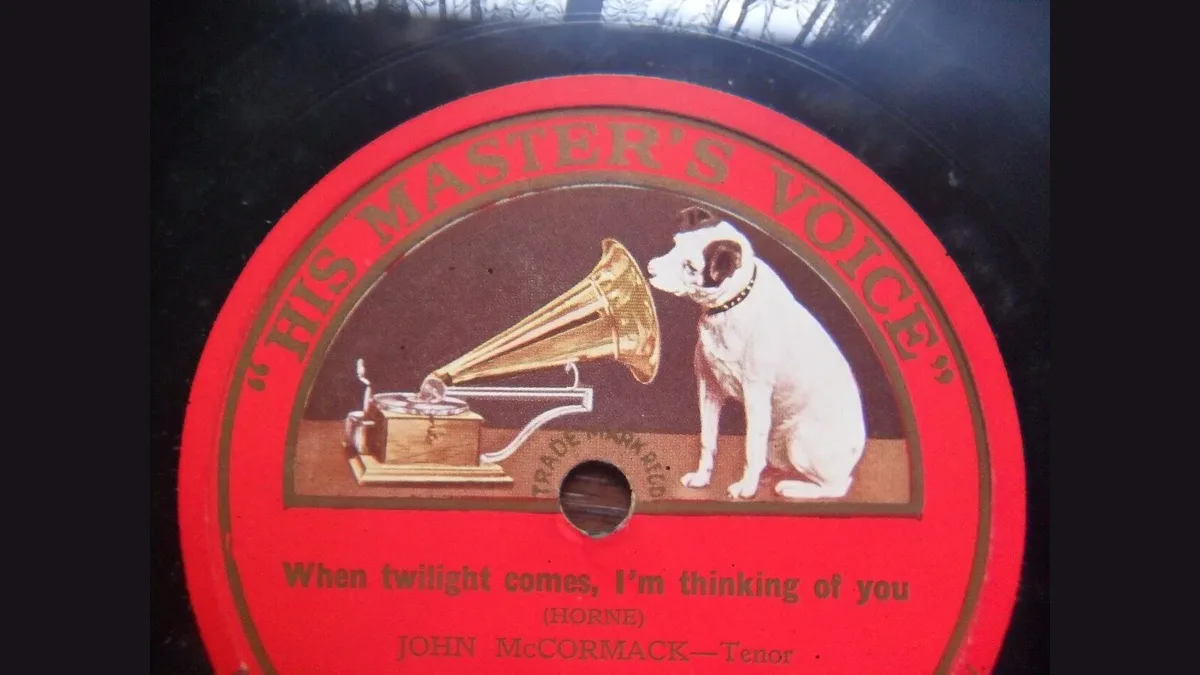
On the afternoon of Wednesday 22 October 1902, at four o'clock, a ship carrying the world's most experienced recording engineer dropped anchor at Colombo. Fred Gaisberg had left Liverpool Street Station in London three weeks earlier with a crate of recording equipment, a colleague named Tom Addis, Addis's wife, and a young assistant called George Dillnutt. They were bound for Calcutta on the first serious recording expedition to South Asia.
They were in Colombo for forty-eight hours. On the Friday they were back aboard. Gaisberg recorded nothing in Ceylon at all — not a drum, not a nurthi song, nothing. On the Monday night the ship reached Calcutta, and within a fortnight he was making the recordings that would turn Gauhar Jan into the first great Indian recording star.
That non-event is the honest beginning of Sinhala recorded music. It sets the pattern for the next thirty years: Ceylon was never a recording territory of its own. It was a port of call.
A stop on somebody else's circuit
The Gramophone Company ran its Asian business out of Calcutta. From 1908 it pressed records at Sealdah, on Beliaghatta Road — a factory built to supply the whole of Asia — and it was there that the shells and metal masters for the Indian, Burmese and Ceylonese repertoires were all sent.
The catalogue numbering tells you exactly where Ceylon stood. Sinhala records were not given their own series; they were slotted into unused "chunks" of the Indian blocks. By the 1930s, when the His Master's Voice P- series had run past P-10740, the company had reserved specific numeric ranges for non-Indian material — P-14500 for Burmese, P-15200 for Ceylonese, P-15500 for Cantonese. The P- series was the premium label; N- was the middle price; the yellow TWIN label, introduced in 1928, was the cheap one. Knowing that, a shelf of unlabelled shellac stops being anonymous. The prefix tells you the language block and the price tier, and the matrix number stamped in the wax tells you which session it came from.
Which brings us to the notebook.
The ledger of George Dillnutt
The young assistant on Gaisberg's 1902 voyage became one of the company's principal engineers, and he kept a record of his sessions. Read it and the story of recording in Colombo turns from anecdote into evidence.
Through 1915 and 1916 Dillnutt worked a punishing circuit — Calcutta, Delhi, Bombay, Rangoon, Calcutta again, Singapore, Calcutta again — with the matrix numbers running continuously across the whole tour. Then, between those Calcutta and Madras stops, comes this:
Colombo, 28 August to 2 September 1916 — matrices 3872 to 4003.
Six days. A hundred and thirty-two sides. Five years later, on another sweep through Bombay, Rangoon, Calcutta and Madras, he was back:
Colombo, 1921 — matrices 8079 to 8179.
Another hundred and one. Together, roughly two hundred and thirty sides of Sinhala music cut in Colombo by a named engineer on datable days — and, as far as anyone has published, the artists' names and titles for those sessions have never appeared in print. The session sheets that would carry them sit in the EMI Archive in Britain. This is one of the great unopened doors in Sri Lankan music history, and it is a filing cabinet, not a mystery.
What was actually on the records
We know the shape of the repertoire even where we do not know the names.
Nearly every record released in Ceylon between 1906 and 1930 was a nurthi song — a number lifted from the Sinhala musical theatre that had grown out of the visiting Parsi companies from Bombay. Talent scouts from His Master's Voice, Odeon and Parlophone came knocking on the playwright John de Silva's door because his stage songs were what the local market would buy. දන්නෝ බුදුන්ගේ (Danno Budunge, "those who know the Buddha"), from his 1903 play Sirisangabo Charitaya, is the type specimen: the Tower Hall singer Hubert Rajapakse recorded it for HMV in the 1920s, in a Western operatic style, and the disc went out as Dharma Budunge — Ode to the Sacred City.
Meanwhile the machines themselves were becoming furniture. Owning a gramophone was, in Garrett Field's phrase, a status symbol of affluent urban homes — which tells you who the customer was, and why an ambitious playwright's stage hits sold better than village work songs.
Then nurthi faded, and the record trade needed a replacement. In 1930 Parlophone released six double-sided discs of a genre it called alut sindu, "new music," and Odeon, Broadcast, HMV and Columbia followed. The themes came from the Buddhist revival; a great many of the melodies came straight off Hindi and Tamil film soundtracks. The best-documented Sinhala recording by a woman comes out of this later period — Rukmani Devi's HMV session of 1938, cut when she was fifteen — though no source establishes it as the first.
The first Sinhala record, and why nobody can name it
You will often read that Sri Lanka's first record was a 1903 album called Nurthi, "released via Radio Ceylon."
That cannot be right, and the reason is simple arithmetic: Radio Ceylon did not exist in 1903. Colombo Radio's regular service began on 16 December 1925, and the experimental broadcasts that preceded it were in 1923 at the earliest. The claim appears to have entered circulation through an old encyclopaedia edit, been copied into newspaper features and music sites, and now looks independently corroborated because it appears in several places at once. It is one source wearing several hats.
The honest position is that we do not know which Sinhala record came first. What we can say with confidence is the shape of the era: nurthi song dominated the Ceylon catalogue from 1906 to 1930, the recordings were made on visiting expeditions rather than in a local studio, and the paperwork that would settle the question sits partly in the EMI Archive and partly in the discographies compiled by Michael Kinnear.
Some of it is simply gone. A Sri Lankan gramophone collector has recorded that most of the register books listing the names of dozens of Sri Lankan artists were destroyed — damp, and nowhere to keep them. That is the ordinary way musical history disappears: not suppression, but a leaking roof.
What we know, and how we know it
The hard dates here come from two engineers' own records, published on the Recording Pioneers archive: Gaisberg's diary entries for his 1902 voyage, which put him in Colombo from 22 to 24 October with nothing recorded, and Dillnutt's session list, which gives the Colombo runs of 28 August–2 September 1916 (matrices 3872–4003) and 1921 (8079–8179). The label and numbering system, including the P-15200 block reserved for Ceylonese repertoire, is set out in Michael Kinnear's guide to reading Indian record labels. The character of the repertoire between 1906 and 1930, and the 1930 Parlophone alut sindu release, come from Garrett Field's Modernizing Composition.
What is not known is very large. We have no artist names or song titles for either Colombo session, no confirmed identity for the first Sinhala record, and no complete Ceylon discography in English. Until somebody works through the EMI Archive session sheets and Kinnear's files, roughly two hundred and thirty sides of Sinhala music recorded in Colombo in 1916 and 1921 remain a set of numbers with no songs attached.