
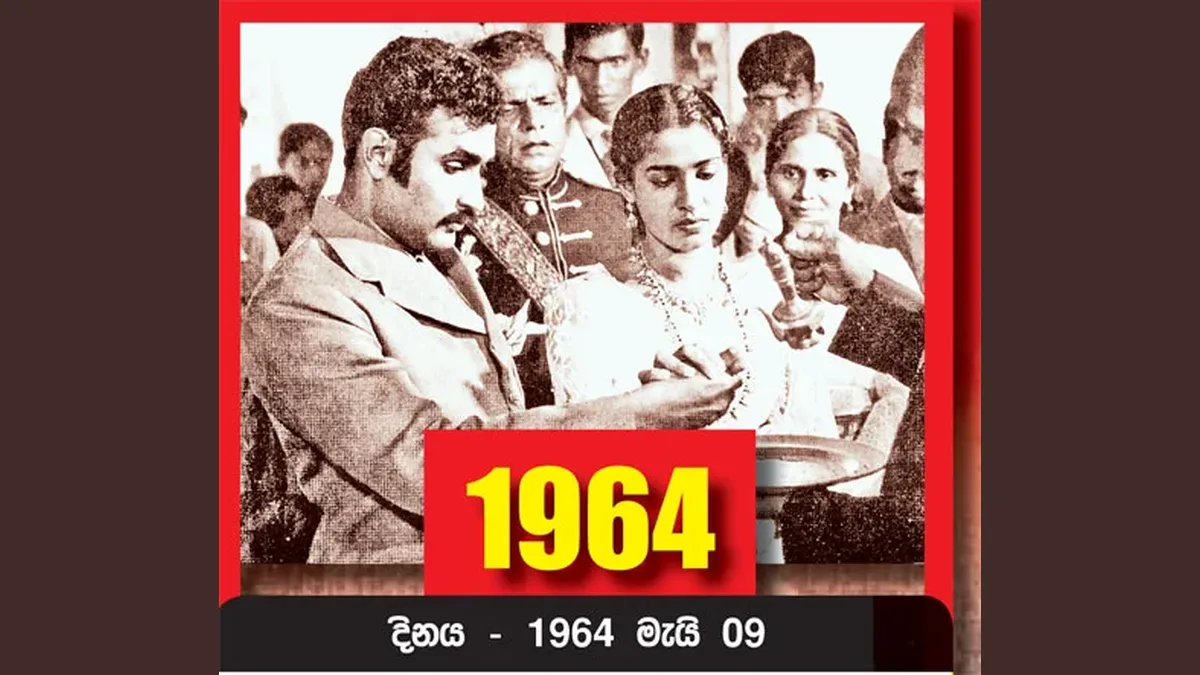
On the evening of 9 May 1964, at the Asoka Cinema in Colombo, the President of the Senate, Thomas Amarasuriya, gave out the first prizes Sinhala cinema had ever awarded itself. A jury of nine had chosen the winners — among them Wilmot A. Perera, the broadcaster M. J. Perera, and Wimala de Silva. Alongside the jury the newspaper Sarasaviya, published by Lake House, ran a readers' poll, and its winning film drew 35,374 votes.
The first Sinhala film had been screened in January 1947. It had therefore taken seventeen years for anyone to organise a ceremony, and the delay is the most revealing fact about the evening.
Why nobody had bothered before
For most of those seventeen years, Sinhala cinema had not been especially Sinhala. The films were shot in South Indian studios with Indian directors, Indian technicians, Indian music directors and, very often, Indian playback singers, because Ceylon had none of the infrastructure and had convinced itself it had none of the talent either. The songs were frequently Indian melodies with Sinhala words fitted over them — a practice known derisively as vacana danava, "putting words."
Sarasaviya's own retrospective puts the timing bluntly: the awards began "at a time when the local cinema was trying to shed its South Indian orientation and establish an indigenous identity." There was no longer any need to go to India to make a film, and the era of Indian artists working in Sinhala cinema had ended. An industry that has just decided it is a national industry needs to say so, and an awards night is how industries say things.
Then there was the backlog. Everyone agreed that something had changed around 1960 and that a run of serious films had appeared since — Rekava, Sandeshaya, Ranmuthu Duwa, Kurulu Bedda, Sikuru Tharuwa, Gamperaliya. Rather than start clean, the organisers judged the backlog. Here the sources disagree and it is worth noting rather than smoothing: the Wikipedia page for the ceremony says the entries covered 1961, 1962 and 1963, while the parent article on the awards says the festival considered films screened from 1960 to 1963. Either way, the first Sarasaviya night was not an assessment of one year. It was a retrospective verdict on an era, delivered while that era was still warm.
One film takes the music
Gamperaliya, Lester James Peiris's adaptation of Martin Wickramasinghe's novel, swept the evening with nine awards including Best Film, Best Director, Best Actress for Punya Heendeniya and Best Script Writer for Regi Siriwardena. W. D. Amaradeva won Best Music Direction for its score — a score with no songs in it at all.
The other three music prizes went somewhere else entirely, and all three went to the same film: Mike Wilson's Ranmuthu Duwa, the first full-length Sinhala film shot in colour, produced with Shesha Palihakkara and Arthur C. Clarke and released on 8 October 1962. Chandraratne Manawasinghe took Best Lyricist. Narada Disasekara took Best Male Playback Singer. Nanda Malini took Best Female Playback Singer, for the first film song she ever recorded.
Here the sources conflict on a detail that matters, and both versions deserve to be on the page. Writing in the Sunday Times in 2010, the columnist Dee Cee stated that all three awards were for one song — ගලන ගඟකි ජීවිතේ Galana Gangaki Jeewithe, "life is a flowing river." Sarasaviya's own archival list of the 1964 winners agrees for the two singing prizes but attaches Manawasinghe's lyric award to a different song from the same film, පාරමිතා බල Paramitha Bala. So either three music awards went to a single song, or two did and the third went to its neighbour on the same soundtrack. Nobody has reconciled the two lists.
The scale of what was being honoured is easy to underrate. Ranmuthu Duwa was seen by more than a million people on its first release across 1962 and 1963 — roughly a tenth of the island's population at the time. It came third in the reader vote, behind Gamperaliya and Sikuru Tharuwa, with 32,843 votes. A song from it now carried the industry's own seal. That is not a prize. That is a canon being poured.
What an award does to a song
The evening had a shadow over it that nobody in the hall could have seen. Chandraratne Manawasinghe, who had spent his career arguing that a Sinhala song lyric should be poetry rather than syllables fitted to a borrowed Hindi tune, collected Best Lyricist on 9 May 1964. He died on 4 September the same year, at fifty-one. Four months.
Narada Disasekara's award has an odd shape too. He had come into Radio Ceylon in 1954 as a mechanic in the engineering section and moved to the microphone the following year. He was the first singer, male or female, to hold a Sarasaviya Award, and he carried that line in every profile written about him until his death in 2010 — a single evening, permanently attached to a name.
That is what an awards ceremony does, and it is why they are worth studying rather than merely reporting. Before 9 May 1964 there was a large, disorderly body of Sinhala film music with no agreed shape. Afterwards there was a list. Songs on the list were reissued, re-sung, taught, anthologised and eventually put on compilation CDs; songs not on it drifted. Half a century on, the Sunday Times was still using the 1964 results as the opening milestone in the story of Sinhala film music, which is precisely how a canon reproduces itself.
The prize that keeps stopping
The institution turned out to be less durable than the canon it created.
Look at the Sarasaviya's own numbering and you can read Sri Lanka's political history off it. The seventh ceremony was held in 1970 and the eighth not until 1980 — a nine-year gap. The numbering goes out of step with the calendar in the late 1980s, with the seventeenth held in 1990 and the eighteenth in 1989. A second national ceremony arrived in 1979, when President J. R. Jayewardene inaugurated the Presidential Film Awards, whose first music prizes went to Premasiri Khemadasa for Bambaru Avith, to W. Jayasiri for its lyrics, to T. M. Jayaratne, and to Rukmani Devi for "Doi Doi" in Ahasin Polawata, awarded after her death in a road accident in October 1978.
Both then lapsed. The Presidential Film Awards were not held from 2005 to 2014 under the Rajapaksa administration and resumed in 2015 under President Maithripala Sirisena; the Sarasaviya's thirty-second ceremony was held in 2010 and its thirty-third not until 2016, after the Minister of Mass Media announced the festival would resume. The pattern is the same in both cases: an award that presents itself as a permanent measure of national artistic worth turns out to depend on who is in office and whether they can be bothered.
What we know, and how we know it
The date, venue, chief guest, jury and full winners' list come from Sarasaviya's own archived "Road to Prestige" retrospective of 2018 and from the Wikipedia page for the first ceremony, which agree on every name; the reader-vote totals are from the same Sarasaviya list. The box-office figure for Ranmuthu Duwa and the "tenth of the population" comparison are from its Wikipedia entry, sourced to the National Film Corporation.
Two things are unsettled. The range of years the first festival judged is given as 1961–63 in one place and 1960–63 in another. And the claim that all three of the singing and lyric awards went to a single song rests on a 2010 newspaper column that Sarasaviya's own archive contradicts on the lyric award. Neither dispute has been resolved in print.