
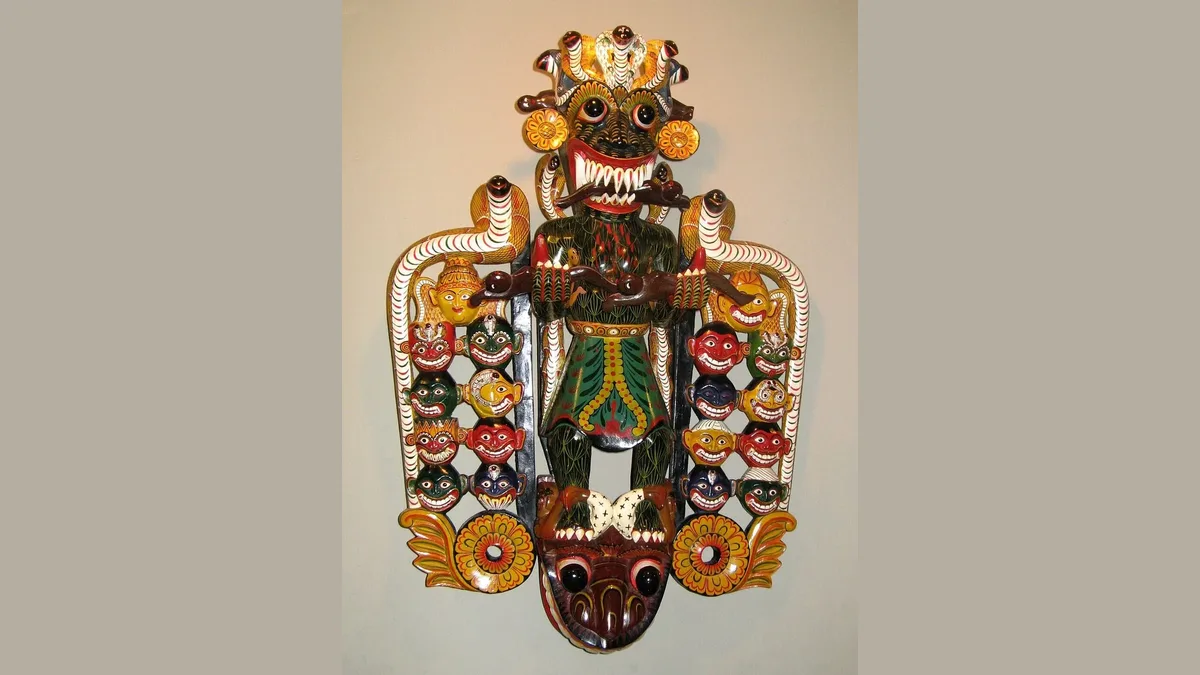
On a wall of the Mask Museum at Ambalangoda hangs a mask a metre tall. At its centre is a green demon with a mouthful of human victims. Cobras arch out of its headdress and frame it on both sides. And running down each frame, in two neat columns, are eighteen small faces: red, yellow, green, black, blue, each grinning or grimacing differently, each with its own eyes and its own snake.
This is මහ කෝල සන්නි යක්ෂයා Maha Kola Sanni Yaksha, the chief of the eighteen. He wears the others because in the ritual he is the last to arrive, and he arrives carrying everyone he commands. What makes the mask worth looking at closely is that those eighteen faces are not eighteen monsters. They are eighteen diseases.
The story the ritual tells
The origin story is told in the ritual itself, and it is a domestic catastrophe rather than a cosmic one.
In the city of Visala — Vaishali — a king of the Licchavi line named Sankhapala had a queen, Ayupali. While she was pregnant she craved mi amba, a kind of mango; the king was away at war, so the chief minister arranged to have some brought. Her maidservant Kali wanted mangoes too and got none. To revenge herself she went to the king and told him the queen and the minister were lovers.
The king ordered his pregnant wife executed: hung by the feet from a tree and cut in two. It was done. Out of the split corpse a child was born alive, and grew feeding on his mother's remains. He became known as the Kola Sanni demon, and he set out to punish his father. He collected poisonous leaves and berries and made eighteen pills of poison. Seeing this, Sakra sprinkled them with venomous water and turned them into eighteen demons. Accounts differ here: the English-language retelling, following Gananath Obeyesekere, has the demon-child charm the pills into demons himself, with no Sakra involved.
They went to Visala demanding food, destroyed its fields, and brought down the city's first famine — followed by disease, by unburied corpses, and by the spirits the corpses attracted: the three fears. In the Sinhala telling of the ritual's own tradition, those three fears were dispelled by the recitation of the Ratana Sutta. It is worth noting that Buddhist canonical sources tell the Vaishali story differently, with the Buddha lifting a plague by that same chanting and no demon-child in it at all. The exorcists borrowed a famous Buddhist episode and gave it a prequel.
Eighteen diseases, and what the masks show
In the BMJ's Christmas issue of 2006, two doctors — Mark Bailey, then a specialist registrar in infectious diseases and tropical medicine, and H. Janaka de Silva, professor of medicine at Kelaniya — published a short paper arguing that this is a nosology: a classification of disease, produced centuries ago by people with no medical training, whose categories a modern clinician can still recognise.
They based it on a literature review plus visits to the National Museum of Sri Lanka, the Ambalangoda Mask Museum, and specialist mask sellers in Colombo and Ambalangoda. They found that although every source agrees there should be exactly eighteen, more than thirty names circulate. The eighteen most consistently described in authoritative texts are these:
ගිනිජල් සන්නිය Gini Jala — malaria and other high fevers. ජල සන්නිය Jala — cholera and chills. ගුල්ම සන්නිය Gulma — parasitic worms and stomach disease. අමුක්කු සන්නිය Amukku — vomiting and stomach disease. බිහිරි සන්නිය Bihiri — deafness. ගොළු සන්නිය Golu — muteness. කණ සන්නිය Kana — blindness. කොර සන්නිය Kora — lameness and paralysis. ගෙඩි සන්නිය Gedi — boils and skin disease. පිත් සන්නිය Pith — bilious disease. ශ්ලේෂ්ම සන්නිය Slesma — phlegm and epilepsy. වාත සන්නිය Vatha — flatulence and rheumatism. දේව සන්නිය Deva — epidemics. මරු සන්නිය Maru — delirium and death. නාග සන්නිය Naga — nightmares about snakes. භූත සන්නිය Butha — insanity caused by spirits. අභූත සන්නිය Abutha — insanity not caused by spirits. පිස්සු සන්නිය Pissu — temporary insanity.
Read the carvings and the correspondences get sharper. The mask for parasitic worms usually has a pale complexion — which could as easily be hookworm anaemia. The mask for vomiting is green with a protruding tongue. The mask for bilious disease is yellow or orange, the colour of jaundice. The mask for lameness always carries a one-sided facial deformity of exactly the kind a stroke produces. The masks for high fever and for cholera are both fiery red, which is what you would expect for two conditions that present alike; the fever mask is distinguished by flames across the forehead, which Bailey and de Silva suggest look remarkably like a temperature chart. The epidemic demon wears a head dress, presumably because disease on that scale was thought to be divine in origin.
The three sensory demons are the most consistent of all across every listing, and the most literal. The mute mask has a wide open mouth with no teeth and no tongue. The blind mask has no eyes. And the deaf mask carries a cobra, often running from the nose across one side of the face — because the cobra was traditionally held to be a deaf animal.
The list is not stable, and it is worth saying so. A widely circulated Sinhala account of the ritual gives a different eighteen, including Vyadhi, Murthu, Demala and Kola Sanniya in place of Gedi, Pissu, Slesma and Maru. That account is itself flagged for lacking sources, and Bailey and de Silva's finding — more than thirty candidate names for eighteen slots — explains why. What is fixed is the number, not the membership.
What happens on the night
The full ritual is සන්නි යකුම Sanni Yakuma, one of the four kinds of tovil performed in the low country, and it runs from dusk to dawn on a day chosen astrologically. The lead exorcist, the yakädurā or edura, first determines whether a demon is responsible at all. Outside the ritual he is likely to be a fisherman, a farmer or a drummer.
It opens with homage to the Buddha, the Dhamma and the Sangha, with the patient seated on a mat, lamps lit, and magul bera — auspicious drumming — played. Then come the Ata Paliya, eight preliminary apparitions including the Suniyan Yakshaniya, who appears three times: as a beautiful woman, as a pregnant woman, and as a mother carrying a child.
Only then do the eighteen arrive, one after another, each dancing his own disease. Each demon negotiates with the drummer for his offering, and the negotiations are startling. The drummer's role is to humiliate the demon — through puns, deliberate misquotation, obscenity and abuse — until the frightening figure who entered the arena has been made ridiculous. One exchange, translated from Sinhala by the anthropologists Sally Falk Moore and Barbara Myerhoff, runs:
Drummer: Where are you off to?
Demon: I am off to Maradana by a first class express bus.
Drummer: …What was it I saw you doing only yesterday? You pissed near the sacred bodhi tree, then shat on the temple grounds after which you stole a monk's robes.
Maha Kola must appear before sunrise, so if the night runs long the processions are cut short. His entrance is theatre with a lock on the door: two men hold pestles crossed over the entrance to the arena and refuse to let him through without a message from the Buddha. He tries threats, flattery and pleading, and fails. When the message finally arrives he grabs it with his foot, is scolded for insulting the Buddha, and has to take it on his head, chanting the Buddha's virtues. The message turns out to be a licence with conditions: he may not take human lives; he may afflict people, but must accept offerings and then cure them. He agrees, takes his offerings, and the ritual ends.
The whole thing is carried by the යක් බෙරය yak beraya, the low-country drum — a drum whose low, resonant sound the drummer Sandhoris Jayantha described to the researcher Sumuditha Suraweera as the medium through which ritual specialists communicate with supernatural beings at all.
The other half of the system
Sanni Yakuma is not the only healing performance, and it helps to see it beside its counterpart. Where tovil deals with demons, බලි bali deals with planets.
If an astrologer casting a horoscope finds misfortune caused by planetary deities — graha dōsha — during an unfavourable period, he prescribes a bali. On the appointed day the healer blesses the clay from which images of the planetary deities will be moulded. In the ämbum bali form these are constructed in bas-relief, painted red, yellow, blue, white, green and black, and stood upright before the ceremony; one account describes effigies as tall as three metres. Music runs all night: chanted mantras, short poems, up-country geta bera drumming, dancing, handbells, conch. The patient sits before the image with two virgins on either side, and is sent home with a pirit thread tied round the wrist.
Then the images are destroyed. That is the point: unmaking the figure is what removes the influence.
The status of both rites today is ambivalent. Sanni Yakuma is still performed, mostly along the south coast, but more often as a cultural spectacle than as a cure — it is long, it is expensive, and the 2004 tsunami hit the coastal communities that carried it. Suraweera records the class dimension too: exorcism is a working-class and peasant practice, devalued by the middle class for that reason, and dismissed by many Buddhist monks as something disreputable practised by low-caste people.
What we know, and how we know it
The diagnostic reading of the masks comes from a peer-reviewed 2006 paper in the BMJ by Mark Bailey and H. Janaka de Silva, based on museum and market fieldwork in Sri Lanka; the ritual's structure and origin story are drawn from the English and Sinhala Wikipedia accounts of the Sanni Yakuma, which in turn rest on Gananath Obeyesekere, Bruce Kapferer, Paul Wirz and Otakar Pertold; the bali material comes from Lasanthi Manaranjanie Kalinga Dona's 2016 study in Muzikološki zbornik, based on a ritual she documented at Ämbokka in Matale district in August 2007. Sources genuinely disagree on which eighteen demons make up the eighteen: Bailey and de Silva found more than thirty names in circulation, and the standard Sinhala list differs from theirs at four places, so both are given above. When the ritual began is unknown; it has been performed in the south and west "since ancient times", which is a way of saying that nobody has a date.