
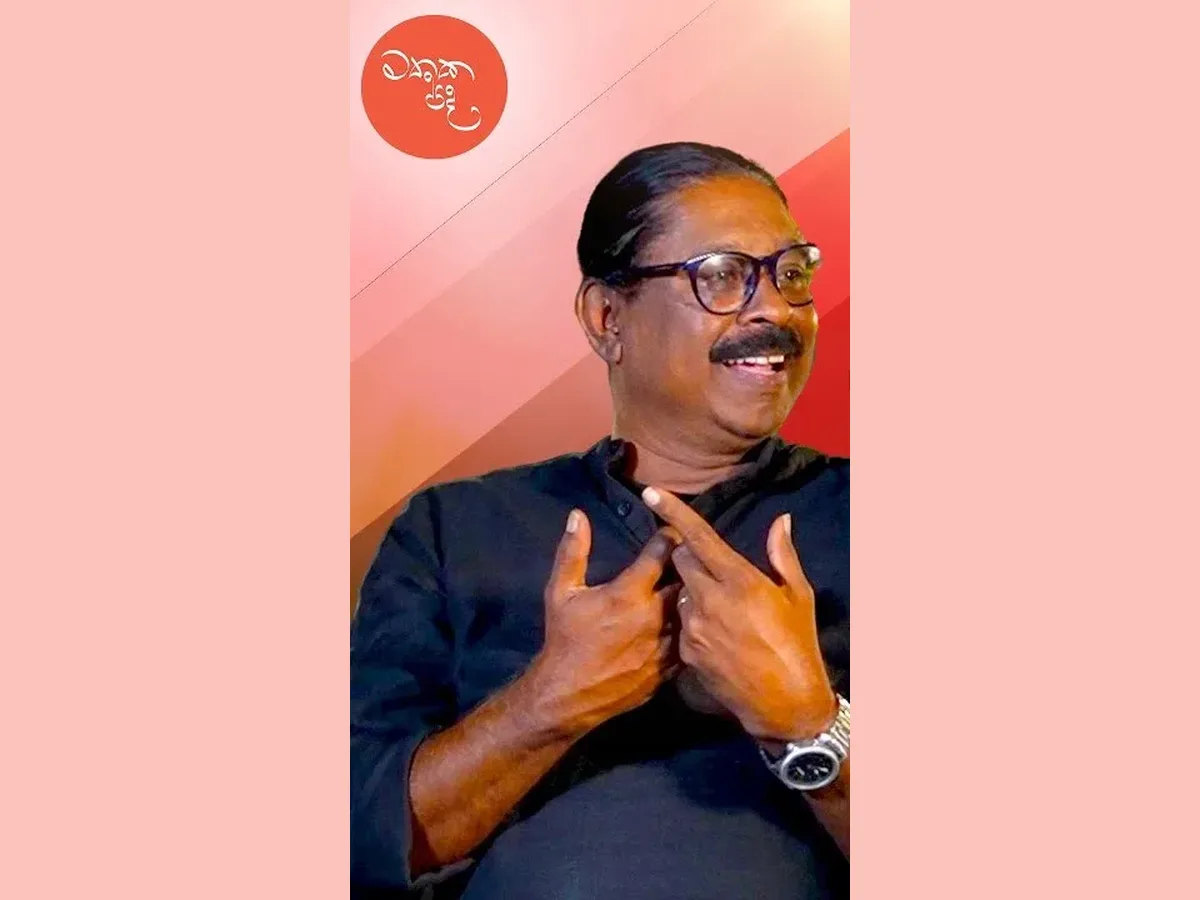
Upul Shantha Sannasgala once introduced him on a television programme with a single breathless sentence, and it has stuck: "Duka hitapu gaman sindu liyanawa, keti katha liyanawa, ragapanawa, danweem hadanawa, sarama adinawa, thekka wikunanawa, company walata yanawa, bulath wita kanawa, denim adinawa." Duka, on a whim, writes songs, writes short stories, acts, makes advertisements, wears a sarong, sells teak, goes off to companies, chews betel, wears denim. The critic Uditha Devapriya, quoting the line in the Colombo Telegraph, called it the best description of the man he had come across.
It is also a fair description of the difficulty of writing about Wasantha Dukgannarala. There is a great deal of him — lyrics, stage plays, films, radio shifts, television formats, two books — and remarkably little of it has been set down carefully anywhere. He is one of the two lyricists who, on Devapriya's reading, largely made the popular Sinhala song of the 1990s onward; the other is Nilar N. Cassim. Neither has had a proper biography written.
Anuradhapura, or Kandy
His full name is Duggannaralalage Wasantha Kumara Bandara, and he was born on 10 December 1969. Where is less settled than it should be. The English Wikipedia entry gives his birthplace as Hingulwala in the Kandy district; Devapriya's essay says flatly that he was born in Anuradhapura. Both can be partly right — his schooling was unambiguously in the north-central dry zone, at Kahatagasdigiliya Primary School and then Anuradhapura Central College — and the Anuradhapura connection is the one that matters to his writing. Accounts differ, and this article does not settle it.
Devapriya's point about that upbringing is worth keeping. Dukgannarala, he wrote, is "more ruralised" than the Matara- and Rahula College-bred Cassim, and yet has spent his career in the metropolitan music industry: "he is of both worlds, yet belongs to neither." That paradox — a village vocabulary sold through Colombo studios — is the single most useful thing anyone has said about his lyrics.
He went on to the University of Sri Jayewardenepura, where he acted in student productions with titles like Paraassa, Yakshagamanaya and Deweni Mahinda, having already directed his own plays at school. In 1995 he joined the radio channel Sawana as a professional broadcaster, under the wing of Jackson Anthony. That is the year his working life is usually dated from.
The songs
The count most often quoted is "more than 300" songs, a figure that traces to a Dinamina interview; other summaries put the range at 300 to 500 or higher. As with almost every Sri Lankan artist of this scale, the totals in circulation are inconsistent, and none of them is auditable. What is clear is the spread. He wrote for straight-ahead pop, for R&B, and for the hip-hop-inflected records that dominated Sinhala radio in the 2000s.
His first widely known lyric was මං සිංහයාට බයයි නංගියේ Man Sinhayata Bayai Nangiye ("I'm afraid of the lion, little sister"), written in 1996 for the singer and composer Senanayake Weraliyadde; he later used the title for one of his two books. In 2000 came Ran Kurahan Mala for the duo BnS, and then Mal Pan Podak for the same act — a song that fixed itself to a whole cohort of listeners. For Ranidu Lankage he wrote අහංකාර නගරේ Ahankara Nagare ("in the arrogant city"), which is regularly described as the first Sinhala song released as a mobile ringtone in Sri Lanka, and which was for a time the most-played song on the local index.
The list runs on: Pana Senehasa for Dushyanth Weeraman, Hanthane for Ashanti de Alwis, Ravum Kade for Gayantha Perera, Ma Desa Neth Nopiya Balapoo for Romesh and Lakshan, and collaborations with Iraj Weeraratne and Chinthi. Two of his best-known pieces are collective rather than romantic: the agricultural anthem Govi Geethaya and අපි වෙනුවෙන් අපි Api Wenuwen Api ("ourselves, for ourselves"), both of which won awards.
Sinhala-language accounts also record a small censorship episode around his song Sokari, recorded by the newcomer Chinthi, in which a single word — kansa, cannabis — was bleeped for broadcast. The story is repeated in his Wikipedia entry, but the Sarasaviya interview it cites is no longer online, and it should be read as unverified in its details.
What he did not do
One claim about Dukgannarala circulates widely and should not be repeated: that he introduced hip hop to Sri Lanka. It originates in an EIN Presswire release — paid wire distribution, not journalism — and no independent reporting supports it. It also runs against the documented record. The 1997 compilation Colombo Tribe Project Vol. 1, by Brown Boogie Nation and Rude Boy Republic, predates anything he did in the genre, and the first Sinhala-language rap album is generally credited to Iraj Weeraratne in 2005.
The truthful version is more modest and more interesting: Dukgannarala was one of the writers who supplied Sinhala words to the hip-hop and R&B production styles once they arrived, and who made them sit comfortably in a language whose song tradition had been built on literary verse. That is a real contribution to the popular Sinhala song. It is not the same as inventing a genre.
Stage, screen and studio
He has kept acting throughout. His film debut was Jackson Anthony's Julietge Bhumikawa in 1998; he returned to work with Anthony in the 2008 historical epic Aba, playing Maha Berana, and appeared in Siri Daladagamanaya in 2014. As a film lyricist his credits run from Anjalika (2006) through Asai Man Piyabanna, Adaraye Namayen, Dancing Star, Challenges, Thiththa Aththa and Nim Him. On television he acted in the serial Ingammaruwa and hosted the agricultural reality format CIC Shoora Goviya on TV Derana for two seasons, and the theatre programme Sonduru Agnyaawa on ITN. He founded a production company, Right Brain Networks, which made the ITN programmes Agree with Murali and Raeta Raeta. On 2 April 2016 he marked twenty-five years in the media with a show called Dukaa at the Nelum Pokuna theatre.
A note on the sources
This entry is shorter and hedged more than it would be for a comparable figure of an earlier generation, and the reason is worth stating. Almost every reference cited inside the English Wikipedia article — Sarasaviya, Business Today, Sooriya, Neth News, Silumina, the Dinamina interview that supplies the song count — now returns a 404. The Sri Lankan online newspaper archive has been quietly disappearing, and a working lyricist of the present day is in some ways harder to document than a lyricist of the 1960s, whose obituaries at least were printed on paper.
What survives and can be checked is a Wikidata record, a song index at sarigama.lk, and one essay by a critic who took him seriously. For a man credited with several hundred songs, that is not enough. His interviews sit in Sinhala print archives that no script can reach, and someone should go and read them.