
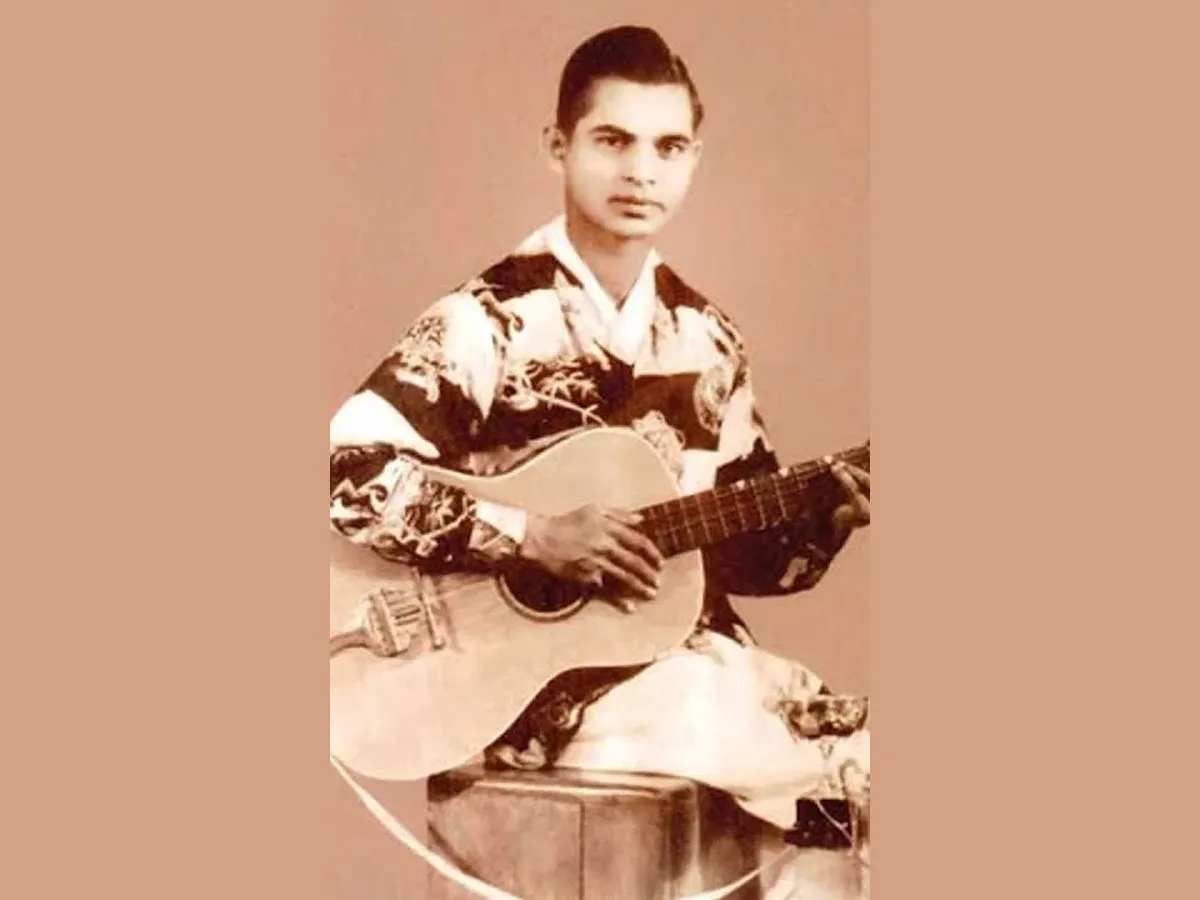
The man who invented Sinhala baila was not called Wally, and it is not entirely certain that his family were called Bastiansz either.
He was baptised Ogustus Martalanus, after a grandfather, Wilhelmus Martalanus. He disliked both names and signed himself O. M. Bastiansz. At home in Piyadigama, and to the neighbours, he was Olie or Olinton. When he started performing he turned "Olie" into "Wally", and for official purposes became Olinton Mervin Bastiansz — different first names, same initials. Under all of that, according to his own family's account, the surname had been acquired in the nineteenth century by a Kandyan nobleman on the run.
Who he was
The family history assembled by his nephew tells it this way. A Gajanayaka Mudaliyar — keeper of the king's elephant kraal at Kandy, a famous archer — fled the province during the Kandyan unrest of the early 1800s and took refuge in Matara. There he wanted to marry the daughter of a family of the Durawa caste named Bastiansz, presented himself as one of them, took their name, and never afterwards disclosed his own.
This matters because sources genuinely disagree about who Wally Bastiansz was. English Wikipedia files him under Burgher musicians. Afropop Worldwide calls him "a traffic warden from Colombo who was half Sinhala and half Dutch Burgher." The family site supports the second reading and adds the specific: his mother, Nelo Fernando, was a Sinhala Buddhist, and as a small boy he was in and out of the Walukarama temple at Piyadigama — an influence you can hear in a song like Dadikala Mage Mawni. The safest summary is that he came out of exactly the mixed coastal world that produced the music, which is probably why he was the one who could carry it across.
He was born on 9 June 1914 at Piyadigama, a village a couple of kilometres inland from the coast between Galle and Gintota, one of nine children of Hinton Wilmot Bastiansz. For schooling he was sent up to Colombo, staying with his eldest brother Cyril Bertrum and attending St Joseph's College, Maradana. He joined the police and was posted to the traffic division in Colombo. He played guitar, banjo and violin.
What he actually did
His technical contribution can be stated in two clauses, and both are easy to underrate.
He fitted Sinhala words to the 6/8 kaffrinha rhythm — the syncopated, three-against-two dance music that Kaffir and Burgher communities had kept alive on the coasts since the Portuguese period, sung mostly in Portuguese creole. And he introduced the chorus. That second thing is what converted a party music into a mass one: a chorus is the part that a room full of people who do not know the verse can sing. It is why Sri Lankan writing calls him the father of baila, and why the style he made is called chorus baila.
The police job was not incidental to the music. A constable in the traffic division spent his working life within earshot of the police band and its march-past repertoire, and Bastiansz plundered it. "The Battle Hymn of the Republic" and "Mademoiselle from Armentières" both went into baila songs. His family have identified another: the opening of හයි හූයි බබී අච්චිගේ Hai Hui Babi Achchige is lifted from the Repasz Band March, an American band piece written by Harry J. Lincoln in 1901. He also sang in English, and his Sinhala is spliced with colloquial English in a way that no respectable lyricist of the 1940s would have permitted himself.
What the songs were about
This is the real revolution, and it is not musical.
Sinhala song in the 1940s meant the nurthi stage, the devotional repertoire, the radio's newly minted "light song" and film playback — everything vetted, elevated and slightly stiff. Bastiansz wrote about a nurse walking down a hospital corridor. නෝනා මගෙ නර්ස් නෝනා Nona Mage Nurse Nona is an ode to a working woman on a ward, and the woman was real: she was his own sister, Felicia Florence "Dolly" Bastiansz, who nursed in the early 1940s and gave it up in 1944 when her first child was born.
He also wrote about a court case — the trial of a jilted lover named Eric Bacho — which is to say he took his material off the crime pages, decades before anyone thought of that as a genre. His nephew Anton Jones, who started in his band in 1952 as a chorus singer, would build an entire career on that idea, writing baila around real news events.
The rest of the catalogue reads like a street: අයිරින් ජොසපින් Irin Josapin, Nondi Simaiyya, Yaman Bando Vesak Balanna, මුහුදේ යමු Muhude Yamu Masun Maranna ("let's go to sea and catch fish"), Kussi Amma Sera ("Kussi Amma, the cook"), Wadakaha Suddiya, Duppath Mawu Kenek ("a poor mother"), රටක් වටිනවා Ratak Watinawa ("our two parents are worth a country") and මිතුරා Mithura ("friend"). Several songs he wrote were later credited to other performers — Wikipedia lists Hai Hui Babi Achchige, Yaman Bando, Ratak Watinawa, Le Kiri Karala, Irene Josephine, Kussi Amma Sera, Muhude Yamu Masun Genenna and Nondi Simaiyya among them — which is what happens to a repertoire that circulates faster than its paperwork.
Condemnation, and after
The musical establishment did not thank him for any of it. For decades baila was treated, in one Sri Lankan writer's phrase, with "implied condemnation": the Sinhala Vishwakoshaya, the national encyclopaedia, defined the baila-kaffrinha form as a type of fast musical dance that stimulates intoxicated men and women. The objections ran from snobbery about the music's origins among enslaved Africans and Portuguese soldiers, to the complaint that lyrics written to serve a beat were not literature, to the musical grievance that it was all in 6/8 and therefore monotonous.
One thing that is repeated constantly and is not true: baila was never formally banned. No gazette, no directive, no prohibition. What existed was contempt, which does not need a law. The reversal came, of all things, through scholarship — Sunil Ariyaratne's study An Inquiry into Baila and Kaffirinna, which won a State Literary Award and made the form a legitimate subject.
Bastiansz died on 10 January 1985, aged seventy. By then the succession was secure: M. S. Fernando had carried the style through the 1970s and 1980s with organs and electric guitars; Nithi Kanagaratnam had started singing baila in Tamil in 1967; Sooriya Records had put a good deal of it on vinyl; and the music a national encyclopaedia once defined by the drunkenness of its dancers had become what the country plays at weddings.
The ancestral house at Piyadigama, where he and all eight of his siblings were born, stayed in the family until 2024, when the last of Florence's sons living there sold it and moved away.
A note on the sources
Almost everything biographical about Bastiansz traces to two places: his English Wikipedia article, which carries standing warnings for original research and thin sourcing, and the family website maintained by his nephew Robin Kolitha Jayasekera, which is explicit that it rests on what he heard growing up in the Piyadigama house from Wally's sister — his own mother — and from aunts and uncles. That is family memory, honestly labelled as such, and on the points where it can be checked it agrees with the published record. What almost nobody has is dates: individual songs, recording sessions and releases are essentially undated, and no discography of his HMV, Philips and Sooriya sides appears to have been compiled. For a man this important to Sri Lankan popular music, the archival record is close to empty.