
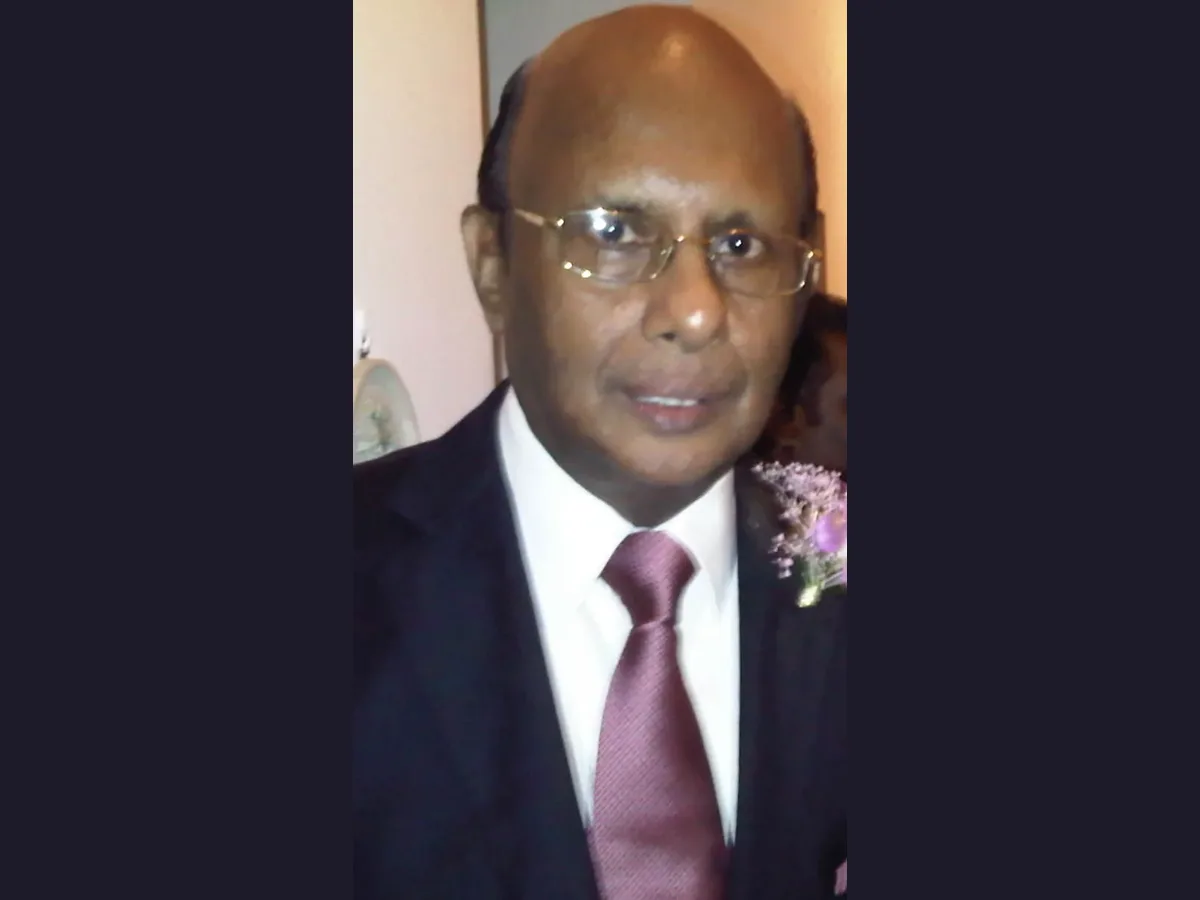
The American announcer was ill, and somebody had to read Kiddies' Corner. It was 1964, the studio was the Commercial Service of Radio Ceylon, and the young man who happened to be in the building that day had no broadcasting experience whatsoever. He had left S. Thomas' College, Mount Lavinia, and was on his way to becoming an accountant. His cousin — Vernon Corea, already one of the station's senior voices — told him to go in and read.
He read. Sixty years later he was still in front of a microphone, and a good part of the history of Sinhala pop music had passed through his hands.
The stand-in who stayed
Vijaya Corea was born in Colombo on 28 January 1943, into a Chilaw family with a long public record. The Sunday Times gives his full name as Jawaharlal Vijaya Srikumaradas Corea. His father was Dr C. V. S. Corea, remembered as a pioneer of homoeopathy in Sri Lanka; his mother was Amybelle Corea; his paternal grandfather was Victor Corea, one of the leading agitators of the Ceylonese independence movement.
He joined the Commercial Service in 1964 as a relief announcer, which is to say by accident, and stayed because listeners would not let him leave. Radio Ceylon in the mid-1960s was not a national station in the modest sense — its transmitters reached across the Indian subcontinent, and its announcers had something close to film-star recognition in South Asia. Corea's shows — the Morning Show, Saturday Star, Lanka's Talent in Focus — became appointments. A recurring memory in Sri Lankan writing about the period is of schoolboys and university students deliberately arriving late so as not to miss the end of his programme.
He won the Daily Mirror's public poll for most popular DJ in the mid-1970s, and Sri Lankan accounts credit him with a record of sixteen sponsored programmes a week. That figure comes from promotional and tribute writing rather than from a station log, and is best treated as the claim of an industry rather than a measured fact.
The English service and the Sinhala bands
The part of his career that matters most to Sinhala music is also the least glamorous, and it turns on a piece of institutional meanness.
In the 1960s the SLBC's Sinhala service gave Sinhala group songs — guitar bands, harmony groups, anything with a drum kit in it — something remembered as a quarter of an hour a week. Officials in the station dismissed the new sound as thuppahi sangeethaya, half-caste music, and kept it off the air. The way round the blockage was sideways, through the English stream, where the Corea family had standing. Sri Sangabo Corea managed the Moonstones; Vernon and Vijaya Corea put them on Saturday Star on the Commercial Service. A Sinhala-language band therefore reached the country first in English-language airtime — an inversion that says everything about who controlled the Sinhala hours.
The list of people who say they got in that way is long and specific. Annesley Malewana has said it took Vijaya Corea to break the embargo on the guitar bands. The Moonstones' first hit මන්ගෝ කළු නැන්දේ Mango Kalu Nande ("dark auntie of the mango tree") and the La Ceylonians' fishermen's song හෝයියා හෝයියා Hoiya Hoiya belong to that opening. The Dharmaratne Brothers credit him with their airtime on the sponsored shows. La Bambas name him and Vernon as the two men who told them to keep going when audiences jeered. Sri Lankan press accounts add Clarence Wijewardena, Indrani Perera and the Three Sisters, Paul Fernando, the Mendis Foursome, La Ceylonians, Super Pink 'N' Purple and Luke Henricus; Wikipedia and the Sri Lankan press together put the total number of pop musicians he introduced to the Radio Ceylon recording booth at more than a hundred.
He also fronted the Sooriya Show on the Sinhala Commercial Service, the broadcast arm of Gerald Wickremesooriya's Sooriya Records. Wickremesooriya's own summary of the relationship was blunt: "Without Vijaya, there wouldn't be Sooriya." The rehearsal room at the Sooriya Village in Colombo, built by his grandson decades later, carries Corea's name.
A dinner dance in Kandy
The clearest single example of what he actually did happened in 1969, and it is on record because the man it happened to told it.
Corea went up to Kandy to compere a dinner dance. The band was a local outfit called the Fortunes, and what caught him was two saxophones playing a melody line together — no vocal at all. One of them belonged to a young naval signals officer named Stanley Peiris. Corea told him to stop confining himself to Kandy and come to Colombo, then went back and badgered Gerald Wickremesooriya, who wanted nothing to do with instrumental records at a moment when Sinhala pop songs were selling everything.
In Peiris's words: "Vijaya was a man able to convince the impossible… Finally, because of Vijaya and Vijaya alone, Gerald agreed to have me and my band 'The Fortunes' for a 'test' at his Sea View Avenue home in Colpetty one morning. But Gerald wanted Vijaya to be there to prove the talents of this young man Stanley. Myself and boys started and up went the thumb of Vijaya Corea and Gerald responded with a smile that confirmed Stanley and his boys had a future."
Stanley Peiris went on to compose for four decades. He said more than once that without Vijaya Corea there would have been no Stanley Peiris.
Television, and the state occasions
Corea holds the distinction of being the first television presenter Sri Lanka ever had. In July 1976 Colombo hosted the Fifth Non-Aligned Summit, and the inauguration at the BMICH was put out as the country's first television transmission, produced with Yugoslav Radio and Television and carried live abroad on 31 July 1976. Corea was the man on the stage.
The state kept calling. Prime Minister Sirimavo Bandaranaike had him as master of ceremonies at the banquet for the visiting heads of state at that same summit; four years later President J. R. Jayewardene had him do the same at the banquet for Queen Elizabeth II and Prince Philip. When Air Ceylon became Air Lanka in 1979, his was the voice on the "taste of paradise" campaigns in Europe and Southeast Asia.
He rose through management to become Director-General of the Sri Lanka Broadcasting Corporation, sitting simultaneously on the boards of the Rupavahini Corporation and the National Film Corporation. Sources disagree on when: the Sunday Times dates the appointment to 1991, while an older Wikipedia caption places it in the 1980s and the Sinhala Wikipedia article says the 1990s.
Sixty years with a microphone
The tributes have been unusually persistent. In August 2005 a concert called Grand Salute to Vijaya Corea filled the BMICH for his fortieth year in the business, with Desmond de Silva flying in from London and Alston Koch from Australia; de Silva presented him with a Lifetime Achievement Award from the UK's Autism Awareness Campaign, a cause Corea has publicly supported. Sri Lankan musicians in Melbourne fêted him in September 2007. At the first National Media Awards in 2007 he received a Gold Award from Prime Minister Ratnasiri Wickremanayake, and in January 2018 a state Lifetime Achievement Award. In August 2024 a stamp was issued in his name, and a second Grand Salute, organised by an S. Thomas' College old boys' batch, marked sixty continuous years in broadcasting; Piyal Perera of the Gypsies, Priya Peiris of La Bambas, Indrani Perera, Annesley Malewana and Mariazelle Goonetilleke sang a salutation song written for the occasion. A memoir, Life Away From The Stage and Microphone, was published the same year.
A word about sources. Vijaya Corea is living, and this article deliberately keeps to his public work. His English Wikipedia article was cut back to a few lines in 2025 after being tagged for promotional writing; the fuller Sinhala Wikipedia article is a translation of the older English version and carries the same difficulty. Where a claim here rests only on tribute writing — the sixteen programmes a week, the hundred-plus musicians — it is presented as a claim. What is firmly documented, and enough on its own, is that a great many Sri Lankan musicians of the 1960s and 1970s say in their own words that he was the reason they were heard at all.