
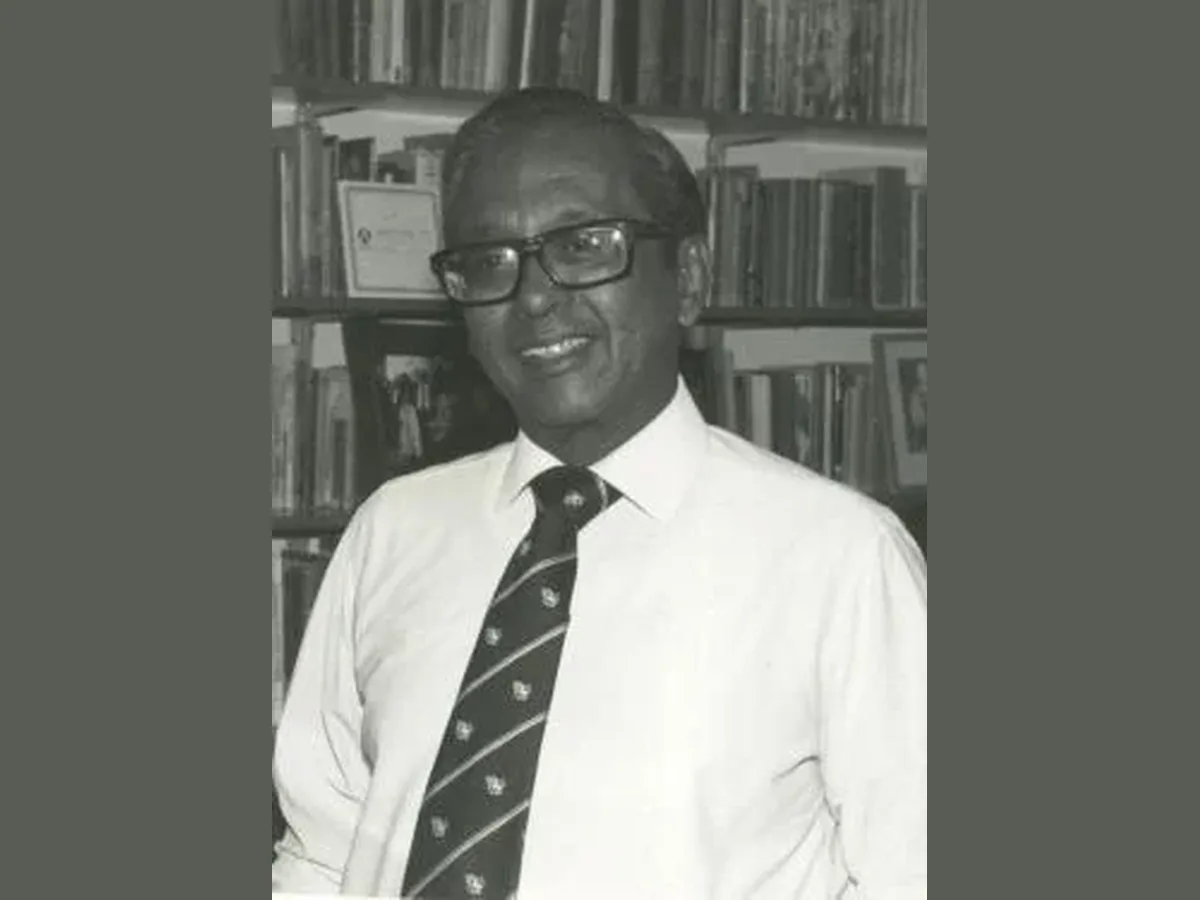
Somewhere in Colombo in the late 1960s, a young man with a guitar and a demo tape would be told the same thing by everyone he asked: go and see Vernon. Not because Vernon Corea ran a record label — he did not — but because he had a microphone on the English service of Radio Ceylon and a column in the Ceylon Daily News, and because he was the one broadcaster on the island who would listen to a Sinhala pop group without first deciding it was beneath him. Being written up in his EMCEE column was, as the Sunday Observer put it plainly, "a huge plus."
That habit of listening is the whole story. The rest — the fame across South Asia, the BBC, the "Golden Voice" tag that followed him for fifty years — grew out of it.
Kurana, Calcutta, and a career he did not want
Hector Vernon Ivan Corea was born on 11 September 1927 at Kurana, near Katunayake. His father was the Reverend Canon Ivan Corea, Vicar of St Luke's, Borella, and of St Paul's, Milagiriya; his mother was Ouida Corea. The family came from Chilaw and belonged to a line with a long political memory: his grandfather Dr James Alfred Ernest Corea was a brother of Charles Edgar and Victor Corea, founders of the Chilaw Association and figures in the Ceylon National Congress. Vernon's brother Ernest Corea became a well-known journalist and later ambassador to the United States.
He was educated at Royal College, Colombo, where he played tennis, acted and debated, and was then sent by his father to Bishop's College in Calcutta to train for the priesthood. He decided it was not for him and came home. He taught for a while at Uva College in Badulla — where he met Monica, a fellow teacher, whom he married — and sold cars at Car Mart in Colombo. Only after the death of their first son, Harishchandra, did he and Monica move to Colombo and did he walk into Radio Ceylon, in 1956, as a relief announcer.
He was appointed a full announcer the following year by the Australian Clifford Dodd, who ran the Commercial Service, and his assistant Livy Wijemanne. Accounts differ slightly on the year — Wikipedia dates the appointment to 1956, the Sunday Observer to 1957 — but the effect was the same. He joined a roster that has become a kind of roll-call of the era: Livy Wijemanne, Pearl Ondaatje, Tim Horshington, Greg Roszkowski, Jimmy Barucha, Mil Sansoni, Eardley Peiris, Bob Harvie, Chris Greet, S. P. Mylvaganam, Thevis Guruge, and the Indian voice of Binaca Geetmala, Ameen Sayani.
The shows
For twenty years he was one of the most-heard voices between Colombo and Karachi. Ponds Hit Parade at seven in the evening. The Maliban Show, Dial-a-Disc, Two for the Money, Take It or Leave It, Saturday Stars, To Each His Own, Holiday Choice, Roving Mike, Old Folks at Home, and the children's programme Kiddies Korner. Listeners across the Indian subcontinent stayed up into the small hours for Radio Ceylon, and the fan mail arrived by the sack. Television had not yet come to the island; the announcer was the star.
In 1970 he spent six months in Britain on a Nuffield Trust fellowship and stood in for the Director-General at a Commonwealth Broadcasting Conference. He also became, at the SLBC, Business Manager and then News Director. And on 15 June 1972 he was asked to present the first experimental television broadcast made in Sri Lanka, for the Radio Society of Ceylon — a few grainy minutes of black and white seen by whoever in Colombo had a set.
Fifteen minutes a week, and the Saturday evening
The part of his career that matters most to Sinhala music is the part he was never officially assigned. In the 1960s the SLBC's Sinhala service allowed Sinhala group songs, by one much-quoted account, "a paltry 15 minutes a week." The Moonstones — Clarence Wijewardena's guitar and Annesley Malewana's voice — reached the ears of schoolboys in 1969 and went nowhere near the airtime their popularity warranted.
What broke the rationing was not a policy change but a family. In the words of a Sunday Times memoir of that childhood, "it was the mighty Corea clan, Sangabo, Vernon and Vijaya, who having influence in the English music stream of the SLBC, gave fans like us a chance on Saturday evening on their radio show. It was they who convinced businessman Gerald Wickramasooriya of 'Sooriya' fame to invest in the hugely talented group." The 2004 Sunday Observer profile says the same thing from the other side: "Together with his cousins, Sangabo Corea and Vijaya Corea he made" a place for Clarence Wijewardena, Annesley Malewana and others on the English service. Sangabo and Vijaya were his cousins, not his brothers — a detail that gets garbled often, and worth getting right, since the point is precisely that this was a clan operating across a station's language divide.
The Hindu of India, in a 2004 piece on the great broadcasters, credited him specifically with introducing Sinhala music to the English services of the Commercial Service and the SLBC. Alongside the radio slot ran the EMCEE column in the Daily News through the 1960s and 1970s, where he wrote up local groups week after week. He interviewed Nimal Mendis, Bill Forbes, Des Kelly and Cliff Foenander among the first wave of Ceylon's pop stars.
One song ties the strand together. Clarence Wijewardena wrote මා ඇති දැඩි කළ පියාණෙනි Ma Ethi Dedi Kala Piyaneni — "father who raised me" — as a tribute to Vernon's father, Canon Ivan Corea. Annesley Malewana later recalled that on a 1994 tour of England, Vernon asked him to sing it; when he began, Vernon broke down, and so did the hall.
London Sounds Eastern
The family moved to England in 1975, initially as missionaries with the radio arm of the Worldwide Evangelization Crusade at Upper Norwood. From there he went to BBC Radio London and the Sunday-evening programme London Sounds Eastern, an hour of Asian music and personalities in English that built a large following in the capital and was written up in the Radio Times. His guests included Ravi Shankar, Amaradeva, Asha Bhosle, Usha Uthup, Lata Mangeshkar, Clarence Wijewardena, Annesley Malewana and Nimal Mendis.
In 1978 he was appointed the BBC's first Ethnic Minorities Adviser, having earlier taken the post of Local Radio Asian Programmes Officer — the first Asian in senior management at the Corporation. He trained minority-ethnic broadcasters, found them placements across the BBC's local radio network, lectured at the BBC training centre, and was invited to Nepal, Bangladesh and the Maldives to do the same work there. Among those who came to him for advice was the newsreader George Alagiah. The Times judged that "his importance both as a figurehead and a consultant was recognised by his appointment as the first ethnic minorities adviser in 1978."
He was a lay reader of the Church of England, at Christ Church, Gipsy Hill and then at Emmanuel Church, Wimbledon Village. In the last year of his life, after a grandson was diagnosed as autistic, he wrote a set of Prayers for Autism that are still read on Autism Sunday each February.
He died at New Malden on 23 September 2002, twelve days after his seventy-fifth birthday, having given forty-five years to public service broadcasting in two countries. Reginald Massey's Guardian obituary caught the man rather than the résumé: "a born broadcaster and racy raconteur, prone to making outrageous remarks with a straight face" — behind which was "a generous and large-hearted Christian."