
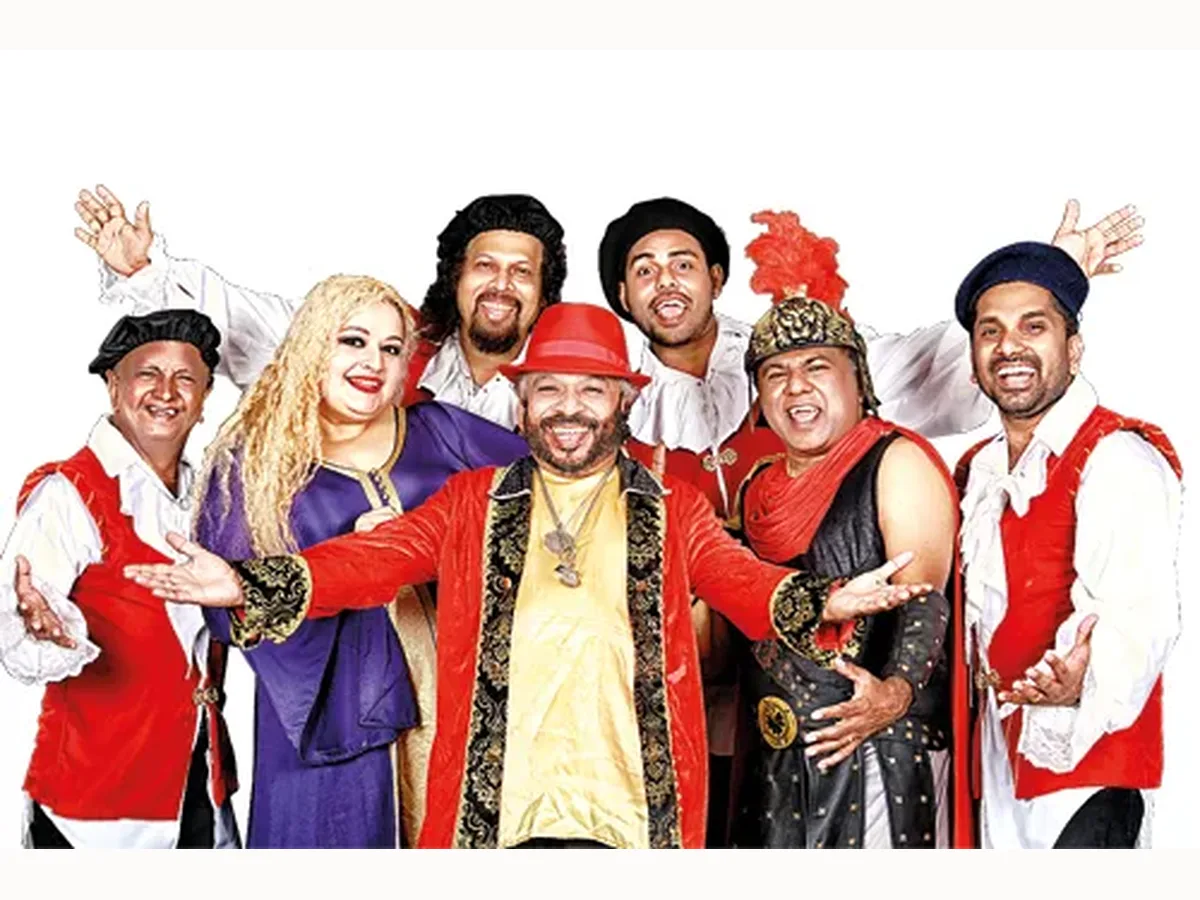
Anton Perera wanted a doctor, an accountant, an engineer and a mechanic. Sunil was to be the doctor, Nihal the accountant, Lal the engineer, Nimal the mechanic; Piyal, the youngest, was too small to have been assigned a profession yet. What his sons wanted was to play in a band, and the music pissuwa — the music madness — had them completely.
Anton Perera was a businessman, a co-founder of the Uswatte confectionery works on the Galle Road at Ratmalana, and businessmen change strategy rather than lose. If he could not talk his sons out of music, he decided, he would make them the most successful band in Sri Lanka. He hired voice coaches — Marianne David and Lylie Godridge — and Winston Jayawardene to teach Sunil the guitar and Cas Ziad to teach Nihal the drums. He asked Joy Ferdinando, then conducting the Sri Lankan symphony orchestra, to be the band's overall musical director. He asked the broadcaster Vijaya Corea to coach Sunil into a stage speaker. He converted part of the family house into a recording studio, put his sons on a practice rota with a log-in and a log-out, and paid them a wage. Then he went round the record shops himself, selling their first single.
He also chose the name. Reading through encyclopaedias, he found that gypsies were free-spirited nomads who travelled from place to place singing for their living, decided that this was what his sons were going to be, and settled it.
Who was in it, and when
The founding is one of those band histories where the family and the encyclopaedia do not quite agree, so both are worth setting down.
The family's own account, given by Sunil Perera in interviews and by Piyal Perera in a memoir of his father published on what would have been Anton's hundredth birthday in February 2024, dates the band to 1969 and describes a line-up of four brothers and two cousins: Nihal on drums, Sunil on lead vocals, Nimal on bass, Lal on keyboards, and their uncles' sons Noel on rhythm guitar and Neville on vocals — seven of them counting Anton. Piyal joined afterwards, pulled out of school at sixteen just before his O levels and told he was in the band, despite never having sung a note. He first played percussion, and added vocals later.
English Wikipedia gives 1970 and describes the band as Anton Perera plus five sons — Sunil, Nihal, Piyal, Nimal and Lal — with the cousins absent. The Smithsonian's National Museum of Asian Art, which hosted the Gypsies in concert in Washington, splits the difference: 1969, five sons, no cousins. The 1969 date is the one the family celebrates, and the one that makes their fiftieth anniversary fall in 2019–20 and their fifty-fifth in 2024.
By the mid-1970s the other brothers had drifted off into business and the band settled around Sunil and Piyal, who between them led it for the next four and a half decades. Everyone else came and went: the long-serving vocalists Corrine Almeida, Sharon "Lulu" Nesaduray, Judith "Ginger" White, Radhika Rajavelu and Monique Wille; the singer Ronnie Leitch, whom audiences knew as Thattaya; the bassist Derek Hepponstall; a succession of guitarists and keyboard players. Piyal Perera is the last of the original line-up still playing.
From Engelbert to baila
They did not start as a baila band at all. "We started only doing western pop," Sunil recalled. "At that time Radio Ceylon was playing a lot of western pop music. Everyone in school was also listening to Family Choice and Housewives' Choice." The early Gypsies played Engelbert Humperdinck, Tom Jones, Ricky Nelson and Jim Reeves at weddings, and the five Dance with the Gypsies LPs they cut through the 1970s are full of covers — Rivers of Babylon, Night Fever, Brown Girl in the Ring, Another Brick in the Wall.
What turned them was hearing Clarence Wijewardena's Moonstones, two years or so into their existence: a Sinhala band playing pop, and getting away with it. Their own first Sinhala records followed — ළිඳ ළඟ සංගමය Linda Langa Sangamaya ("the meeting by the well") and අම්මා අම්මා මේ මට Amma Amma Me Mata ("mother, mother, this is for me"), dated to 1972 or 1973 depending on the account. From there the direction was set: baila, the 6/8 dance music that Sri Lanka inherited from the Portuguese coast and its Kaffir communities, played by a modern band with a rhythm section and a joke in every second line.
The Gypsies are credited with composing the first baila non-stop medley, the continuous run of songs stitched together with no gap that is now the standard closing hour of every wedding and dance in the country. In 1980 they released their first cassette, carrying Kurumitto ("dwarfs") — a Sinhala rewrite of the Dutch novelty hit "The Smurf Song". The 1980s and 1990s brought ලුණු දෙහි Lunu Dehi, Uncle Johnson, ඕයේ ඔජායේ Oye Ojaye, පිටි කොටපන් නෝනේ Piti Kotapan None, සිංඤෝරේ Signore, සයිමා කට් වෙලා Saima Cut Wela and හිනා හිනා Hina Hina. Buongiorno followed in 2018.
They were named Dance Band of the Year in 1989 and 1990. Their first engagement abroad was a three-month residency at the Taj in Delhi; after that came the diaspora circuit — Britain, Singapore, the United States, New Zealand, Australia, Canada — and a concert on the Freer Gallery plaza facing the National Mall in Washington, recorded and archived by the Smithsonian.
Songs about the country
The thing that separates the Gypsies from every other dance band is that they used the dance floor to say things. අයි ඩෝන්ට් නෝ වයි I Don't Know Why is about corruption. Signore is a defeated politician complaining about his ungrateful voters. Saima Cut Wela is a young wife convinced her husband is dying when he is merely drunk. Uncle Johnson is a wedding anniversary party going comprehensively wrong. ලොවේ සැමා Lowe Sama is a straightforward plea for peace between communities. The tunes are party tunes; the words are about caste, religion, class, hypocrisy and whoever happens to be in office.
This got them into trouble regularly, and it is worth being precise about what kind. Baila itself was never banned in Sri Lanka — the genre was looked down on by the respectable, condemned from platforms and kept out of certain programmes, but no law or gazette ever prohibited it, and claims that it was outlawed do not survive checking. What did happen, and is documented, is narrower and more ordinary: individual Gypsies songs were kept off the state broadcasters because of what their lyrics said about the government of the day. Sunil Perera said in his last years that he was facing threats and did not want more controversy, while also insisting that politics had entered the band's music by itself: "When there is dissatisfaction there is a lot of discussion, and we could not avoid such discussion coming into our music."
After Sunil
Sunil Perera died on 6 September 2021, of complications from Covid-19, eight days before his sixty-ninth birthday. The band had been planning a fiftieth-anniversary season; the pandemic reduced it to a set of virtual concerts in 2021.
The Gypsies did not stop. Piyal Perera leads a line-up that still works the wedding and dinner-dance circuit their father built a business plan around in 1969, and the songs have long since escaped the band — Piti Kotapan None and Ojaye are played by every papare band and every wedding outfit in the island, usually without much thought for who wrote them. That is roughly what Anton Perera was aiming at when he read up on nomads and picked a name.