
The head of the folk and research unit at the Broadcasting Corporation, C. J. S. Kulatilaka, spent the 1960s and 1970s doing something nobody else in the country was doing: going out to villages with recording equipment and bringing back the songs people sang while working. At some point he decided that some of this material should be sung on air by a trained voice, and he asked a young music teacher to do it. One of the pieces was ගාන තෙල් සඳුන් Gana Thel Sadun.
The teacher was T. M. Jayaratne. He had trained as a violinist, not a singer. He recorded his first song in 1970.
Dodanwala, or Dodangoda
Tennakoon Mudiyanselage Jayaratne was born on 13 April 1944. Sources disagree about where: English Wikipedia gives Dodanwala, in the Kandy district, while the Sinhala article gives Dodangoda. Both are real places and the two names are easy to confuse in transliteration; the question has not been settled here.
He was schooled at St. Anthony's College in Kandy and at Maliyadeva College in Kurunegala, and spent his teens practising the violin. In 1966 he took a post as a music teacher at Hewavitharana Maha Vidyalaya in Rajagiriya — the ordinary starting point for a great many Sri Lankan musicians of that generation, and the job that put him within reach of the Colombo studios.
The Khemadasa years
Jayaratne's playback debut was ලා හිරු දහසක් La Hiru Dahasak ("a thousand pale suns"), with words by Sunil Ariyaratne and music by Premasiri Khemadasa. That pairing set the tone for the decade that followed. More than any other singer of his generation, Jayaratne is the voice on Khemadasa's film scores, and Khemadasa's scores are attached to the most serious Sinhala films ever made.
The best known is හෙමින් සැරේ පියා විදා Hemin Sare Piya Vida ("gently spreading its wings"), a duet with Sunila Abeysekera from Dharmasiri Bandaranayake's Hansa Vilak (1980). It is one of the songs Sri Lankans can be relied on to know all the way through. Its authorship needs care: a 2005 Sunday Times report on a Khemadasa film festival, and the Sinhala Wikipedia article, both credit the lyrics to W. Jayasiri, while the English Wikipedia entry credits the film's director and some databases record a garbled version of the name. The Jayasiri attribution has the better support.
He also sang for Dharmasena Pathiraja's Bambaru Awith, another of the films that defined the Sinhala new wave. Other Khemadasa songs in his repertoire include මේ අයුරින් අපි සංසාරේ Me Ayurin Api Sansare and මාල ගිරා ගෙල Mala Gira Gela, both to Ajantha Ranasinghe's words, සෙවණේ කුඹුක් සෙවණේ Sewane Kumbuk Sewane and අඳුරු කුටිය තුල Anduru Kutiya Thula.
His first cassette, Tharanga Volume 1, was released in 1978.
It is worth pausing on what a Khemadasa session asked of a singer. Khemadasa wrote for the film rather than for the radio: long lines, awkward intervals, orchestration that gave the voice no cushion, and words that were often closer to dialogue than to verse. A singer trained to ornament every phrase would have smothered it. Jayaratne, who had come to singing sideways from the violin and through a folk-collection unit, did the opposite — he sang the line as written and let the orchestra do the rest. That is why those recordings still sound modern.
The lyricist he kept going back to
If Khemadasa is the composer most associated with Jayaratne, Kularatne Ariyawansa is the lyricist. More of Jayaratne's recorded songs carry Ariyawansa's words than anyone else's, usually with Rohana Weerasinghe's melodies underneath: හිරුට හොරෙන් Hiruta Horen ("in secret from the sun"), වළා තීරයෙන් එහා Wala Theerayen Eha ("beyond the line of cloud"), එක සිත දෙතැනක Eka Sitha Dethenaka ("one heart in two places"), රත්තරන් නෙත් දෙකෙන් Raththaran Neth Deken, කුරහන් යායේ Kurahan Yaye ("in the millet field") and the comic චණ්ඩිකමට රණ්ඩුවක් වෙලා Chandikamata Randuwak Wela.
Two of those — Kurahan Yaye and Chandikamata Randuwak — appear in Stanley Peiris's list of compositions, as does සිතින් මා නොසැලී Sithin Ma Nosali, which is one of the songs most often requested of him. He worked with Clarence Wijewardena on දෛවයේ Daiwaye and රුවට රුවේ Ruwata Ruwe, with Nimal Mendis on රන් ටිකිරි සිනා Ran Tikiri Sina and කල්පනාවෝ පාව යයි Kalpanawo Pawa Yai, and recorded a long run of duets with Neela Wickramasinghe.
His devotional and patriotic material has stayed in circulation too — නේරංජාවේ තොටුපල අභියස Neranjawe Thotupala Abhiyasa, set at the ford of the Neranjana river where the Buddha broke his fast, and උපන් බිමෙන් Upan Bimen.
The count, and the awards
Jayaratne has received the Presidential Award four times — in 1978, 1979, 1980 and 1987 — and in 2006 was named best male singer at the Raigam Tele Awards. His English Wikipedia entry states that he has sung in 79 films. That number is more specific than most figures in this subject and may well be right, but it is unsourced, and Sri Lankan output totals have a habit of drifting upwards with each retelling; it is safer to say he sang in a great many.
What is easier to establish is the shape of the career. He came in through the folk unit rather than the light-music department, which gave him an unusually plain, unforced delivery for a trained musician; Khemadasa used exactly that quality, casting him as the ordinary man's voice in films about ordinary men. He also composed music for some songs himself, though the singing eclipsed it.
Still on the stage
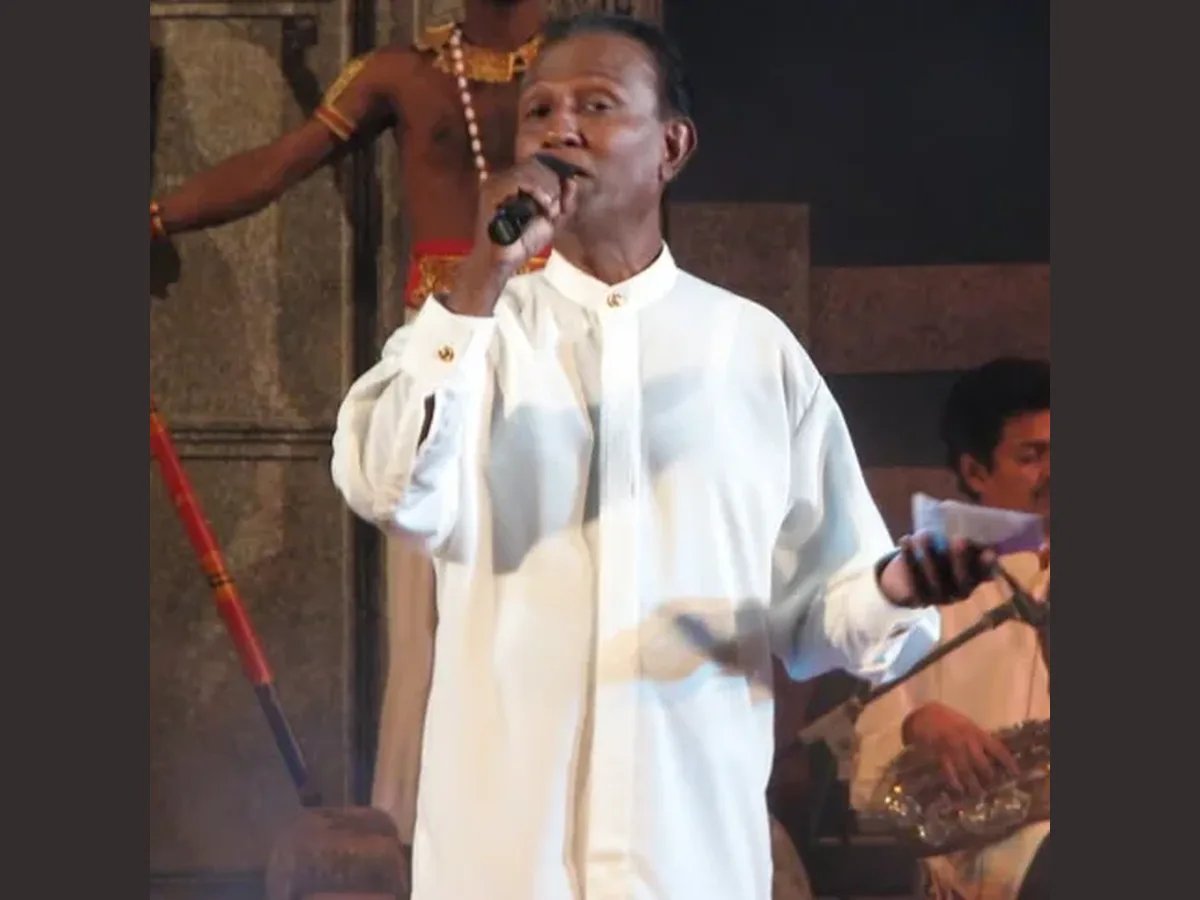
Jayaratne is married to Malini Jayaratne, and their son Isuru Jayaratne also sings; father and son have performed together. He has continued to appear in concert well past the age at which most singers of his generation stopped, and the Khemadasa songs remain the reason audiences come.
The best summary of the career belongs to the man who started it. Kulatilaka went looking for someone to sing village songs on the radio, and found a violin teacher who could sing them without decorating them. Everything else followed from that — the film work, the awards, and a catalogue that runs from a Buddhist song about a riverbank to a comic number about starting a fight.