
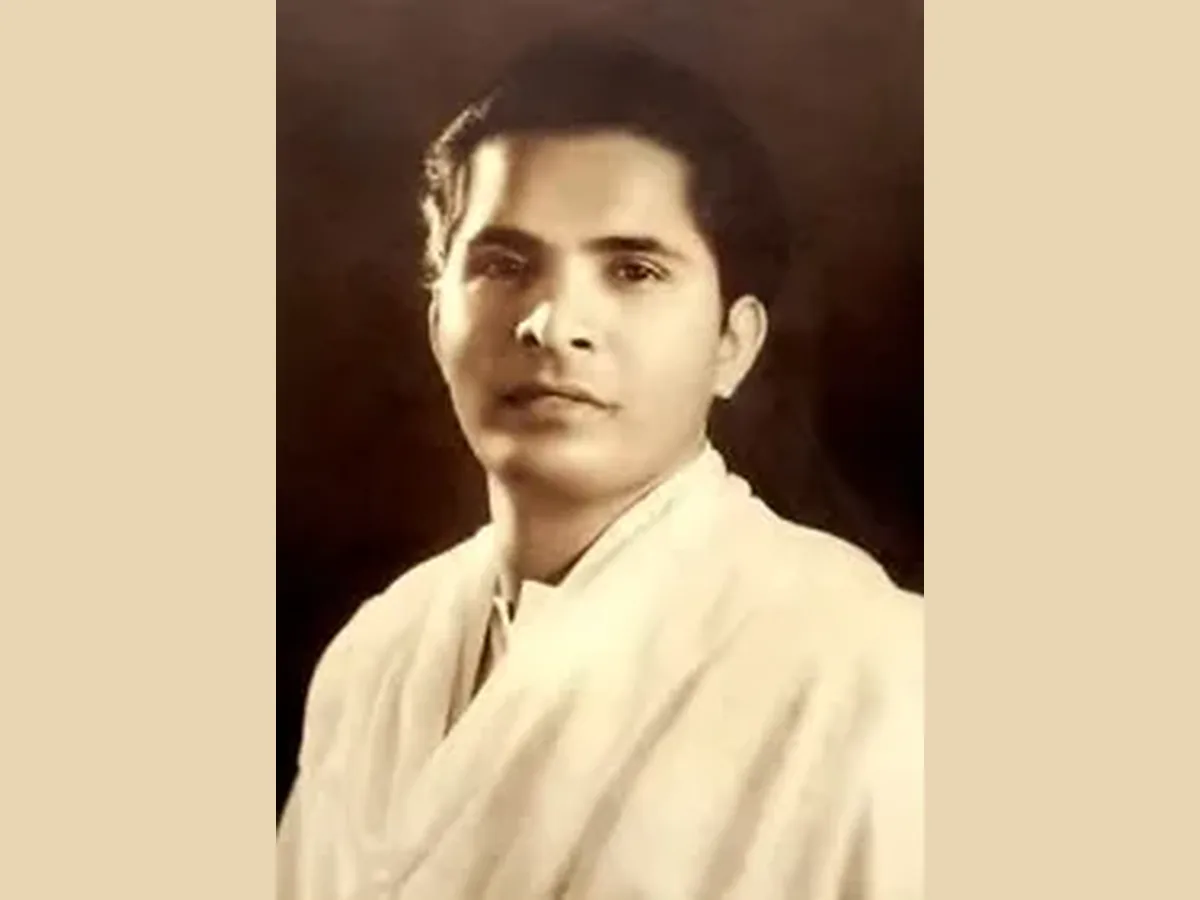
There were no tape recorders. When Radio Ceylon recorded a song in 1946, the sound went straight onto a disc as it was performed, and if anything went wrong the disc was wasted. The first song the station ever cut that way was "Olu Pipila" (ඕලු පිපීලා, "The lotus has bloomed"), and the words, the tune and the voice all belonged to the same man — a former schoolteacher from Ja-Ela who had just come back from five years of music study in North India and had decided, on the way home, not to sound Indian at all.
Nothing had sounded like it. It moved plainly from note to note, without the sliding ornaments that every India-trained Sinhalese singer used, and it pronounced Sinhala words the way Sinhala speakers pronounced them. It was the beginning of a modern Sinhala song idiom, and it made Sunil Santha, within a year or two, the most successful recording artist in the country.
Joseph John of Dehiyagatha
He was born Baddaliyanage Don Joseph John on 14 April 1915 — Sinhalese New Year's Day — at Dehiyagatha in Ja-Ela. Both his parents were dead before he was two, and his grandmother brought him up. His first music was church music: he sang in choirs, and picked up guitar and harmonium along the way.
He was a formidable student. At St Benedict's College, Colombo, he came first in the island in the school leaving certificate examination, and in 1933 he passed the Teachers' Final Examination and began teaching at Mt Calvary School in Galle, now St Aloysius' College. He led its choir to three straight wins at the Southern Schools Music Competition, produced plays including a Sinhala Hamlet, and — a detail his family always stressed — spent his spare time taking machines apart. He wanted to be an inventor. He built radios and repaired car engines all his life.
At the end of the 1930s he gave up teaching and left for India: first Santiniketan, the school Rabindranath Tagore had founded, then the Bhatkhande college of music at Lucknow from 1940 to 1944, where he took top marks in both sitar and voice. He came home in late 1944 with a Sangeetha Visharada, and with a new name. Joseph John became Sunil Santha. (Even the spelling of it is contested: the English Wikipedia infobox gives සුනිල් සාන්ත, the Sinhala Wikipedia සුනිල් ශාන්ත, and both forms are in common use.)
The Hela argument
On 2 March 1946 he sang at a commemoration for the grammarian Munidasa Cumaratunga, and Radio Ceylon asked him to record. Over the next six years he composed and recorded over a hundred songs for the station and built a ten-piece orchestra to play them — violins, bamboo flutes, guitar, Hawaiian guitar, cello and Eastern percussion — among whose musicians was a young violinist called Albert Perera, later W. D. Amaradeva.
The songs travelled fast: "Handapane" (හඳපානේ), "Ho Ga Rella Negei", "Bowitiya Dan Palukan Vare" (බෝවිටියා දං පලුකන් වාරේ), "Suwanda Rosa Mal Nela", "Kokilayange", "Mihikatha Nalawala". They were sung at picnics and family parties and played by military bands. Not all of them were pastoral: in "Mage Himiyaneni", recorded in 1948 or 1949, the wife of King Siri Sangabo begs her husband to come back from the forest.
Behind the plainness was an argument. Santha had joined the Hela Havula, Cumaratunga's movement for a pure Sinhala stripped of Sanskrit borrowings, and he sang lyrics by Cumaratunga himself, by Raipiyel Tennakoon, by Arisen Ahubudu, by Hubert Dissanayake and by Fr Marcelline Jayakody. He applied the Sinhala laghu-guru bedha, the language's own system of long and short syllables, to govern his metres. Musically he did the opposite of what his training suggested: simple, catchy tunes in the major scale over Western I–IV–V harmonies, upright bass and acoustic guitar. It worked on everyone. In June 1951 Joan Eleanor Ramsbotham, the Governor General's daughter, wrote him a letter praising "Olu Pipila", "Kokile Nade" and "Handa Pane".
The audition he refused
In 1949 Radio Ceylon brought S. N. Ratanjankar from Lucknow — Santha's own former principal — to audition and grade Sinhalese musicians. He awarded the A grade to five: Lionel Edirisinghe, Ananda Samarakoon, Devar Surya Sena, S. Amarasinghe and Sunil Santha.
In April 1952 the station's director general M. J. Perera invited Ratanjankar back, to grade musicians again and to advise on how a Sri Lankan national music should be built. Some 716 applicants sat before him. Santha was not one of them. He boycotted the auditions and then, in a step nobody expected, resigned his A-grade post — and set out his reasons in public, in an article headed "Ape Desiya Sangitaya Kumakda?" ("What is our national music?") in Lankadipa on 5 May 1952: "I do not believe that we should wish for a foreigner to come to Sri Lanka to advise us on how to create a national music just because we brought a German to advise us on the Sinhala language."
The reference was to Wilhelm Geiger, and to the older fight about who was fit to edit a Sinhala dictionary. The station's music policies in those years bore him out on the narrower point: certain instruments, the piano and harmonium among them, were barred from Sinhala recordings, and counterpoint and harmony were forbidden.
He was not blacklisted for lacking talent — he had been graded A three years earlier and was, by 1947, one of the country's biggest sellers. He was out because he would not be re-measured against a standard he thought wrong. From 1952 until 1967 Sunil Santha was largely absent from Sri Lankan music. His songbooks were pirated, his songs sold without his consent or a rupee in royalties. He tried photography, and selling clothes, and selling electronics. In 1953 he opened a small school in the Newton building at Maradana and vowed to teach ten pupils free. In 1955 the journalist D. B. Dhanapala ran a campaign in Lankadeepa to expose his plight and raised some money. He also wrote to the newspapers about the plight of another man the state had left in the cold: Ananda Samarakoon.
Rekava, Sandeshaya, and the way back
Lester James Peries had heard "Olu Pipila" in London in the 1940s and decided that whenever he made a film, this was the man who would write its music. It took him two years of visits to Ja-Ela to get a yes, and the yes came with conditions: Fr Marcelline Jayakody would write the lyrics, and Santha's pupil Ivor Dennis and the musician B. S. Perera would sing them, not Santha. Peries agreed. Rekava (1956) carries "Vesak Kekulu Athu Aga Hinda" (වෙසක් කැකුළු අතු අග හිඳ) as a result, recorded in Madras because Colombo had no studio good enough.
Sandeshaya (1960) went less well. Santha was not present at the Madras sessions; the film's music director R. Muttusamy introduced a shehnai — an instrument Santha never used, precisely because of its Indian colour — and altered part of the melody of "Puruthugeesi Karaya" (පෘතුගීසිකාරයා), Arisen Ahubudu's lyric, without consulting him. Ivor Dennis, who was there, said flatly that Santha would have objected had he been in the room.
In 1967 a change of government brought Neville Jayaweera in as Director-General of Radio Ceylon, and the doors opened again. Santha came back — and was promptly put on the panel auditioning other artists, alongside Amaradeva and H. W. Rupasinghe. His late work is his strangest and most experimental: melodies confined to five notes, or three, or one. "Gum Gum Gum", about the movement of bumble bees, has a melody built on a single note, and most listeners never notice. The 1980 record Seegiri Gee set the Sigiriya graffiti — verses scratched on a rock wall by visitors more than a thousand years ago — to four-note tunes played on Sri Lankan drums.
The last six weeks were cruel. On the evening of 28 February 1981 his son Jagath, aged 23, drowned in a hotel swimming pool at Negombo. Santha shut himself in his room with photographs of the boy. On 11 April 1981, three days short of his sixty-sixth birthday, he died of a heart attack.