
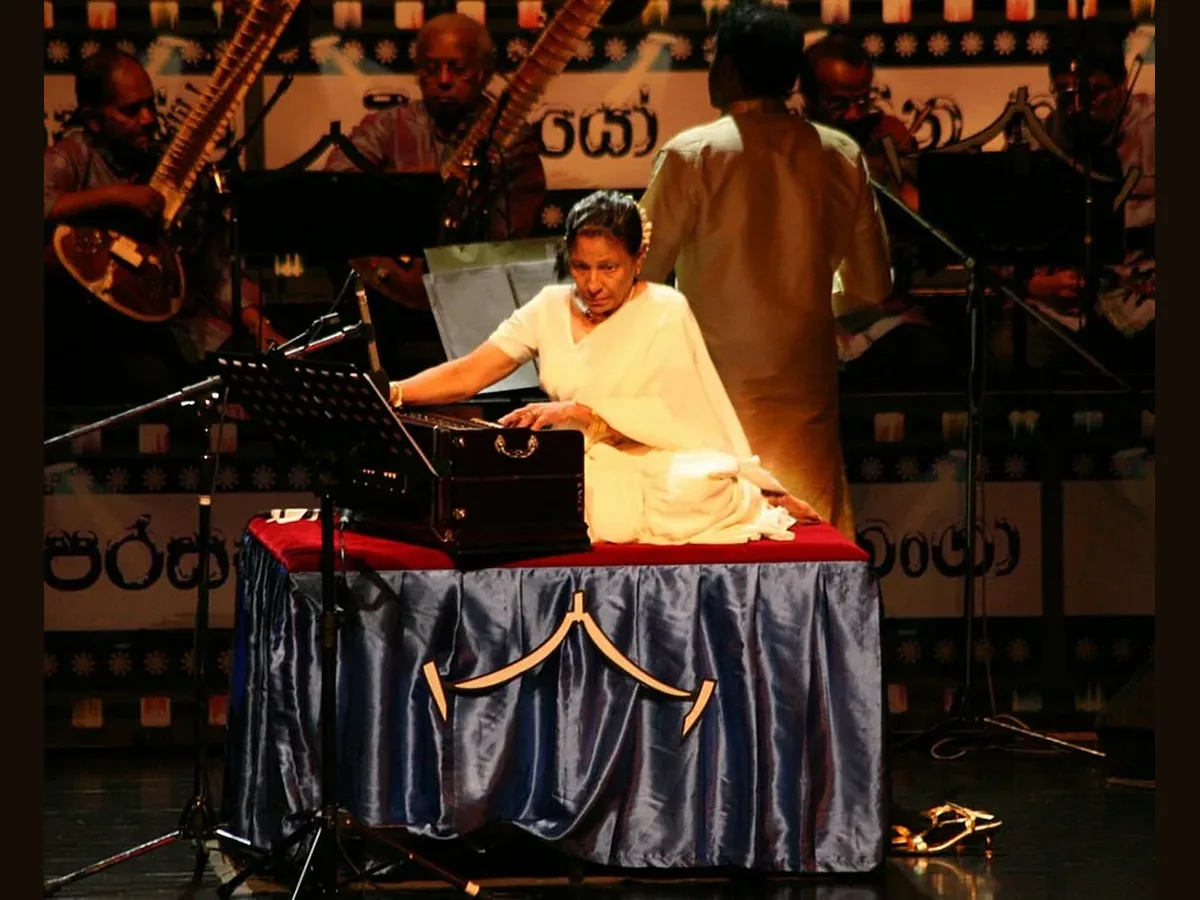
She was eight years old, and the song was called Malse Dileva. It went out from Radio Ceylon in 1950 on a feature programme, to music composed by A. J. Kareem, sung by a child from Kelaniya who had been taken along to the studio because her mother was a Tower Hall actress and singer and this was the sort of thing the family did. Seven decades later she was still recording. Almost nobody in Sri Lankan music has a career that long, and nobody at all has one that starts younger.
Sri Lankan writers call her the golden bell of Sinhala song, and the nickname is a description rather than a compliment. Hers is a bright, precise, carrying voice with an unusual amount of tonal range for a playback singer, trained hard enough in the North Indian classical tradition to sustain a khayal and flexible enough to sound completely at home over a film orchestra.
A note on the name
The name is spelled both ways and both are correct. Sinhala writes it සුජාතා අත්තනායක; English-language sources render that as Attanayake, Aththanayaka or Attanayaka depending on the house style, and she appears under all three. Her birth name was Mudunkotuwa Munasinghe Arachchige Sujatha Perera; Attanayake is her husband's name. This site files her under the slug sujatha-aththanayaka while using Attanayake in the text, which is the form the Sri Lankan English press uses most often.
The screen voice
Sri Lankan cinema in the 1950s and 1960s ran on playback: the actress moved her lips, and somebody else's voice did the singing. Sujatha Attanayake became the voice the studios called first. Her film debut came in 1956, at fourteen, in S. M. Nayagam's Sohoyuro, and from there she simply did not stop.
Exactly how much she recorded is one of those numbers that Sri Lankan sources give differently every time, and it is more honest to give the range than to pick one. English Wikipedia says nearly 400 Sinhala films and 20 Tamil films; the Sunday Times says over 350 Sinhala and 19 Tamil; the Sunday Observer in 2008 said 352 and 19. Song totals are reported anywhere from "well over a thousand" light songs to six thousand Sinhala songs, which is the kind of figure that should be treated as folklore rather than arithmetic. What is safe to say is that she sang for several hundred films across four decades, which is as many as anyone.
The songs themselves need no hedging. පරවුනු මල් වල Parawunu Mal Wala from Parasathu Mal, ජීවන විල මැද Jeewana Vila Meda, පුතුනේ මේ අහගන්න පුතුනේ Puthune Me Ahaganna from Kalyani Ganga, ගුවන් තොටිල්ලේ Guwan Thotille, ඔංචිල්ලා තොටිලි කොයින්දෝ Onchilla Thotili Koindo, හෘදේ රස මාළිගේ Harde Rasa Malige, පුංචි දවස්වල Punchi Dawaswala, සඳ රැජිණියනේ Sanda Rajiniyane from Sekaya. She sang duets with essentially every male voice of the era — ඝණ අන්ධකාරයෙන් මිදී Gana Andakarayen Midi with H. R. Jothipala, පුෂ්ප මකරන්දය මාගේ Pushpa Makarandaya with Narada Disasekara, පිරුණා හද සන්තානේ Piruna Hada Santhane, මධුර යාමේ Madura Yame with R. Muttusamy, බොඳ මීදුම් කඳුරැල්ලේ Bonda Meedum Kandurelle with Abeywardena Balasuriya, and recordings with Amaradeva, Victor Ratnayake and Sanath Nandasiri.
One much-repeated story about her working method is worth telling because it is specific: she once recorded playback songs for four different films in a single day, moving between the S. P. M. studio at Kandana, Vijaya Studios at Hendala, the Kelaniya university studio and Lanka Studios.
The awards came early. She won the Swarna Sankha award for best female singer in 1965 for Duka Ena Kala from Yata Giya Dawasa, and both the Swarna Sankha and a Sarasaviya award in 1966 for Parawunu Mal Wala. In 1974 she took the Sarasaviya awards for best female playback singer and most popular singer for Puthune Me Ahaganna. In 2016 Sarasaviya gave her its Ranathisara award for contribution to cinema. She has also said, publicly and repeatedly, that she was passed over for awards she believed she had earned — she named Sanda Rajiniyane at the 1969 Sarasaviya festival as one — and that the award committees of the period were not always decided on merit.
Nine languages, and a classical training
The playback career sat on top of a serious musical education. She studied at the State College of Aesthetic Studies and then the State College of Music, and in 1967 went to India, taking a master's degree and the Visharada examinations at Lucknow in voice and sitar. She plays harmonium, sitar and other instruments, writes notation quickly, and studied Kathak dance under Srimathi Rasadari. On her return she worked at Radio Ceylon, where she is described as the only woman singer presenting classical music programmes on Sri Lankan radio. In 1979 she came first in an SLBC grading examination for light song, ahead of every other singer who sat it.
Language was where she was genuinely unusual. She sang in Sinhala and Tamil, and beyond them in Hindi, Urdu, Telugu, Malayalam, Marathi, Gujarati, Bengali, Nepali and English, with sources listing eight or nine depending on how they count. In 1958 she became the first Sinhala singer to record a Hindi song for the radio programme Bal Sakha; in 1980 she sang Subha Kamana at President's House for the visiting King Birendra and Queen Vimla of Nepal, and is described as the first Sinhala singer to perform a Nepali song on the Asian Hindi Service. She gave a solo Tamil concert, Swaram, at Bambalapitiya, and a concert of Islamic songs, Ilampirai Geethangal, at Maradana, for which the Sri Lanka Muslim Artiste Front honoured her with the title Pan Mai Kokilam.
Alongside all of it she was a teacher and an administrator: a lecturer at the Kalutara Teachers' Training College, and later an Assistant Director and then Director of Aesthetic Education at the Ministry of Education.
The first woman in the music director's chair
In 1975 she did the thing that puts her in the history books rather than only in the record catalogues. She became the first Sri Lankan woman to work as a film music director, scoring Hariyata Hari, and afterwards Sanda Kinduru.
It is worth pausing on how unlikely that was. Sinhala film music in the 1970s was a closed shop of men, most of them trained in the same institutions and moving between the same studios; women sang, and men decided what they sang. Nothing about her career had prepared the industry for a female playback singer turning up with a score. She kept doing it: in 2016 she directed the music for the Sri Lanka Police theme song — her father had been a police sergeant — and later composed the theme for the Special Task Force.
Absence and return
In 1992 her son Captain Chanaka Sanjeewa Attanayake, an army officer, was killed at Pooneryn. She was performing in Melbourne at the time. She stopped singing, began wearing only white sarees, and left Sri Lanka for the United States; accounts differ on the year of departure, with 1992 and 2002 both reported. She released a cassette, Yuda Bima Kandulak, to mark his first death anniversary, and the armed forces have honoured her repeatedly since, most visibly with the title Weera Matha — mother of a hero.
She came back to the stage. Her first solo concert had been Asi Mihira in 1974; nearly forty years later she performed Jeewana Vila Meda to a full Nelum Pokuna theatre in 2012–13. In November 2017, on her seventy-fifth birthday, her biography Sujatha Attanayaka Divisirita and a companion collection of her songs were launched. In December 2019 the University of the Visual and Performing Arts awarded her an honorary doctorate, conferred by its chancellor Sanath Nandasiri, with whom she had recorded කොහෝ කොහෝ Koho Koho decades earlier. She has also compiled a book of a hundred nurthi songs of the Tower Hall era with their notation set down accurately — her mother's repertoire, written out for the teachers who would otherwise have nowhere to find it.