
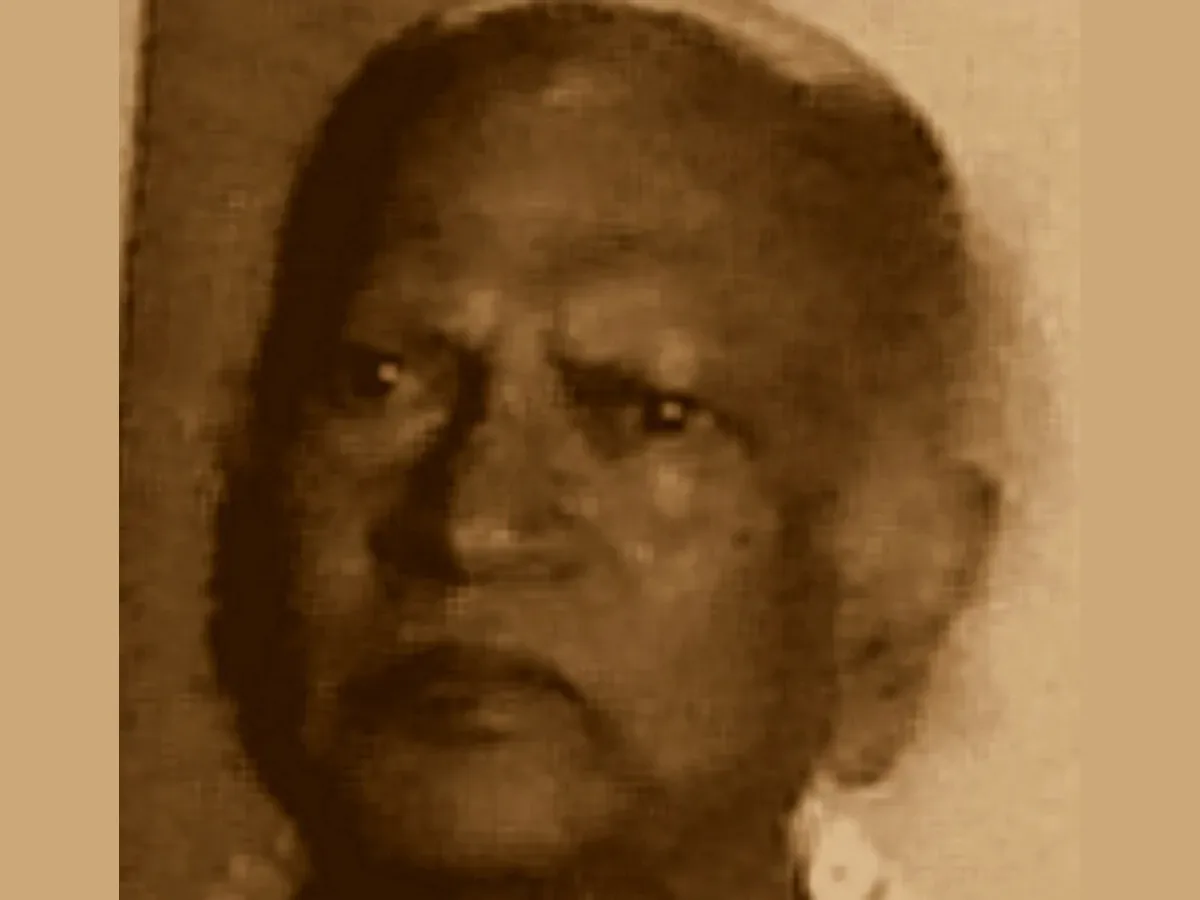
For most of a thousand years, a Sinhala poem meant four lines that rhymed at the end and could be counted on the fingers. Metre was not decoration; it was the definition. Then in 1956 a young Sanskrit lecturer at Peradeniya published a thin book of poems that did none of that — no rhyme, no fixed line, no stanza — and called it Mas Le Nathi Ata, "bones without flesh and blood". The traditionalists were appalled, which was the point. Sinhala song has been living off the consequences ever since, because once a poem no longer had to fit a metre, neither did a lyric.
A quarrel with the four-line stanza
Siri Gunasinghe was born on 18 February 1925. Most sources place his birth at Ruwanwella in the Kegalle District; a Sunday Observer tribute written the week he died says Galle, and a 2005 profile says only "the South" — the accounts genuinely differ, though the tribute's own account of a village Sinhala school and a bilingual school at Ruwanwella points back to Kegalle.
He was educated in English at Mahinda College, Galle, took a first-class degree at the University of Ceylon and was taken onto the academic staff. Then he went to the Sorbonne, where he wrote a doctorate on the techniques of Indian painting, published in Paris in 1957 as La technique de la peinture indienne d'après les textes du Silpa. He came back to Peradeniya to teach Sanskrit and, for a period, in the Sinhala department.
This is the crucial fact about his rebellion: it came from the inside. Gunasinghe knew the classical tradition better than the people defending it. Professor Hemapala Wijewardena described him as "a great revolutionary among the revolutionaries, with the traditional knowledge gained from the learning of Sanskrit, a new knowledge acquired from a Western university". His attack on the four-line stanza was not ignorance of the rules but impatience with them, and he extended the same impatience to Sinhala prose, arguing all his life that people should write the language they actually spoke rather than the literary dialect. He went so far as to drop two letters of the alphabet — ණ and ළ — from his own writing.
Mas Le Nathi Ata, 1956
The 1956 collection was followed by Abinikmana ("the renunciation") in 1958, Rathu Kekula ("the red bud") in 1962, and, after a very long gap, Alakamandawa in 1998. Four books of poems is not much. Their effect was out of all proportion to their bulk: a school of poets followed him, and the term he is credited with coining for the new form — නිසඳැස් nisandas, free verse — entered the language.
He was also, according to Sinhala accounts, the first to put illustrations into a Sinhala book of poems, a pioneer of book-cover design in Sri Lanka, and a broadcaster who presented radio programmes. In 1960 he published Hewanella, "the shadow", widely described as the first Sinhala novel written in stream of consciousness; Mandarama and Miringuwa Ellima followed.
What free verse did to the song
The timing matters. Garrett Field's study of twentieth-century Sinhala song points out that the late 1950s produced two Sinhala forms with no precedent at all — the radio opera, gita natakaya, and free verse, nisandas kavya — and that both came out of the same small, self-consciously high-minded circle of university men and Radio Ceylon staff. Neither was created to sell. Both were created to raise the standard.
For songwriting, the practical effect was liberation. As long as a Sinhala lyric had to fall into four metrical lines, the easiest way to write one was to borrow an existing melody and count syllables against it — the practice contemporaries mocked as vacana danava, "putting words". Once poetry itself had abandoned fixed metre, a lyricist could write a text first and let a composer find the shape of it. The lyricists of the radio-song generation — Mahagama Sekera above all — worked in exactly that freer space, and the songs Sri Lankans now think of as the summit of the form are not four-line verses set to music.
It should be said plainly that this is an argument about influence, not a documented chain of cause and effect, and that Gunasinghe himself never worked as a jobbing lyricist. He has, so far as the record shows, exactly one film song to his name — and it is a good one.
Sath Samudura: the film that refused to sing
In 1967 he wrote and directed his only feature, Sath Samudura ("the seven seas"), released on 22 February. Asked years later why it looked so unlike other Sinhala films, he gave an answer that is worth quoting whole: "I tried to make the movie more cinematic. In the sense that I wanted to make the visuals the main medium. I used very little dialogue in that movie. No dance and music and fighting… The Sinhalese film was all dancing and singing… of the Bombay variety kind."
The joke of it is that this deliberately song-resistant film produced one of the most loved songs in the language. At the Sarasaviya festival held in 1968, Sath Samudura took best film, best production, best direction, best supporting actor, best supporting actress, best editing, best music direction for Somadasa Elvitigala, best lyrics for Mahagama Sekera and best male singer for W. D. Amaradeva — the last two for the same song, සිනිදු සුදු මුදු තලාවේ Sinidu Sudu Mudu Thalawe ("on the smooth, white, soft sand"). Most accounts, including Wikipedia's, say the film won eight awards; the Sarasaviya archive's own list for 1968 names nine.
Gunasinghe's own lyric for the film was පිපුණු කුසුම Pipunu Kusuma ("the flower that bloomed"), set by Elvitigala and sung by Amaradeva. He also directed a short film, Ran Wan Karal, and much later turned the fifteenth-century Guttila Kavya into a television serial.
Exile, and an argument about who was first
In 1970 he left for Canada and stayed for the rest of his life, teaching in the Department of History in Art at the University of Victoria in British Columbia. He was blunt about how it happened: "I didn't really leave Sri Lanka. I came here as a visiting professor for one year. And then certain political problems — not national politics but university politics — compelled me to stay on." He went on publishing on Sri Lankan art, including work on the Sigiriya frescoes translated as Kassapa's Homage to Beauty. He died in British Columbia on 25 May 2017.
One credit is genuinely contested. English-language obituaries and the 2005 profile call him the first Sinhala poet to break the four-line stanza and the coiner of the word nisandas. BBC Sinhala's obituary tells it differently: the free-verse tradition, it says, was begun by the writer G. B. Senanayake, and what Gunasinghe did was nourish it and hand it on to the poets who came after. Both accounts are held by serious people. The safest statement is the one nobody disputes — that Mas Le Nathi Ata is the book that made free verse impossible for Sinhala literature to ignore.