
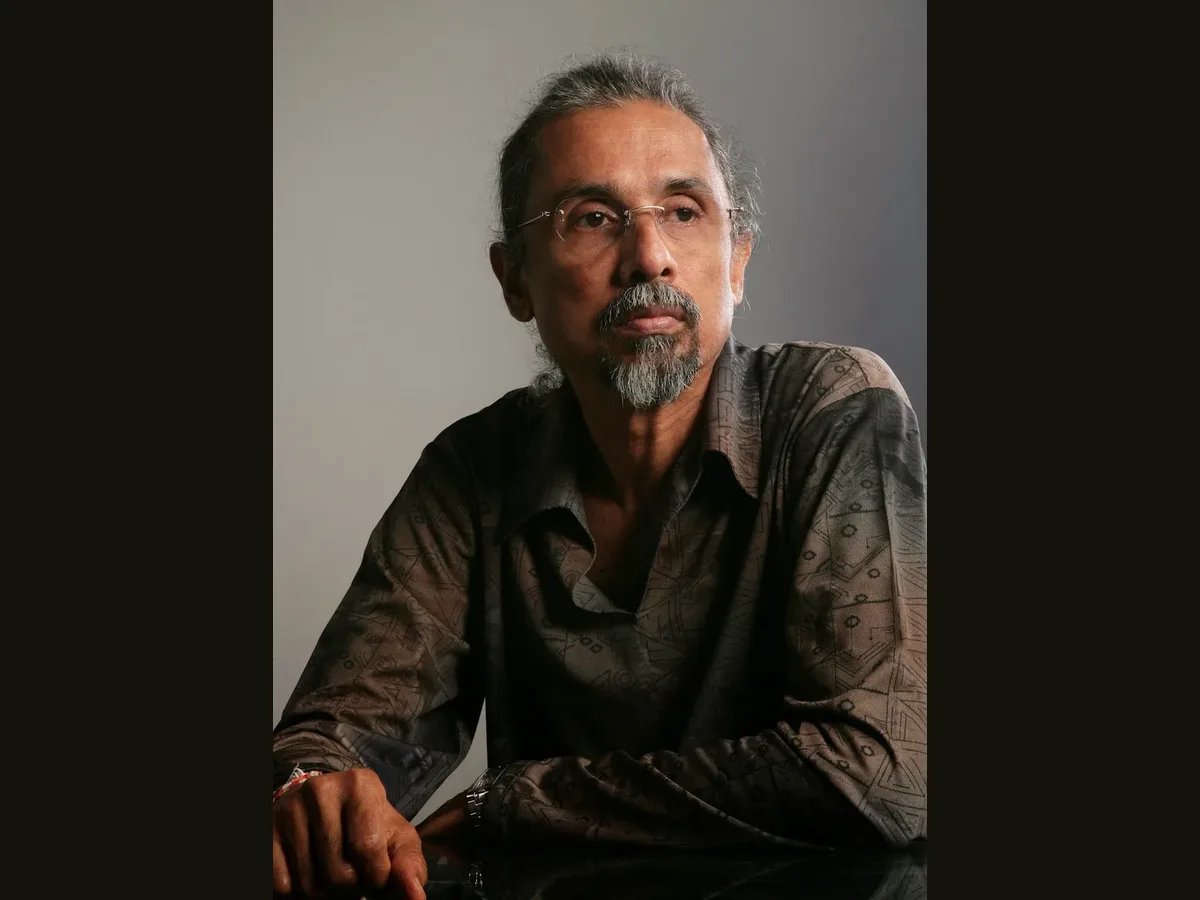
Most people are recognised by their faces. A handful are recognised by their voices, and in Sri Lanka almost nobody managed it as thoroughly as Saman Athaudahetti. For a whole generation of children he was Gulliver — the Sinhala voice of Gulliverge Suvisariya — and for their parents he was Ryuzo, the husband in the Japanese serial Oshin. He was also on the sports service, in the children's studio, on the first television broadcasts of the Rupavahini Corporation, and, quietly, on the credits of some of the most-loved songs of the 1980s and 1990s.
He is one of the harder people in Sinhala music to research. There is no Wikipedia article about him in either language, and no newspaper archive that has been digitised will yield much. Most of what follows comes from a single long interview published in The Nation in 2014, plus his publisher's catalogue.
Ehatuwewa, and then Colombo
His parents were teachers, and when they married they wanted quiet. They chose Ehatuwewa, a small village about ten kilometres from Galgamuwa in the North Western dry zone, and that is where Saman was born. When he was three his father moved to Siyambalagamuwa Maha Vidyalaya, which became his first school. By the time he reached the second grade his parents had decided that education mattered more than quiet, and the family moved back to Colombo, where both had deferred teaching posts waiting at Royal College.
He was a shy child. His own account is that his parents once had to offer him ten rupees to get him to sing on a stage, and then teased him afterwards that he was already behaving like a professional.
Royal Junior School turned out to be the right accident. Its principal, H. D. Sugathapala, loved the arts and threw the place open to them, so that the boys were sharing corridors with Sugathapala de Silva, Dayananda Gunawardena, Dhamma Jagoda, Tony Ranasinghe and Nawanandana Weerasinghe, who came there to rehearse. In 1968 he won best actor at the school drama festival. The veteran broadcaster Prabha Ranatunge noticed the group and pulled them into the Sri Lanka Broadcasting Corporation's children's programmes — Lama Pitiya — and by the time he left school he was already working there as a relief announcer.
Cartoon natyaya
In 1978 he became a permanent member of SLBC staff, on the sports service. Sports broadcasting at the time, by his own description, was dull, and the innovation he is proudest of is that he and his colleagues made Kreeda Sangrahaya interesting.
The work that lasted, though, was the radio drama. His first experimental script was Rukada Pancha, an adaptation of Carlo Collodi's Pinocchio. Then, with Karunathilaka Handuwala, he wrote Landesi Dupatha — an adventure-detective serial whose two characters, Jill John and Vandabona, are still remembered by people who were children in the late 1970s. The point of it, he said, was that Sinhala children's drama had until then offered either fairy tales or realism, and nothing in between; they went for fantasy characters that sat between the two. Professor Sarath Amunugama, then a ministry secretary, called what they were doing cartoon natyaya — cartoon drama — which was meant as a description of the pictures it put in a listener's head.
Dubbing followed, and then television. He was among the first presenters on the Sri Lanka Rupavahini Corporation. His voice carried Gulliverge Suvisariya, Dosthara Honda Hitha and Oshin, and he has firm opinions about why nobody dubs like that now: directors used to hold up a recording for days until they got the specific voice they wanted, and stopped doing so. "This is why we don't remember characters as we remember Gulliver."
He is equally blunt about radio. FM made listening effortless, and national radio lost its audience anyway, which he blames squarely on SLBC's failure to notice that the medium had changed. He dismisses ratings as a measure of anything except purchasing power — "the majority is not included in this category" — and he once ran a survey of the working vocabulary of radio presenters and reported that it came to about 250 words.
Five songs
His lyrics are not numerous, but they went to the right voices. මලක් උනේ ඇයි ඔබ මට Malak Une Ai Nuba Mata ("why did you become a flower to me") and ඉරි තැලුනු වලා Iri Thalunu Wala ("the cracked clouds") were sung by Amarasiri Peiris. සිලිලාර සිත නයනා Sililara Sitha Nayana, from the collection Soorya Nagare, went to Athula Adikari. He wrote "Kawurunda Oba Mage" for Sunil Edirisinghe and "Kawuruth Ennathi, Kauruth Dannathi" — nobody comes, nobody knows — for Gunadasa Kapuge.
His diagnosis of the modern song industry is worth quoting because it is a broadcaster's rather than a poet's. A song today, he argues, arrives as a package: it is made to launch a star a channel has produced, played four or five times a day, put on the phone networks, and dropped by its own makers the moment it has covered its production cost. "If a song is truly popular, people would not forget the song in two years."
Wandering with pleasure
The third career is books. His first was Kinsi, a collection of children's drama scripts, in 1983; Raigampalage Kathandara followed in 1987. He wrote Pramada Dosha, an account of what went wrong at SLBC, for the corporation's fiftieth anniversary — an unusually candid thing for a serving broadcaster to publish. Harda Suthra came in 2005, written with Sunethra Rajakarunanayake, and Eya Mese Sidu Wiya in 2008.
Then he became a travel writer, and the series titled සොඳුරු සැරිසර Sonduru Sarisara — roughly "wandering with pleasure" — took him along Japan's Hanamichi, the Silk Road, the Sarawak river in Borneo and the Red Fort in Delhi. Hanamichiya Dige won the Vidyodaya Literature Award in the year it appeared. He is clear that travel writing costs money and time, and that he could only do it because institutions in those countries helped him. Asked why he never wrote a travelogue about Sri Lanka, his answer was that it should be done by a stranger: "We have seen our country and its beauty has become something usual for us… We are prejudiced about our land."
His lyrics were later gathered into a book of their own, මලක් වුණේ ඇයි නුඹ මට — the title borrowed from the Amarasiri Peiris song. His most recent published work is a translation, Adara Ankura, of the Indian novelist Kishwar Desai's Origins of Love.
A note on the name
Even the sources that praise him cannot agree how to spell him. The 2014 interview alternates between "Athaudahetti" and "Athawudahetti" within the same article; the mathaka.org song database carries him as "Saman Athawudahetti". Published Sinhala sources, including his own publisher, are consistent on සමන් ආතාවුදහෙට්ටි, with the long ආ, and the romanisation used here follows them. His date of birth is not given in any source found, and no freely licensed photograph of him exists — which, for a man whose whole fame was a voice, is almost fitting.