
Near the end of a long poem published in 1943, a blind boy asks his mother a question she cannot answer. People keep telling him that flowers are pretty and that they are good colours. He can smell the flowers. He can feel that the petals are soft. What he wants to know is what a colour is, and whether light is a thing at all, and whether he will understand any of it when he grows up. His mother has no reply.
The poem is සුදෝ සුදු Sudo Sudu, and that scene is not in the English original it was adapted from. It was put there by a former Buddhist monk from Ratnapura who signed his verse "Kayes".
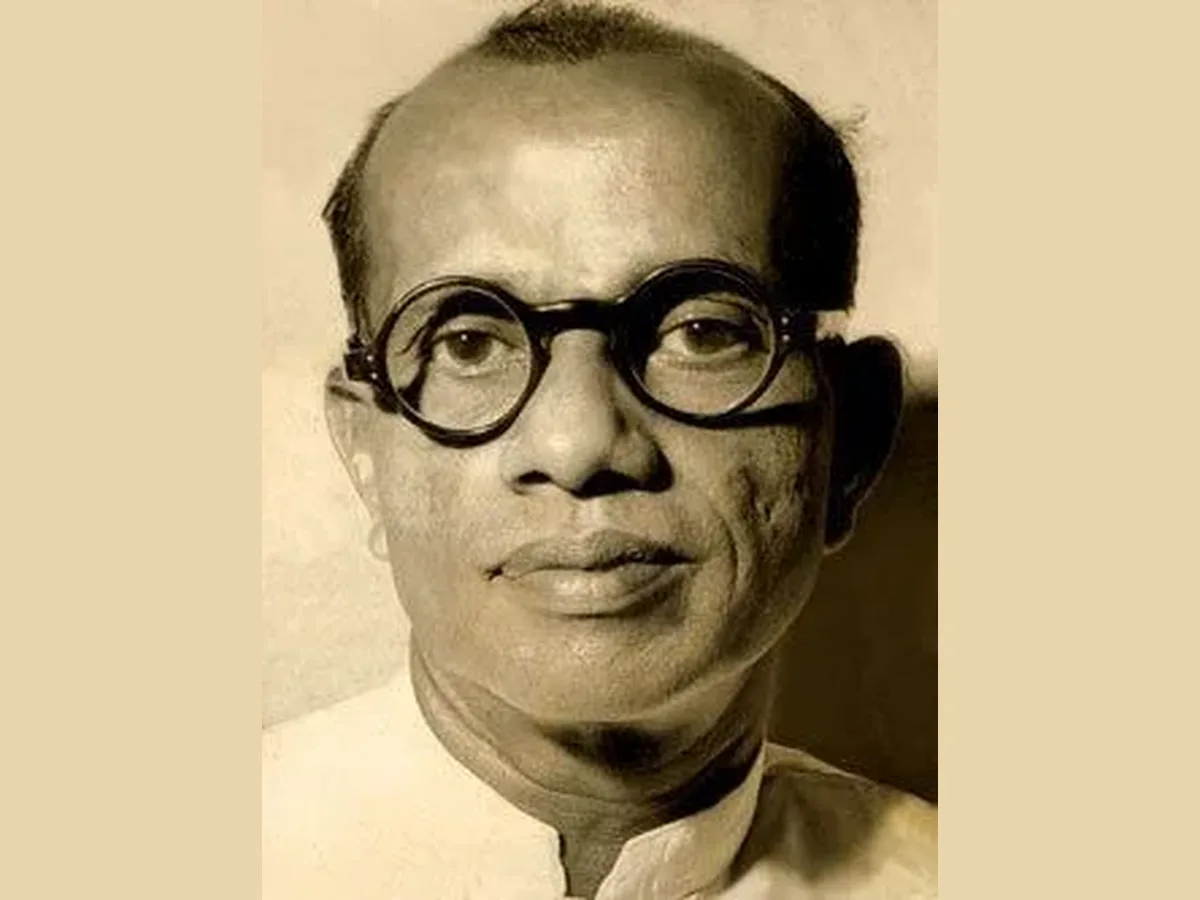
Kalalelle Ananda Sagara
He was born Palansuriya Mohottalalage Dingiri Mahaththaya on 11 March 1908 at Kalalella, in the Ratnapura district. He went to the village school at Madampagama, entered the Sangha as Ven. Kalalelle Pemananda, and studied Sinhala, literature, sociology, politics and several eastern languages at the Vidyalankara Pirivena — the institution that later became the University of Kelaniya. He also travelled to Santiniketan, Rabindranath Tagore's school in Bengal, which by the late 1930s had become a standard destination for ambitious Ceylonese artists.
In robes he took the name Kalalelle Ananda Sagara, and from its initials — K.A.S. — came the pen name he used for the rest of his life: කේයස් Kayes. He later disrobed, reverted to lay life as Sagara Palansuriya, and taught at Ananda College and at Nalanda College in Colombo.
Sources do not entirely agree on when he was born. English and Sinhala Wikipedia both give 11 March 1908; Garrett Field's study of the period gives his dates as 1910–61. The 1908 date has two sources behind it and is used here, but the disagreement is real.
Enoch Arden in a Sinhala village
The 1940s were the decade of the Sinhala narrative poem. Prof. Ananda Guruge, surveying the period afterwards, was blunt about the scale of it: everyone who could write a verse tried to write a narrative poem, and "in no other field had so many people tried to write when they had nothing to write about". Out of that flood he named a handful of genuine poems — and put Kayes's Sudo Sudu first on the list.
Palansuriya took the plot from Alfred Tennyson's Enoch Arden (1864) and rebuilt it, in 136 quatrains, as something a Sinhala villager could recognise. Tennyson's port with red roofs and a mouldering church becomes Katuroda, a village of paddy and high ground with a river running through it and a kada mandiya, the marketplace that traditionally sat on the boundary. Annie Lee, prettiest girl in the port, becomes හීන් මැණිකේ Hin Manike. The rich miller's son becomes Tikiri Banda, son of the village headman. The sailor's boy becomes Adiri, a farmer's son.
The rest follows Tennyson closely and diverges exactly where Ceylon diverged from Victorian England. Enoch breaks a limb; Adiri catches malaria. Annie's third child is sickly; Hin Manike's child is born blind. Enoch sails for China; Adiri sails to fight in the Second World War, and the letter that comes back is posted from Singapore, saying he has been shot and lost a hand — a detail that would have landed hard on readers who had followed the fall of Singapore in 1942. Then the letters stop. Her love for him, the poem says, is as certain as the full moon that rises each Poya day.
The dialogue is where the transplant really works. When Adiri comes to ask Hin Manike's mother for her daughter, the old woman greets him with ayubovan and then with arumakke — village slang for "well, it's been a while" — and the scene stops being a translation.
Palansuriya's ending is his own too, and it drew the one serious criticism the poem attracts. Tennyson ends with a village funeral for a brave heroic man. Sudo Sudu ends with Hin Manike, Tikiri Banda and the blind boy going out every evening to light a lamp at Adiri's gravestone in the corner of the garden. The critic Ariya Rajakaruna, who praised the poem's colloquial language, thought the closing image more Protestant than Buddhist: Sinhala Buddhist villagers do not offer flowers at graves.
What else he wrote
The verse collections are listed in Sinhala sources under both his names: මල්හාමි Mal Hamy, Visivuna Taru ("Scattered Stars"), Kalakanniya, Kelani Viththi, Kande Gedara, Pilaruwa, Ape Aththange Viththi, Uthuren Kavi Panthiya and a ධීවර ගීතය Dhivara Geethaya, a fisherman's song. Mal Hamy and Sudo Sudu are the two on which his reputation rests.
A caution for anyone searching a lyrics database: the well-known song Sudo Sudu Dethola Madhu, from the 2016 film Paththini, shares this poem's title and nothing else. Its words are by Sunil Ariyaratne, its music by Rohana Weerasinghe.
Vagathuga, and the seat for Horana
In October 1947 the Times of Ceylon group launched Lankadipa as an evening paper, with Julius de Lanerolle as editor-in-chief and D. B. Dhanapala — who had a gift for spotting writers — as his deputy. On 17 November 1947 the paper began a daily column of social, political and economic commentary called Vagathuga, and the poet they gave it to was Sagara Palansuriya. He held it for about a fortnight before handing it on to Chandraratne Manawasinghe, who then wrote it without a break until September 1964. Two weeks is a short tenure, but the column he started ran for seventeen years and became one of the most-read things in Sinhala journalism.
He entered politics in 1947, joining Philip Gunawardena's Viplavakari Lanka Sama Samaja Party, and in 1956 won the Horana seat as part of S. W. R. D. Bandaranaike's Mahajana Eksath Peramuna. He kept close ties with the Sama Samaja and Communist Party benches and spoke often about rural farmers. He left politics in 1960 in poor health and died on 22 June 1961.
What he left the song
Palansuriya is not a lyricist, and this article does not claim him as one. His name does not sit under many recorded songs. What he did was earlier and harder to see.
Sinhala radio song, when Radio Ceylon began building it in the 1950s, needed a language: a way of writing about ordinary people in ordinary Sinhala that was still shaped enough to sing. The Colombo poets of the 1940s built it, and Sudo Sudu is the clearest single demonstration of the method — a whole imported plot resettled in a Sinhala village, told in the words villagers actually used, with a scene invented from nothing when the story needed one. Every lyricist who later wrote a three-minute song about a woman waiting for someone who does not come back was working in an idiom this generation made.
When he died, one of his fellow Colombo poets, P. B. Alwis Perera, wrote a long memorial poem and simply called it Keyas. Its thirty-second stanza borrows a line of Tagore's: he is near to the heart of the Sinhalese as the meadow flower is to the earth.