
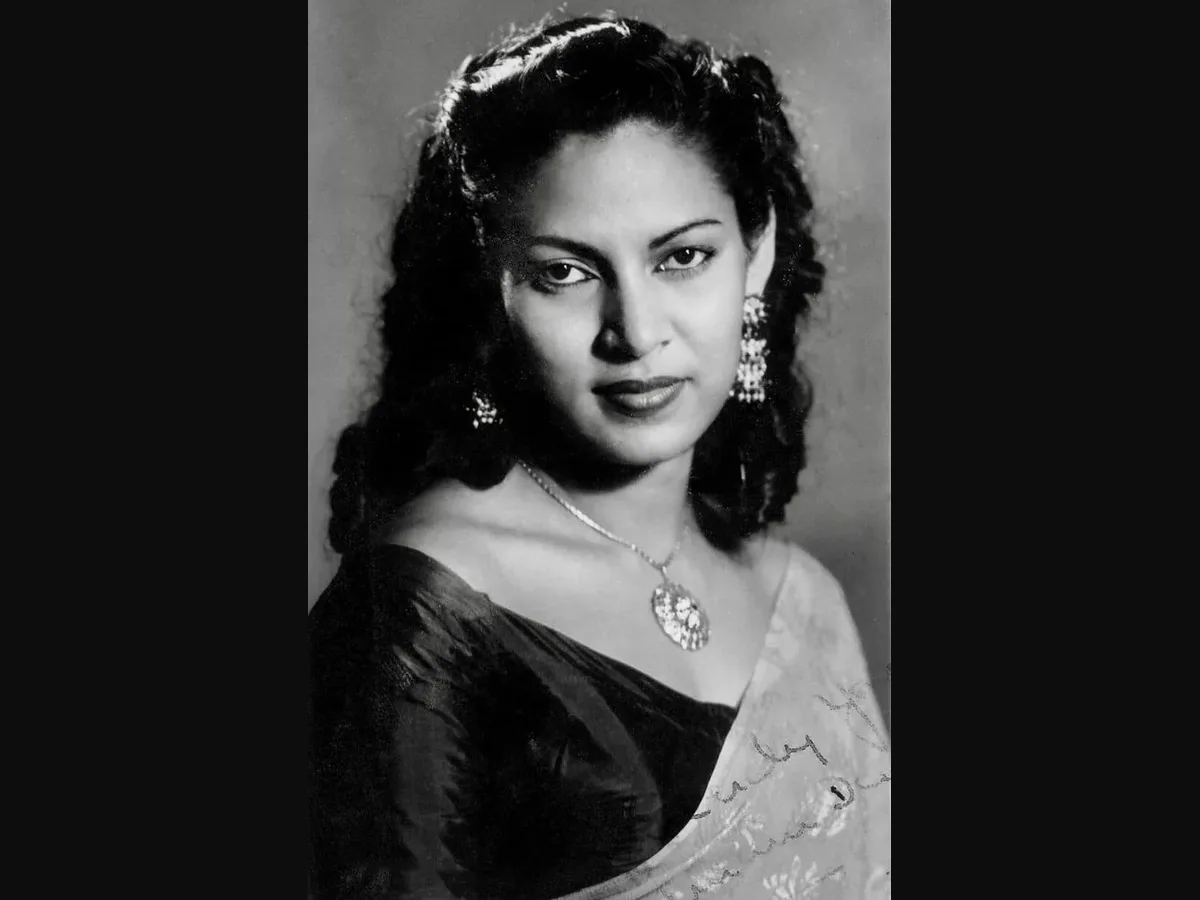
At about half past six on the morning of 28 October 1978, a van coming up the coast road from Matara ran into a petroleum bowser outside St Mary's Church at Thudella, near Ja-Ela. The woman in it had sung at an open-air show in Uyanwatte the night before and had driven through the dark to get home. She had already dropped her husband at their house and was on her way to see her parents in Negombo. She died at the scene, as did the driver. The next evening she had been due to stand on a stage in Colombo for a concert called Swarna Gee — "golden song" — marking forty years of her singing.
She had been born Daisy Rasammah Daniels, in the hills at Ramboda near Nuwara Eliya, on 15 January 1923, to a Tamil Colombo Chetty Christian family. Her father John Daniel worked on a plantation; her mother Helen Rose was a teacher. The country knew her as Rukmani Devi, the Nightingale of Sri Lanka, and the astonishing fact at the centre of her life is one that Sinhala-language profiles routinely leave out: the voice that defined the first era of Sinhala popular song belonged to a Tamil Christian woman who could not, at the start, read or write Sinhala at all.
A schoolgirl playing Sita
The family moved down to Colombo, and she was educated at St Matthew's School and then at St Clare's, Wellawatte. At seven she was singing Christmas carols. A part in a school nativity play, The Shoemaker's Wife, put her in front of a drama producer named Walter Abeysinghe, who went to her father for permission to cast her as Sita in his Ramayanaya. She was twelve when she performed it, in 1935, for the Sinhala Natya Sabha.
The stage took her immediately. Dick Dias cast her; Charles Dias cast her as Mayawathi; she played Juliet in a Sinhala adaptation of Romeo and Juliet. She acted in nurthi dramas — Janakiharanaya, Rohini, Mayawathi — the North Indian-derived musical theatre that was still, in the 1930s, the main school of Sinhala popular singing.
Cargills, HMV and a shellac disc
The record business in Ceylon ran through the colonial import houses. Cargills of Fort was the local agent for His Master's Voice, and Gabriel Gunaratne handled its recording. In October 1938 Gunaratne introduced her to the musician H. W. Rupasinghe — Rupasinghe Master — who heard her sing and put her on a record. The song was සිරි බුද්ධගයා විහාරේ Siri Buddhagaya Vihare, a devotional number sung with Rupasinghe himself, cut for HMV as matrix N-9300 and issued by Cargills the following year. Accounts differ on her age at the session: most give 1938 and fifteen, while at least one profile says she was thirteen. No source calls it a first for a Sinhala woman, and this article does not either — it is simply the earliest well-documented recording by one.
Somewhere in these years Daisy Daniels became Rukmani Devi. Who gave her the name is genuinely disputed: some accounts credit Rupasinghe Master, others Jayantha Weerasekara and Michael Sannas Liyanage.
Joining Rupasinghe's band as a regular singer meant facing three problems at once. She had no formal Hindustani training, and her competition — Lakshmi Bai, Annie Boteju, Susila Jayasinghe — did. And she could not read Sinhala, so she wrote her lyrics out phonetically in English letters and sang from that. She learned the classical idiom on the job, from the songs themselves. Between 1938 and 1945 she recorded forty-four sides for HMV, many of them Sinhala settings of Hindi and Bengali devotional models, in the manner of the Indian bhajan singer Juthika Roy.
The first face on the screen
On 21 January 1947 the first Sinhala feature film opened. Kadawunu Poronduwa ("broken promise") was B. A. W. Jayamanne's adaptation of his own Minerva Dramatic Club stage play, and Rukmani Devi played Ranjani — which makes her the first star of Sinhala cinema, and put her singing voice into the first Sinhala talkie. She had by then married Eddie Jayamanne, the dramatist, comic actor and singer she had met in the Minerva company; they lived at a house called "Jaya Ruk" at Angurukaramulla in Negombo.
For the next three decades she was simply in Sinhala films — a reference work cited on her Wikipedia entry counts ninety-nine of them between 1947 and Ara Soyza in 1984, with roles still appearing after her death. In Umathu Vishwasaya she played a double role, said to be the first Sri Lankan actress to do so. She won best actress at the Lankadipa Deepasika awards in 1956 for Kele Handa, and topped a readers' poll in the Dinamina in 1955 with more than sixteen thousand votes. In 1953 she came first in the popular-singing category of the radio artists' grading test.
The songs are where she survives. Sandyave Sriya came from Kadawunu Poronduwa itself; මැවිලා පෙනේවි Mawila Penewi and අන්න සුදෝ Anna Sudo from Kele Handa; Adarayai Karunawai from Daiva Yogaya; පෙම් සිහින ලෝකේ මායා Pem Sihina Loke Maya from Mathabhedaya; දොයි දොයිය පුතා Doi Doiya Putha, a lullaby from Ahasin Polawata, which took the best playback singing award at the first Presidential film awards in 1976. She sang with everyone: Mohideen Baig, Dharmadasa Walpola, H. R. Jothipala, J. A. Milton Perera, Sujatha Attanayake, and, in 1975, පෙම් රජ දහනේ Pem Rajadahane with Milton Mallawarachchi, three decades her junior.
Calypso at forty
The unlikeliest turn came in the mid-1960s, when a woman who had begun on shellac singing devotional bhajans joined a calypso group. Los Caballeros, led by Neville Fernando, were putting Latin American guitar rhythms under Sinhala words, and with them she recorded මල්බර හිමිදිරියේ Malbara Himidiriye, මැණිකේ ඔබේ සිනාවේ Manike Obe Sinahawe and සඳක් නැගී Sandak Nagi. The gramophone voice of the 1930s had walked into the beat-group era without missing a step, and those recordings are still played.
Contemporaries who worked with her tend to describe the same person: unhurried, patient with beginners, unimpressed by her own fame. In 1956 she published an autobiography, Mage Jeewana Withthi ("the facts of my life"). She was awarded the Sarasaviya Rana Thisara lifetime achievement award posthumously in 1979.
Afterwards
Sri Lanka took her death hard, and kept taking it hard. A statue went up at Kanuwana Junction. President Ranasinghe Premadasa renamed the road past the Rukmani Devi Museum in Negombo as Rukmani Devi Mawatha, on the anniversary of her death in 1990. Tissa Abeysekara made a documentary about her, Rupa Chaya, for the Government Film Unit. The second-generation Toyota HiAce is still called the Rukmani model in Sri Lanka, because that is what she was travelling in.
The strangest coda came in August 2011, when a statue of her that a fan had erected on her grave in Negombo was removed. A former mayor and MP was arrested over it, and a protest rally was held in the town two days later. Some of the reporting at the time described it as an attack by unknown vandals; the arrest record says otherwise. What is not in dispute is that thirty-three years after her death, people in Negombo were still willing to march for her.