
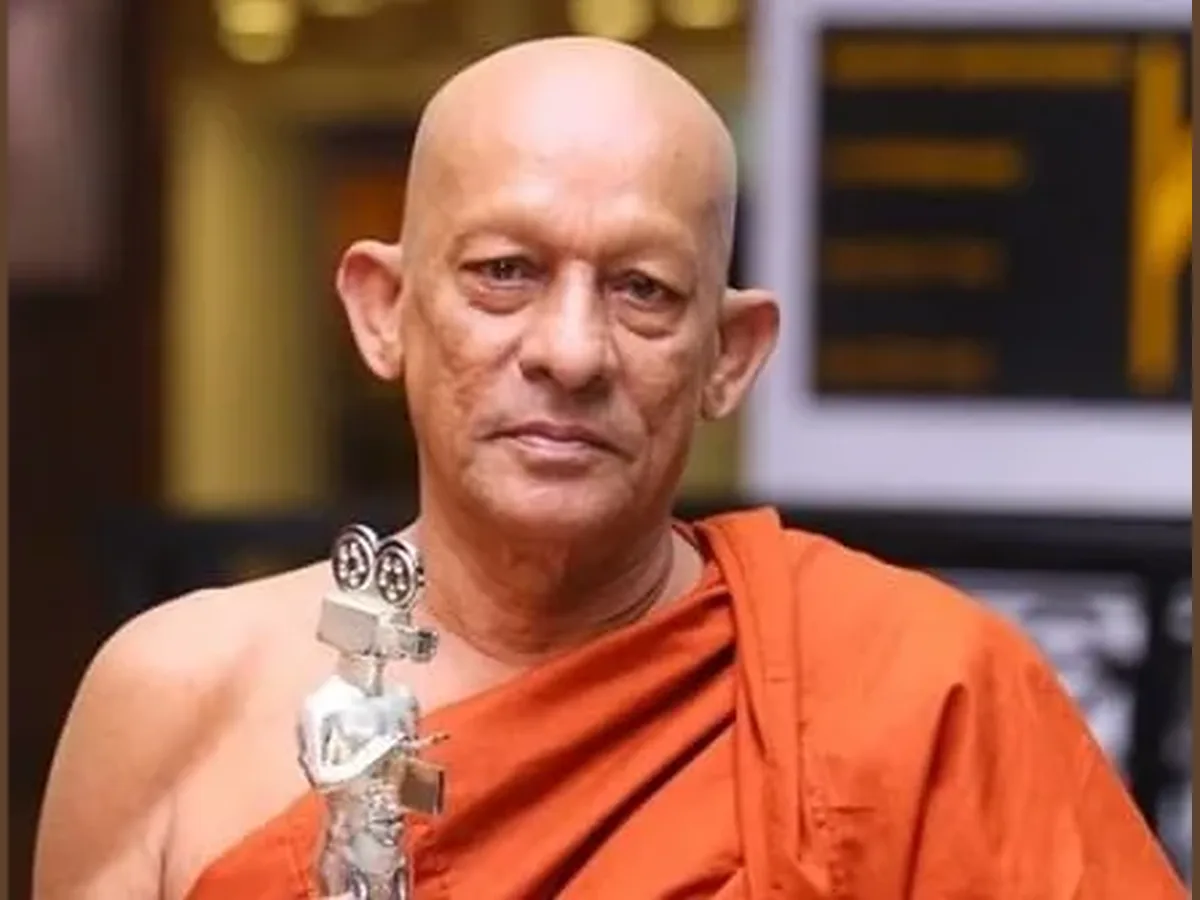
Of all the songs written by a Buddhist monk in Sri Lanka, the one that startles you is not a devotional. It is four lines that T. M. Jayaratne sings, and it goes roughly like this: You people, used to the sun and the rain — it was your two hands that built the countries. And when those people die, tell me: over which palace does the white flag go up?
The song is අව්වට වැස්සට හුරු මිනිසුන්නේ Awwata Wassata Huru Minisunne, and it was written by a bhikkhu who spent fifty years doing a thing almost no other member of the Sangha has done: writing popular song lyrics, professionally, for the singers of his time.
Ananda Liyanage of Rambukana
He was born Ananda Liyanage on 22 May 1950, on a Vesak full-moon poya day, in the village of Rambukana in the Morawak Korale of the Matara District, up near Deniyaya in the wet hill country of the deep south. His parents were Liyanage Simon and Sobana Hami, and he was the eldest of six.
On 22 July 1963, at the age of thirteen, he entered the order at the Gangathilaka Viharaya in Weliwa and took the name by which the country would know him. He was educated at the Hetthachala Pirivena in Galle and the Sunethradevi Pirivena at Papiliyana, and went on to a special degree in Buddhist philosophy from the University of Kelaniya. He received higher ordination in 1972 in the uposatha hall of the Malwatu Vihara in Kandy. For much of his working life he was the registrar in charge of English and mass-communication studies at Sri Jinaratana Technical College, and he travelled to Japan, Korea and Burma on Dhamma work.
That is a perfectly ordinary scholarly monk's career. The unusual part ran alongside it.
Song as a Dhamma medium
His first radio sarala gee was written in 1976 for Dayaratne Ranatunga — "Kalpa Kala Gatha Wana Thuru." Ten years later came his first collected volume of lyrics, and in 1987 the cassette Sansare Api, which is where most accounts date the start of his public career. (Sources differ slightly: the fullest biographical note gives 1986 for the anthology and 1987 for the cassette, and the reference books tend to record only one of the two.) Sansare Api was followed by Gammane Api, Samanala Kanda, Sansare Gee Yathika, Budu Ama Wessa and Sansara Charika, and by the award-winning lyric anthology Sasara Danavva.
His own explanation of what he was doing was straightforward. Song was a transmission medium, and he was using it to teach the parts of the Dhamma a person has to understand inside the reality of an ordinary life. That is not a small claim to make from inside the robes, and it took him into rooms — recording studios, cassette launches, film-award ceremonies — where monks do not usually go.
The songs
The list of singers who recorded his words reads like a roll of the Sinhala art-song generation, and each of them got a different kind of lyric out of him.
Gunadasa Kapuge sang සද්ධර්ම මකරන්ද Saddharma Makaranda and පිහිටක් නැති සරණක් නැති Pihitak Nathi Saranak Nathi. Victor Rathnayake sang බුදු හාමුදුරුවෝ අපිත් දකින්නැති Budu Hamuduruwo Apith Dakinnathi — "the Buddha, whom we too will never see" — and කඳුළු පැන් කෙණ්ඩියේ Kandulu Pen Kendiye. Malani Bulathsinhala sang හිමි සනරාමර Himi Sanaramara and සෙනෙහස පුදා අම්මාවරුන් වගේ Senehasa Puda Ammawarun Wage, and Premasiri Khemadasa set පිපෙනා මලකට Pipena Malakata for her.
Edward Jayakody had the largest share: මේ ඉර හඳ යට Me Ira Handa Yata, "under this sun and moon"; බණ කියන රටක් Bana Kiyana Ratak, "a country that preaches, a country that listens"; නුඹට හිතැති නුඹ හිත නැති Nubata Hithathi Nuba Hitha Nathi. With Charitha Priyadarshani Peiris he sang පන්සලේ පල්ලියේ Pansale Palliye — "in the temple, in the church" — and with Bulathsinhala, බුදු බණ කිව්වා Budu Bana Kiwwa. T. M. Jayaratne sang සියක් ආයු ලැබ Siyak Ayu Laba as well as the labourers' song. Karunarathna Divulgane recorded what is probably the single best-known of them all, ලා දළු බෝපත් La Dalu Bopath, the young bo leaves — a song so quietly written that people describe listening to it as a kind of cooling.
Others followed: Niranjala Sarojini's අනුරාධපුරේ අනුරාව නැගූ Anuradhapure Anurawa Nagu, Abeywardana Balasuriya's මලක මෙලෙක සිතාගන්න Malaka Meleka Sithaganna, and the Athula Adhikari and Samitha Mudunkotuwa duet සඳ තරු මල් Sanda Tharu Mal, set by Rohana Weerasinghe, which the Lanka News Web appreciation of him describes as one of the songs he built out of an episode of lay life rather than out of scripture.
Cinema
Two film songs brought him the awards he is formally credited with. පෙර සංසාරේ Pera Sansare, written for the film Sandakadapahana, won a Sarasaviya award. Much later, සැඩ පහරක් සේ එකමුතු වූ දා Seda Paharak Se Ekamuthu Wu Da — "the day we came together like a flood in spate" — sung by Samantha Perera for Chathra Weeraman's Aloko Udapadi, won a Derana cinema award. He also served for a period as chairman of the Sri Lanka Arts Council.
In November 2016 a tribute concert built around his lyrics, Sasara Danavva, was held in Colombo. The Sri Lankan entertainment press reported afterwards that it was the last public occasion W. D. Amaradeva attended before his death a few days later — the senior figure of Sinhala song, in the audience for the work of a monk who wrote songs.
Last years
Rambukana Siddhartha Thero died on the afternoon of 18 August 2026, while under treatment at the Sri Jayewardenepura Hospital. He was seventy-six. His remains lay at the Sudharmarama Viharaya in Wellawatte, and the funeral rites were held on 21 August at the Saranankara grounds in Dehiwala.
His name is spelled several ways even in Sinhala — රඹුකන and රඹුක්කන both appear in print, and this site's own lyrics database carries the doubled form — which is a fair sign of how little settled scholarly attention a lyricist gets, however many of his lines a country can sing. There is no biography of him in English and no English Wikipedia article. What there is, and what will outlast the spelling question, is a shelf of cassettes, a stack of Sarasaviya clippings, and the fact that for half a century one of the most reliable ways to hear the Dhamma on Sri Lankan radio was to wait for a love song to end and the next track to start.