
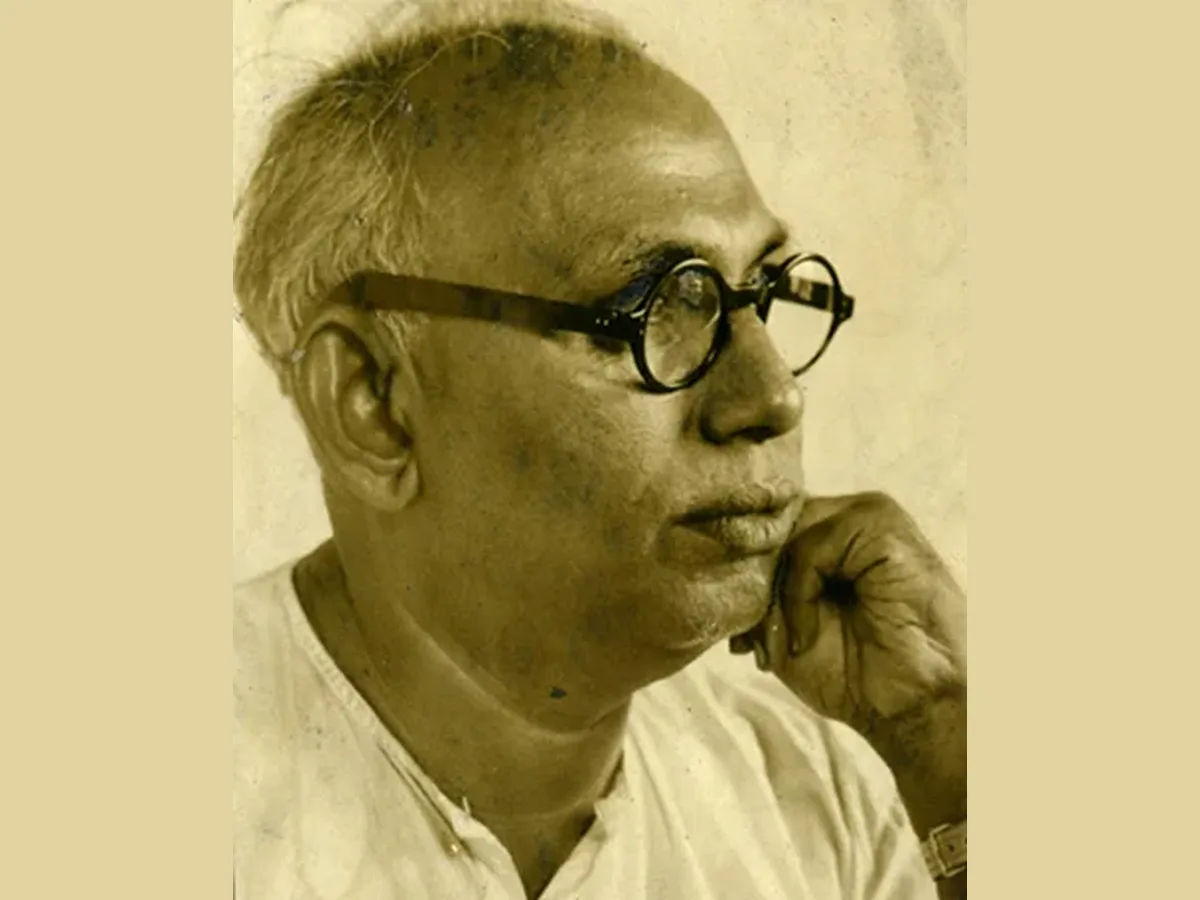
A bat and a drongo bird meet at dusk. The bird's husband is late home, so the two fall into conversation, and the bat begins to boast about his ancestors — one of whom, he says, lived in the garden of Sita's father, and was later exiled to south India, where a certain Rama and his brother Lakshmana happened to live. Over the next few hundred verses the bat retells the Ramayana with the Sri Lankan characters put right: Ravana is a great and protective king, his sister Surpanakha is a beautiful and friendly woman, and Rama and Lakshmana are the ones who behave badly.
The poem is called වවුලුව Vavuluva, "Bat Language". It was published in 1939 by a village schoolteacher from Negombo, and it was, among other things, an elaborate joke at the expense of a German professor.
The history master at Nittambuwa
He was born Tennakoon Arachchige Don Raphael on 19 December 1899 at Ganepola Walallavita, in the Negombo district, the youngest of a large family. His mother died while he was an infant and his sisters brought him up. He was schooled at the Raddoluwa Buddhist School, learned Sanskrit, Pali and English from monks and a local notary, and stayed on at his own school as a pupil-teacher.
Then, in 1927, Kumaratunga Munidasa was appointed principal of the teacher training college at Nittambuwa, where Tennakoon taught history and geography. The two men became friends, and the friendship redirected the rest of Tennakoon's life. He read Kumaratunga's Virit Vakiya, the 1938 treatise on Sinhala poetic metre, and set about composing in the metres it prescribed. Within two years he had finished eleven long metrical poems, four of them running past a thousand quatrains each. Kumaratunga, impressed, published three of them in Ruvan Vala, the book series he reserved for members of his circle.
That circle became the Hela Havula, the Pure Sinhala Fraternity, founded in 1941 to reform modern Sinhala back toward the language of the island's twelfth- to seventeenth-century literature. Tennakoon joined in 1942, and after the death of Jayantha Weerasekera in June 1949 he led it — remaining its head until his own death sixteen years later. A 1941 issue of Kumaratunga's journal Subasa printed a group photograph captioned "Developers of the native language": Tennakoon top left, and among the others a young man then called Aryasena Anshuboda, who would later rename himself Arisen Ahubudu.
Why a bat
Vavuluva had a second target, and it is the reason the poem is remembered as an argument rather than a fable.
Since 1926 the Royal Asiatic Society had been compiling a Sinhala dictionary under the chief editorship of Sir D. B. Jayatilake, with the German philologist Wilhelm Geiger as its guiding scholar. By 1935 only part one of volume one had appeared. Kumaratunga, who had offered to finish the whole thing in two years and been passed over, published thirteen sardonic letters attacking Geiger's A Grammar of the Sinhala Language (1938) and the young discipline of comparative philology behind it.
Tennakoon's contribution was the poem. The very title is the joke: he took vavula, bat, and bolted on the suffix -uva from eluva, the word for pure or ancient Sinhala — so "Bat Language", a scholarly tongue that is neither one thing nor the other. Kumaratunga liked it enough to write a long introduction analysing its aesthetics, and to claim that in English translation it could win a Nobel Prize. Sources differ on the poem's length: Garrett Field, who has studied it most closely, counts 551 quatrains, while other accounts give 557.
The Hela poets wrote unlike anyone else. Their Sinhala was deliberately archaic to the point of being cryptic; they preferred gi metres, quatrains of uneven syllabic weight taken from classical works like the Kavsilumina, over the even sivpada the Colombo poets used; and they appended full scholarly commentaries to their own poems, because without them a reader would miss half the allusions. It was poetry with a footnote apparatus and a grievance.
The curse, and the song
Tennakoon's second long poem, හැවිල්ල Havilla — "the curse" — appeared in 1940 and satirised fanatical religious practice. Its second chapter tells of a poor village woman whose hens are stolen, leaving her without a living. She walks to Kataragama and asks the god to destroy the thief.
Sometime around 1952, Sunil Santha set that chapter to music as දුදන් ඔද බිඳ Dudan'oda Binda — a title Field renders "Kill this cruel creep". Tennakoon had built the verse on a metre that swings between six and twelve matra and packed it with the hard Sinhala letter da, and Santha wrote three-note melodic figures to match the three da sounds per line. W. D. Amaradeva later said that Santha had turned the poem into a song of the highest order precisely because he put the sounds of a village into it — cursing, pleading, crying — instead of the ornamented Hindustani manner then expected of a trained singer.
The timing mattered. In April 1952 Radio Ceylon brought back the North Indian musicologist S. N. Ratanjankar to audition and grade Sinhalese musicians. Santha boycotted the auditions and gave up his A grade, writing in Lankadipa that he did not see why a foreigner should be imported to tell Sri Lankans how to make a national music "just because we brought a German to advise us on the Sinhala language" — which is to say, he restated Tennakoon's joke as policy. Dudan'oda Binda is the clearest single case in Sinhala music of a Hela poem crossing into song, and of a song carrying an argument about who gets to define the nation's music.
Mahakavi
In 1954 D. B. Dhanapala, editor of Lankadeepa, and his deputy Mahanama Dissanayake announced a competition to find a national maha kaviya, a great poet, who could write the history of the Sinhala people in verse for the 2,500th anniversary of the Buddhist era. Tennakoon won it, and with it the commission: 2,500 verses running from the arrival of Prince Vijaya to the premiership of Sir John Kotelawala. The result, සිංහල වංසය Sinhala Vansaya, was published in 1956 and won state awards. Kumaratunga had already given him the title Kiwisuru; the anniversary gave him Mahakavi.
He kept writing in every direction: the satires සක් පුබුදුව Sak Pubuduva, Ruppe Andaraya and Pasamandora Andaraya; the prose works Kavuduva (1954) and Bas Para; criticism under the titles Ape Kavi and Ape Asun Kavi; commentaries on the Guttila and on the classical sandesha poems; and histories of Anuradhapura and of the Portuguese period. The Sinhala Wikipedia repeats a claim that by his death he had written more than 25,000 verses — a figure worth treating as tradition rather than a count.
Two spellings, and one date that cannot be right
His name appears in the Sri Lankan press in two forms, රැයිපියල් තෙන්නකෝන් and රැයිපියෙල් තෙන්නකෝන්, and the Sinhala Wikipedia manages both — the article is titled with the second and written with the first. This site uses රැයිපියල්. In English he is also found as Rapiyel and as Raphael Tennekoon, the last being simply his baptismal name.
One date should be flagged plainly. The English Wikipedia article's infobox, its categories and every Sinhala source give his birth as 19 December 1899, but the body of that same article opens by saying he was born in 1918 — which would have made him twenty-one when Vavuluva appeared and nine when he met Kumaratunga at Nittambuwa. The 1918 figure is an error, and it is repeated often enough to be worth naming.
He was harried out of the headship of the training college, spent 1952 to 1957 as principal of the school at Gangodawila, and retired from school administration after that. He died on 8 March 1965 at Parakumdeniya, Gampaha. The Gangodawila school was renamed after him. In 2013 the house he had lived in was reopened as the Raphael Tennakoon Memorial Studio — a recording studio, which for a poet whose best-known lines reached most people as a song is a reasonable way to be remembered.