
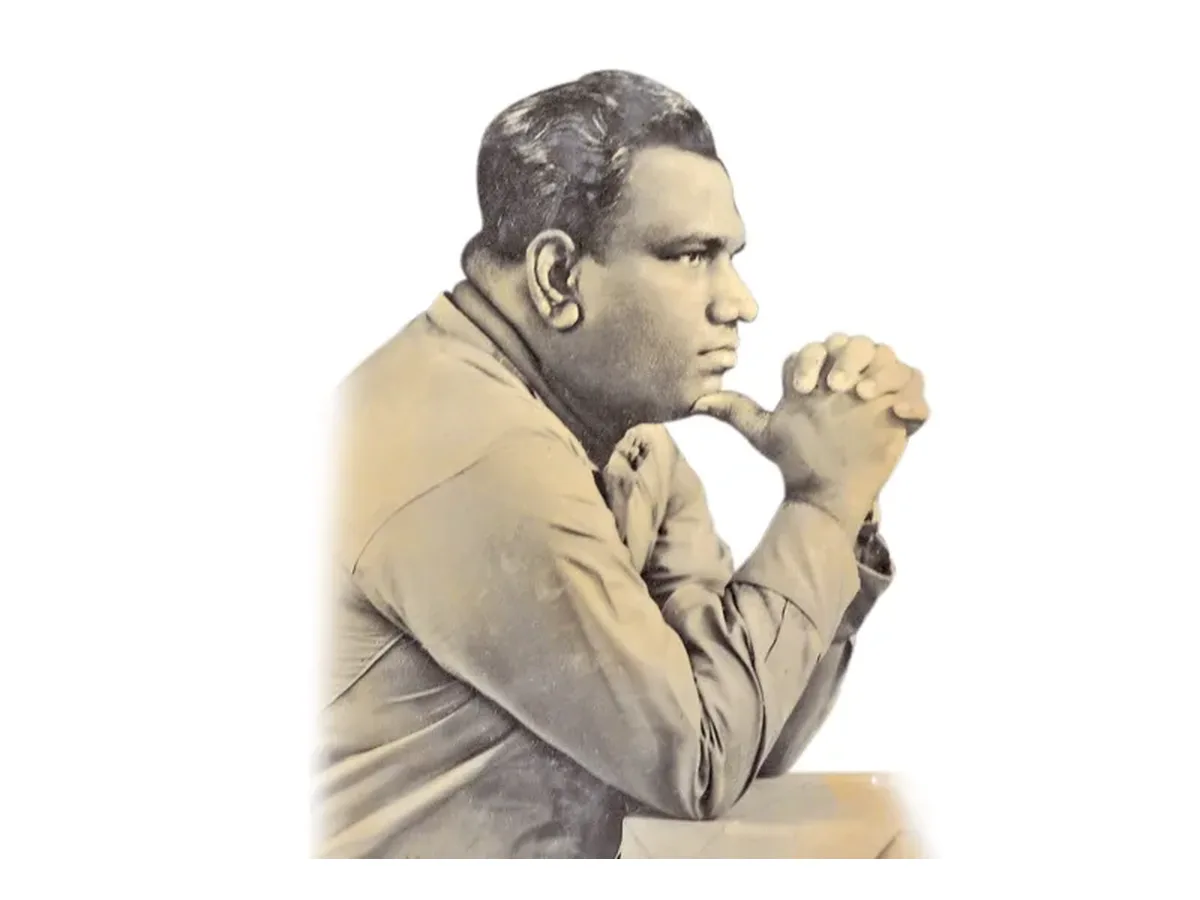
On the evening of 12 April 1935, seven young men were sitting under a tree in Victoria Park in Colombo — the park is called Viharamahadevi now — having the kind of conversation they had most evenings. This one turned into a decision. Sinhala poetry, they agreed, needed an organisation to push it, and they would start one and call it the Colombo Kavi Samajaya. The name changed within weeks to Aganuwara Tharuna Kavi Samajaya, the Colombo Young Poets' Association, shortened by everybody to ATHAKASA.
The oldest of them was in his twenties. The one recorded as their first president was eighteen years old and had left school in the fifth standard. His name was P. B. Alwis Perera.
No schooling to speak of
He was born on 3 March 1917 at Palliyawatte, Kollupitiya, the son of P. B. Jemis Perera. He went to a Wesleyan Methodist school and was afterwards admitted to St Anthony's, but family circumstances ended his education around the fifth standard, and he went out to work as a minor employee at a newspaper firm.
Everything he knew after that, he taught himself — language, literature, the arts — by reading. In 1944 a poem of his took first prize in a competition run by the Sinhalese Society of the University of Ceylon, an institution he had no chance of ever attending. From then on his poems appeared constantly in newspapers and journals, and he became editor-in-chief of the paper Heladiva.
Impromptu verse, and a room that would not sit down
ATHAKASA's programme was to promote the "Colombo School" of poetry — a manner that fused the older Matara and Kandy traditions but wrote in language deliberately simple, flowery and strictly metrical, and therefore readable by ordinary people rather than only by scholars. The society's own history, published by the Chitrananda Abeysekera Foundation, singles out one skill above the rest: its poets could compose හිටිවන කවි hitivana kavi, verse improvised on the spot on any subject given to them, in everyday speech. They took it round the island — to temple ceremonies, New Year festivals, village development society meetings — and it made ATHAKASA a household name.
Out of that grew the kavi maduwa, the poetry contest, and the story of how it began is told by the journalist D. S. S. Mayadunne. Alwis Perera had finished giving a lecture in a town about forty kilometres from Colombo when someone in the audience asked him to recite. He answered that he would if somebody first inspired him with an original poem. A young man who edited a local poetry journal stood up and recited one. Alwis Perera replied immediately in verse. Others joined in, and the argument in poetry ran on for about forty-five minutes. Within a few years kavi maduwas were being held in towns all over the country and could last a whole day.
Accounts differ on when exactly he led the society. The ATHAKASA history names him as president among the first office-bearers in 1935, with the Tibetan-born monk Ven. S. Mahinda as patron; a biographical sketch has him elected president later, after his magazine had made him famous. Both agree that the society was his.
Uk Dandu Dunna, 1942
His first book of poems, උක් දඬු දුන්න Uk Dandu Dunna — the sugarcane bow, which Garrett Field renders as "The Sugarcane Arrow" — appeared in 1942, and the scholar Garrett Field treats it as the book that opened the second generation of Colombo poetry. Its subject was romantic love, and that was the scandal. Sinhala classical verse had erotic love in it, but sentimental romantic love between young people, unattached to marriage, had barely appeared before; the previous generation of Colombo poets had used verse for Buddhism and moral instruction.
Alwis Perera opened the book by naming Rabindranath Tagore, whom he had read in English, and the debt is real — he translated poems from The Crescent Moon and Fruit Gathering into Sinhala. But Uk Dandu Dunna is not a Tagore imitation. It begins in full Sanskrit dress, with Kamadeva stringing a bow with honeybees and firing flower-arrows, and then abruptly a first-person narrator gets hit by one and the poem turns into feeling. It is also, by any standard, cheerfully vulgar: one scholar counted sixty-nine terms of endearment in it, and the poet compares his lover's pinky finger to a pencil, her breasts to Japanese paper balloons about to burst, and her thighs to jackfruit.
Martin Wickramasinghe described it as a panegyric inspired by Tagore, written to awaken feeling. Critics have called its love bolanda premaya, puerile love, and mocked its "sighing words". What is not in dispute is the effect: after 1942 a Sinhala poet could write about desire and romance as a popular entertainment, and readers bought poetry in numbers that now look impossible.
Dedunna, and the fight he lost
By 1950 four monthly poetry magazines published from Colombo were read across the whole country: Suwanda edited by Kapila E. Seneviratne, Meewadaya by John Rajadasa, Amba Vanaya by Sirisena Maitipe — and දේදුන්න Dedunna, "the rainbow", edited by P. B. Alwis Perera. His was the best-selling of them, and he was, in Mayadunne's phrase, the most formidable figure at the kavi maduwas.
Then the universities turned on him. In a 1950 English-language article the Peradeniya academic Siri Gunasinghe took Uk Dandu Dunna as his example of what was wrong with modern Sinhala verse: it was skilful, he allowed, but it detailed "an idealized world", and Alwis Perera had reduced poetry "to mere verbal music and sentimental weeping". "Whenever the facts of life stand up before him," Gunasinghe wrote, "he shrinks from them." Free verse followed, metrical poetry was declared worthless, and the popular poets — Alwis Perera loudest among them — fought back and lost.
Songs, and afterwards
His verse crossed into song. The children's song මල් කියන්නෙ කාට කාට Mal Kiyanne Kata Kata — "who are the flowers speaking to? To children, in colour after colour" — carries his lyric, set and sung by Nanda Malini; it turns a flower garden into a school, closed for the rainy season, whose pupils dress up in their holiday clothes to bloom. His other collections include Soba Dahama, Minipana, Budu Madura, Rantaliya, Vedanava, Ape Hatana and Miya Giya Kirilliya, and in 1961 he wrote Keyas, a long poem in memory of the poet Sagara Palansuriya.
He died on 31 August 1966, aged forty-nine. There is no Wikipedia article about him in English or in Sinhala. Sri Lanka did issue a commemorative postage stamp in his honour, one of four for poets of that generation, and ATHAKASA — still going — remembers him as its founder.