
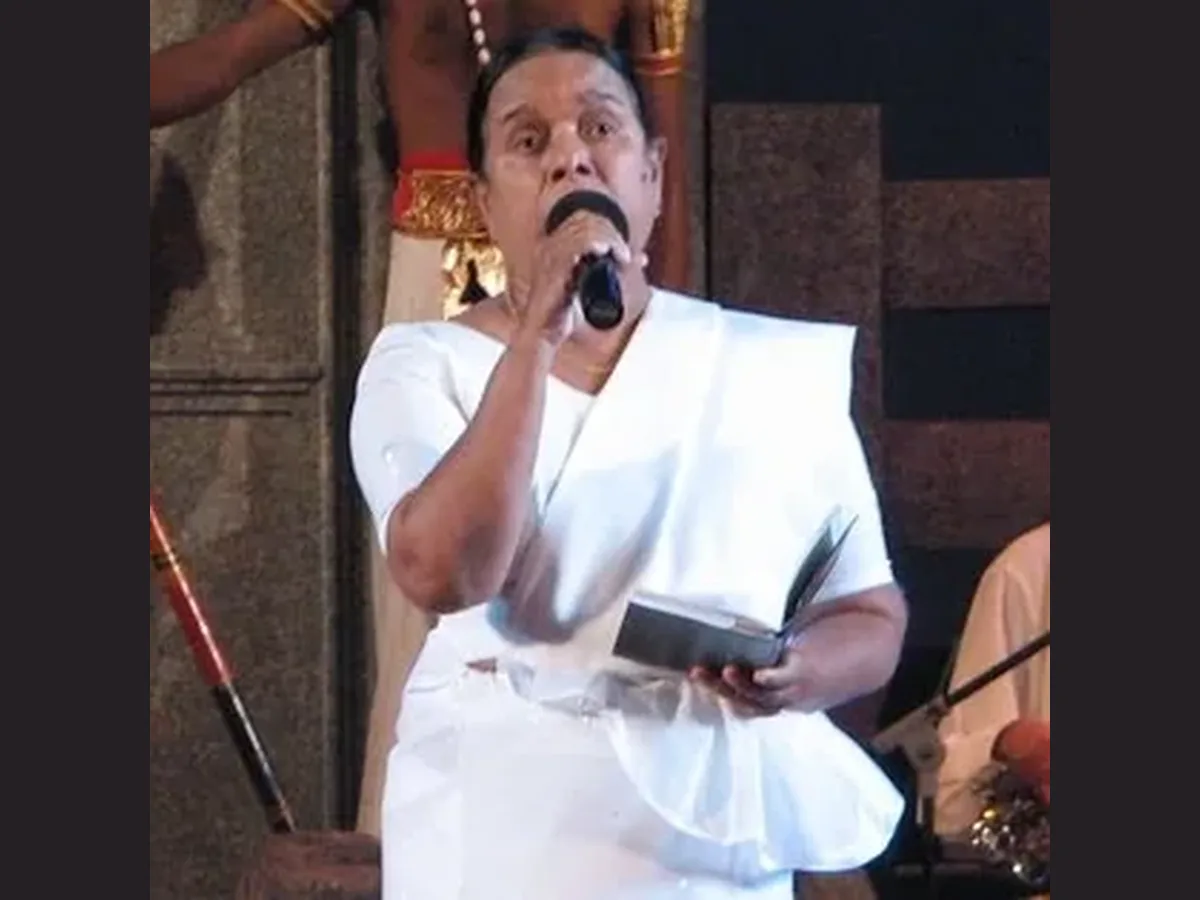
There is a line the critic Uditha Devapriya wrote about her that anyone who grew up in Sri Lanka will recognise as literal rather than lyrical: nearly every radio station played that voice every hour or so, and unless you switched the radio off, you could not escape it. For seven decades Nanda Malini was simply part of the sound of the country — first as the voice of tenderness and small domestic comedy, then, disconcertingly for many of her own listeners, as the voice of protest.
She died at her home in Nawala on 20 August 2026, aged 82, three days short of her eighty-third birthday. The government declared 21, 22 and 23 August days of national mourning. Her remains lay in state at the music academy she had founded, and her final rites were set for the afternoon of Saturday 22 August at the General Cemetery, Borella.
A gold medal at thirteen
Her full name was Mirihana Arachchige Nanda Malini Perera. She was born on 23 August 1943, the fourth child of nine in a family at Lewwanduwa in Aluthgama; her father, Vincent Perera, was a tailor, and her mother, Liyanage Emily Perera, kept the house. (Some reference works give Kotahena in Colombo as her birthplace; the fuller accounts, in both English and Sinhala, agree the family was from Aluthgama and that she came to Kotahena as an adolescent.) At Sri Gunananda Vidyalaya in Kotahena she came under a teacher named T. N. Margaret Perera, who seems to have been the first person to hear what the child could do.
In 1956 she won a gold medal at a padya gayana — verse-singing — competition at the Borella YMBA. The prize brought her to Radio Ceylon, where she sang බුදු සාදු Budu Sadu, written by Asoka Colombage and set by D. D. Danny, on Karunaratne Abeysekera's children's programme Lama Mandapaya. She was thirteen.
She kept studying long after she was famous: with B. Victor Perera, then a year at the Heywood Institute of Art, then the Bhatkhande Music Institute in Lucknow in 1963, and finally back to Heywood's successor for a Visharada degree in 1984, taken with a first-class distinction.
Galana Gagaki Jeewithe
In 1963 W. D. Amaradeva chose her to sing for Ranmuthu Duwa, the first Sinhala colour film. The song was ගලන ගඟකි ජීවිතේ Galana Gagaki Jeewithe ("life is a flowing river"), a duet with Narada Disasekara, and the first film lyric written by Chandraratne Manawasinghe. The film swept that year's Sarasaviya awards and she took Best Female Vocalist — the first of a very long run. Sources do not agree on the exact tally: the English accounts say eleven Sarasaviya and eight Presidential awards, the Sinhala ones twelve and ten. What is not in dispute is that she won in almost every decade she worked, from Ranmuthu Duwa in the 1960s to The Newspaper in 2020.
Amaradeva then brought her onto his radio programme Madhuvanthi, where she sang Sannaliyane and Ran Dahadiya Bindu Bindu. The songs of her first two decades are domestic, wry and closely observed: පිපුණු මලේ රුව Pipunu Male Ruwa, සුදු හාමිනේ Sudu Hamine, කඩ මණ්ඩියේ Kada Mandiye, and සාරි පොඩිත්තක් Sari Podiththak ("a little sari"), which is about a family trying to marry a daughter off and treats the whole ritual of suitor-visiting as gently ridiculous. Even at her sweetest there was an edge to the voice — a candour that made the later turn less of a break than it looked.
The concert years
Sri Lankan singers of her generation built their careers on concert series that ran for years, and hers were among the longest. In 1971 she appeared with Amaradeva in Shrawana Aradhana. In 1973 she began her first solo series, which ran 530 performances before ending on 22 May 1979. In August 1981 she began Sathyaye Geethaya ("the song of truth"), which ran 500 shows and closed in August 1984. In 1984 she founded a music academy, the Nanda Malini Ashram.
Her principal collaborator through the political work was the lyricist Sunil Ariyaratne. Their partnership began well before the famous material — Devapriya suggests their first was සකුරා මල් පිපිලා Sakura Mal Pipila, a song of gleeful impossibilities, cherry blossoms opening in the open air and lions sprouting wings, which he reports was kept off the air by the authorities for its perceived anti-establishment tilt.
Pavana
Then came Pavana, and here the record needs handling with care.
What is documented is this: a concert series called Pavana opened in June 1987 and ran 205 performances over eighteen months, with lyrics by Sunil Ariyaratne, straight through the years of the bheeshanaya — the period of insurrection, counter-insurgency and mass killing that closed the 1980s. Its songs are explicitly political in a way nothing else in Sinhala popular music has been before or since: යදමින් බැඳ විලංගුලා Yadamin Banda, Seethala Polawa, Upasakamma, Mongoliyanuwane. She performed them in a white sari, which several writers have noted as a deliberate incongruity — the singer of romance, dressed for respectability, singing revolt.
Two things about Pavana are commonly stated and should not be. The first is that sources do not actually agree on what it was: some describe it as an album of the mid-1980s, others as the 1987 concert series, and the Sinhala accounts list a Pavana song collection among her releases. Both descriptions circulate; neither can be dismissed.
The second is the ban. It is very widely written — in essays, tributes and reference articles alike — that the government banned Pavana cassettes outright and that anyone caught with one could be arrested. No gazette notice, court record or contemporaneous news report supporting that has been found. It should be treated as something the country believes rather than something the country has proved. A 2007 tribute in the Sunday Observer makes the narrower claim that her Pavana songs were kept off the state radio and television services; that is a claim about airtime, and a different order of thing from a criminal prohibition.
After
Pavana had no sequel, from her or anyone. She went back to the range she had always had — Buddhist devotional songs on the cassette Saadu Naada, children's songs on Handahami, and in 1990 Sindu Hodiya, sixteen songs written to teach small children the Sinhala alphabet. She sang in Tamil on Kunkuma Pottu in 1993. In 2010, after a gap of twenty-two years, she returned to the solo-concert format with Shwetha Rathriya.
In 2017 the University of the Visual and Performing Arts conferred on her an honorary doctorate — reported at the time as the first such recognition given to a woman artist by a Sri Lankan university. In 2004 a hybrid orchid had been named after her. She kept singing, and recording, and teaching at the ashram, until the end.