
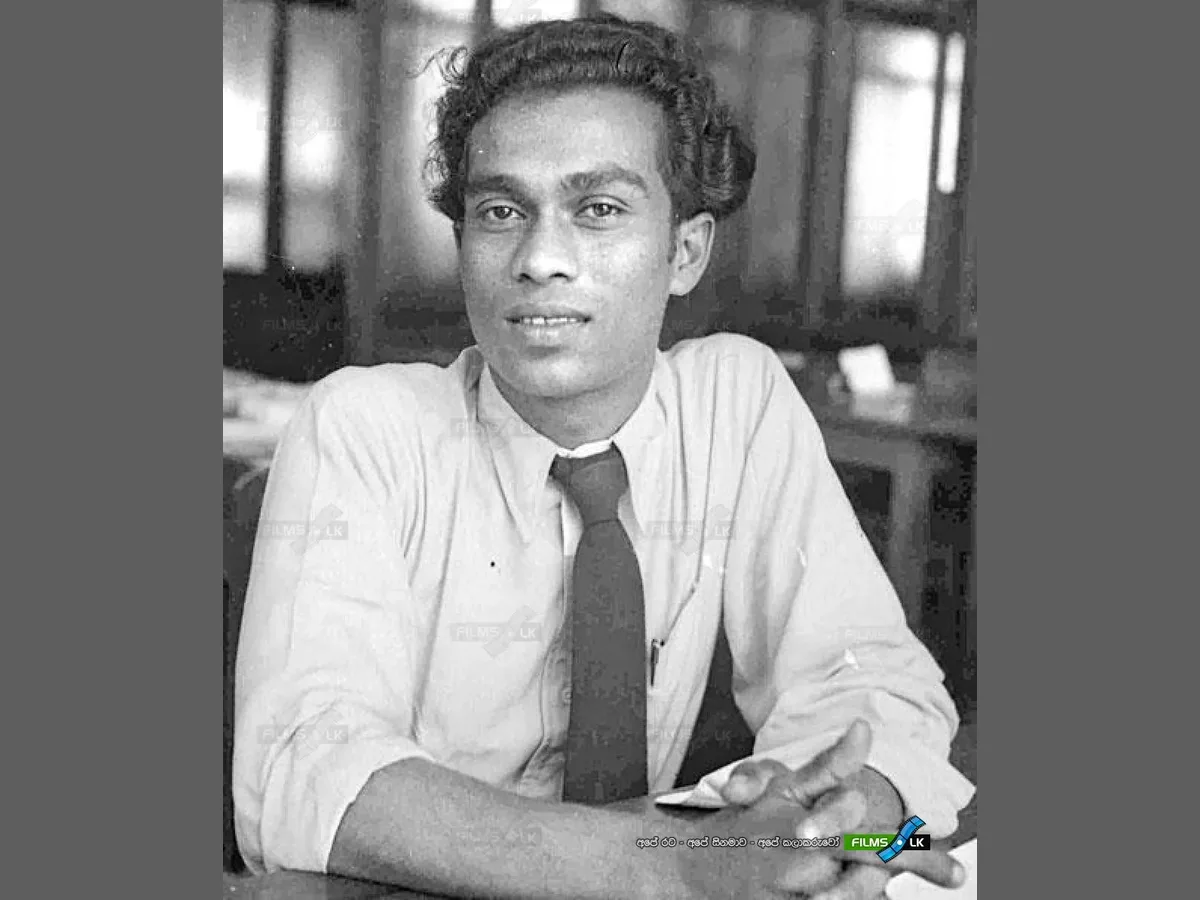
In 1961, in a pre-senior classroom, a fourteen-year-old boy started to cry. The class teacher was reading aloud from the prescribed poetry book, Naveena Padya Rachanaya, and had reached a poem called මියගිය දරුවෙක් Miyagiya Daruwek — "a dead child" — which he read half-chanted, to a rhythm, until the grief of it filled the room. The boy was thinking about his own brother, who had died when he was small. Fifty-seven years later he could still recite two of the verses from memory, and he wrote them out in Sarasaviya for the poet's centenary.
The poem was by Meemana Premathilake, who had written it after the death of his own infant son Saman. The anthology it sat in had been edited by Meemana Premathilake as well. That double presence — the poem in the schoolbook and the hand that chose what went into the schoolbook — is the shortest description of what he was.
A poet of the Colombo era
He was born Karunaratne Premathilake in the village of Meemana, near Horana, and took the village as his name. Sources disagree about the year: English Wikipedia and the scholar Garrett Field both give 20 September 1918, while the Sarasaviya centenary piece, published in September 2018, says 1919. His age at death is variously given as 46, 47 and 48, which follows from the same confusion.
He went to Taxila Central College in Horana, then to a pirivena, then to Ananda College in Colombo, already carrying a reputation as a poet. He failed the London Matriculation and gave up on higher study. In 1936 he joined Silumina as an amateur journalist under its chief editor, the novelist Martin Wickramasinghe, who gave his verse a place on the poetry page.
He belongs to what Sinhala criticism calls the Colombo era — the second generation of Colombo poets, alongside P. B. Alwis Perera, Sagara "Keyas" Palansuriya, Wimalaratna Kumaragama and John Rajadasa. These were the poets a whole generation of Sri Lankan schoolchildren learned by heart, and the ones people mean when they ask, as a Sunday Observer reviewer did in 2008, "where have those Colombo poets gone?"
The scandalous poems
The gentle, syllabus-friendly version of Premathilake is not the whole man, and it is worth being honest about that.
Through the 1940s and early 1950s he published six books of poetry about the passions of romance, several of them explicit by the standards of the day: Adaraya (Love, 1945), Anangaya (The Cupid), Rati Sagaraya (Ocean of lust) and the collection At Vu Premaya (The love that drifted away), followed by Pem Manik (Love gems, 1952). He translated E. Powys Mathers's Coloured Stars: Fifty Asiatic Love Lyrics and, in 1949, a Guy de Maupassant story he retitled Ananga Damanaya.
Garrett Field, whose 2017 study of Sinhala song and poetry gives Premathilake several pages, reads these as Sinhala poetry meeting the late-nineteenth-century French novel — Anatole France and Maupassant were circulating in English translation in wartime Colombo — and notes that they carry a distinctly moralising twist the French originals do not: the women in them are punished. Adaraya ends in suicide, Rati Sagaraya in a double murder. Field also suggests, drily, that some of the more lurid stanzas look written to sell books.
The reckoning came in 1962, when Ariya Rajakaruna's influential critical study Nutana Sinhala Kavyaya accused Premathilake of writing asliya — vulgar poetry — and of degrading the cultivated erotic mood of classical srngara rasa into something merely titillating. It is a landmark quarrel in modern Sinhala letters, and it happened three years before he died.
Gray, Goldsmith, Wordsworth, Shakespeare — in Sinhala
Alongside the scandalous work he did something more lasting. Premathilake systematically brought English poetry into Sinhala verse: Thomas Gray's Elegy Written in a Country Churchyard became සොහොන් බිම Sohon Bima in 1942; Shakespeare's Venus and Adonis became Yamuna; Romeo and Juliet was reworked in 1946 as Devani Adaraya; Oliver Goldsmith's The Deserted Village became Palugama in 1948, and Wordsworth's Michael became Kirihami in 1949.
That list matters more than it looks. The generation of Sinhala poets and lyricists who came up in the 1940s and 1950s met the English romantics in the classroom, and one of the routes by which those cadences entered Sinhala verse — and from there the Sinhala song lyric — runs through this man's translations. He also wrote Miyunu Ella, about a forest waterfall in Kukulu Korale, which the Sinhala press describes as the first Sinhala poem written about a natural beauty spot, and a run of poems about his own village under the title Palugama.
Silumina, and the founding of Sarasaviya
He was a newspaperman for thirty years and a difficult one. He resigned from Lake House in 1953 over what he saw as an injustice, went to Lankadeepa as deputy editor, resigned a second time, worked as a translator at the Department of Co-operative Development and the Ceylon Technical College — and came back. In 1961 he became editor-in-chief of Silumina, the country's largest Sinhala Sunday paper.
Then, in 1963, Ranjit Wijewardene decided Ceylon needed an arts newspaper and picked Premathilake to start it. The first issue of Sarasaviya appeared on 10 April 1963 with a print run reported at 50,000 copies. He handed the editorship over to his deputy Wimalasiri Perera within three months, and told Wijewardene, when asked, that Perera should have been given the top job earlier. In his memoir Mage Premaya, Kalawa saha Jeevithaya he wrote that although he sent the first manuscript to the compositors at the auspicious hour, it was Wimalasiri Perera who actually got Sarasaviya out. (English Wikipedia adds that Premathilake "was its editor for 14 years", which cannot be right: he died two years later.)
Why does an arts newspaper belong in a history of Sinhala song? Because Sarasaviya became the place where Sinhala films, and the songs inside them, were reviewed, argued over and eventually ranked — the paper of record for exactly the material this site is about, and the source, sixty years on, of a great deal of what can still be checked about singers, lyricists and composers who left no other trace. The columns he wrote in Silumina and Sarasaviya were where readers learned to talk about the moonstone, the Samadhi Buddha, Plato, Shakespeare and the Colombo poets in the same breath. In a literary culture where the standard test of a song lyric was whether it could stand up as poetry once the music was taken away, the taste being applied was the taste these pages had taught.
Last things
He was a startlingly unguarded writer for his time. Verse, he wrote in one column, was his wedded wife and prose his mistress — and, like Chekhov, he felt himself pulled towards the mistress. He wrote that concealing the truth was a sin and a curse, and that even covering the body was in some sense unnatural — sentences that read as provocations in the Ceylon of the early 1960s.
On 10 July 1965 he was admitted to Ratnam Hospital and lay in a coma for two days. He died on 12 July 1965 and was buried at Kanatte; one man who was in the crowd remembers the funeral as June. A series of poems he had written before falling ill, Atheetha Smarana, had appeared in Sarasaviya on 23 June, three weeks earlier. His wife Adeline, whom he married in 1942, outlived him by half a century and died in May 2015 at ninety-four. Three of his children went to work at Lake House, one of them, Sunil Madhava Premathilaka, onto the editorial board of the paper his father had edited.