
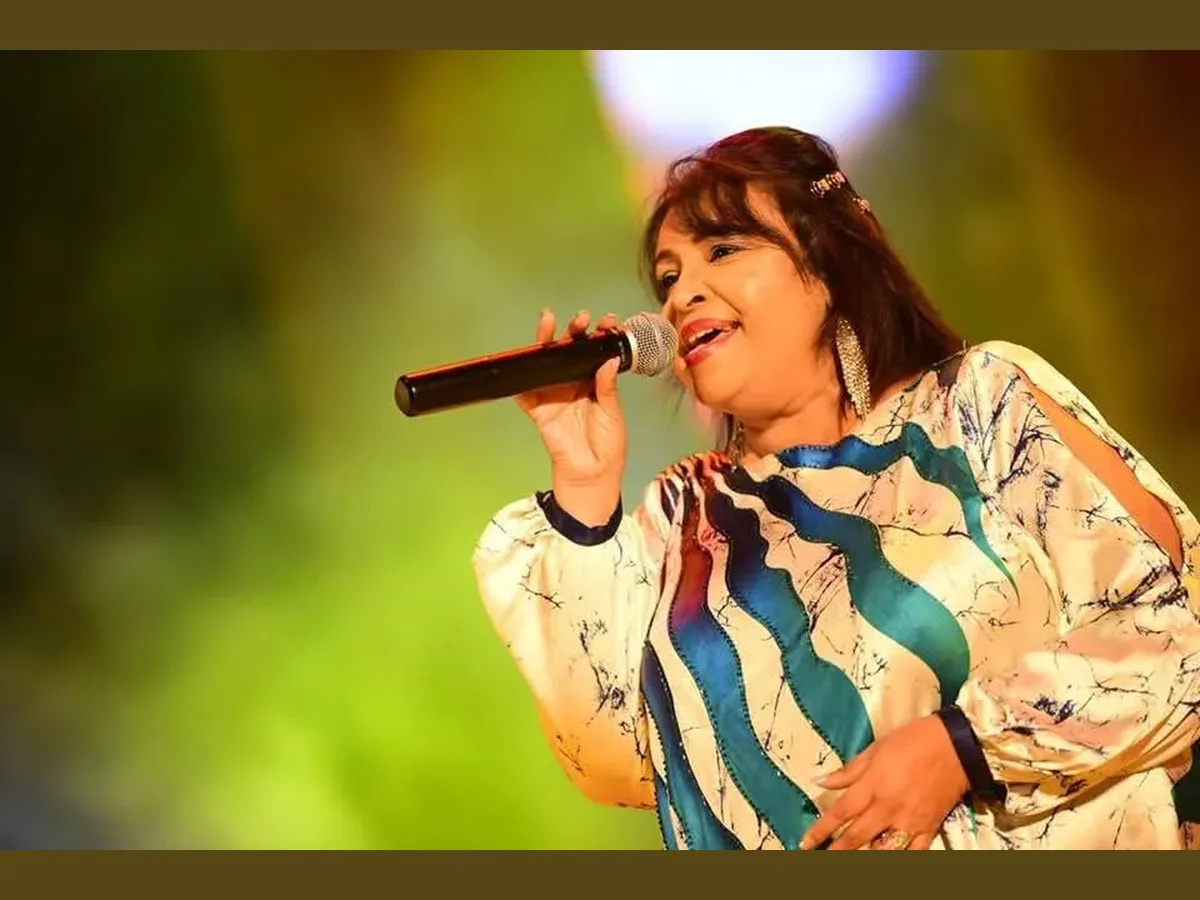
In 1970 the Sunday Observer previewed its own talent contest with a line about one of the entrants: "the little girl with the big voice and guitar higher than her". The paper predicted she would win the junior section. She did. Seven years later she made a record that the radio censors would not play, and it became the song she was named after for the rest of her life.
The little girl with the guitar higher than her
Mariazelle Goonetilleke was born on 11 June 1958 in Nugegoda, into a household that mixed Sinhala and Burgher families. Her parents argued about which language she should be schooled in and the argument was settled in favour of English, at St. Joseph's Convent, Nugegoda. She wanted to be a doctor. Her father, Rajah Wijebadra Gunetilleke, wanted her in music, and by his account she had been singing at house parties since the age of three.
Music in that house came out of a spool tape recorder and off the radio, which she stayed awake past her bedtime to listen to. A frequent visitor, Leonard Weerasinghe — the father of the musician Sohan Weerasinghe — taught her her first chords on the Hawaiian guitar, and at five she was singing Kumbaya and Ebony Eyes to it. His daughter Eranga taught her to harmonise. At seven she moved to the Spanish guitar and studied classical guitar under Winston Jayawardene; later she picked up drums and keyboards as well. She would remain, all her life, a working musician rather than only a singer.
Her first attempt at a competition failed: she could not place in the SLBC's Elasto Talent Competition. The Observer contest went the other way. Accounts differ on her age — English Wikipedia says ten, and the Sunday Observer's own 2026 retrospective says twelve, in 1970, which fits her birth year. Winning it put her into the Junior Rhythmiers, the pre-teen group whose Radio Ceylon appearances made child performers famous across the island, and later into working bands: the Emeralds, and Midnight Mist.
Kandy Lamissi
කැන්ඩි ළමිස්සී Kandy Lamissi, recorded in 1977 with Midnight Mist, was not like anything on Sinhala radio. Its lyric switched between Sinhala and English mid-line — "Singlish", as it came to be called — and the radio censor board's first response was to refuse it airtime for exactly that reason. The ban did not hold and did not matter. The song was an instant hit, it followed her everywhere, and she became "Kandy Lamissi" to a generation who never used her surname.
The same year almost ended everything. She was in a car accident in Nuwara Eliya that damaged her vertebrae and fractured her ribs, shoulder and forearm. Music fans were told she would never perform again. She credited her recovery to a school friend, Christine Nadarajah, and to community prayer, and she came out of hospital into the most productive stretch of her career — helped, as she always said, by a queue of people who wrote for her: Clarence Wijewardena, M. S. Fernando, Stanley Peiris, Ajantha Ranasinghe, Chandral Fonseka, and Sunil and Piyal Perera of the Gypsies.
The Clarence Wijewardena partnership, which the Sunday Observer dates to 1980, was the decisive one. He heard what she could do with harmony — she could blend her voice with almost any other singer's — and liked her guitar tone enough to use her on his recordings as a guitarist and second keyboard player rather than just a vocalist. Out of that came රහසයි සොඳුරු ජීවේ Rahasai Sonduru Jeewe and යොවුන් සිහින ලෝකේ Yowun Sihina Loke, and alongside them පහන් නොවන රැයක Pahan Nowana Reyaka, නෙළුම් මලේ පෙති කඩලා Nelum Male Pethi Kadala with M. S. Fernando, and කුමරාණනේ Kumaranane. She was an indispensable member of the group Madara, with whom she toured England, France and the United States, and in 1985 she moved into film playback with Chalitha Rangali, directed by Clarence Wijewardena.
The song her admirers most often single out is the quietest one. සිහින නෙළුම් මල් Sihina Nelum Mal, with words by Ajantha Ranasinghe, was written for her son Teshan — accounts describe it as marking his first birthday — and it is the record that answers anyone who thought of her only as a baila singer.
The osariya and the dance floor
What she actually changed was less a genre than a permission. Fast-rhythm Sinhala songs by women were not new; Indrani Perera had already established that much. Mariazelle went further and sang baila that was written to be danced to, and performed it as a performance — moving, in public, in front of a mixed crowd, at a time when respectable Sinhala society had inherited both a Victorian and a Buddhist objection to women doing that. The Sunday Observer puts the point plainly: she was the first woman in the mainstream to do it, and other women took the platform after her. The Fulbright scholar Vasana Kelum de Mel, arguing that the study of baila had ignored gender entirely, named her and Corrine Almeida as the female baila singers whose work needed accounting for.
She was doing this while the country's musical establishment regarded baila as beneath discussion. One of her answers was theatrical. Under Clarence Wijewardena's guidance she performed Yowun Sihina Loke in an ඔසරිය osariya, the Kandyan sari — a deliberate reach towards a Sinhala audience that had filed her under Western pop. She did not know how to drape one and wore a pre-stitched version.
Her range was the other answer. She sang in Sinhala, English, Hindi and Tamil; she recorded with Bathiya and Santhush, Desmond de Silva, Annesley Malewana, Umara Sinhawansa and Ashanthi De Alwis; she hosted the television programme Nandana Vindana; and she was permanently in demand among Sri Lankans abroad, in Melbourne, London, Canada and the Gulf. In 2003 she summed up thirty-five years in the business without much sentiment: "To have remained as I am in the music scene for 35 years, retaining who and what I am, is a most difficult thing. It's a feeling of elation because of the struggles I have faced to come out on top."
Walking off
In December 2005 she said she was finished with the concert stage. The specific occasion was a show at the Henry Pedris Grounds where a section of the crowd threw mud at her; the general reason was a sense that audiences had stopped behaving like audiences. She kept working — in hotels, on television, at charity concerts and on records — but the big open-air billing was over by her own choice.
In 2009 she became a committed Christian and joined the People's Church in Colombo. "I have sung all my life," she said, "but now there is singing in my heart. The greatest song I sing is with God as my audience."
Mariazelle Goonetilleke died on 10 July 2026 at the Colombo South Teaching Hospital in Kalubowila, aged 68. The obituaries listed the hits — Kandy Lamissi, Rahasai Sonduru Jeewe, Sihina Nelum Mal, Nelum Male Pethi Kadala, Kumaranane, Yowun Sihina Loke, Pahan Nowana Reyaka — which was the right list, and slightly missed the point. The larger thing she left behind is that a Sri Lankan woman singing dance music in public stopped being a scandal, and started being an ordinary Saturday night.