
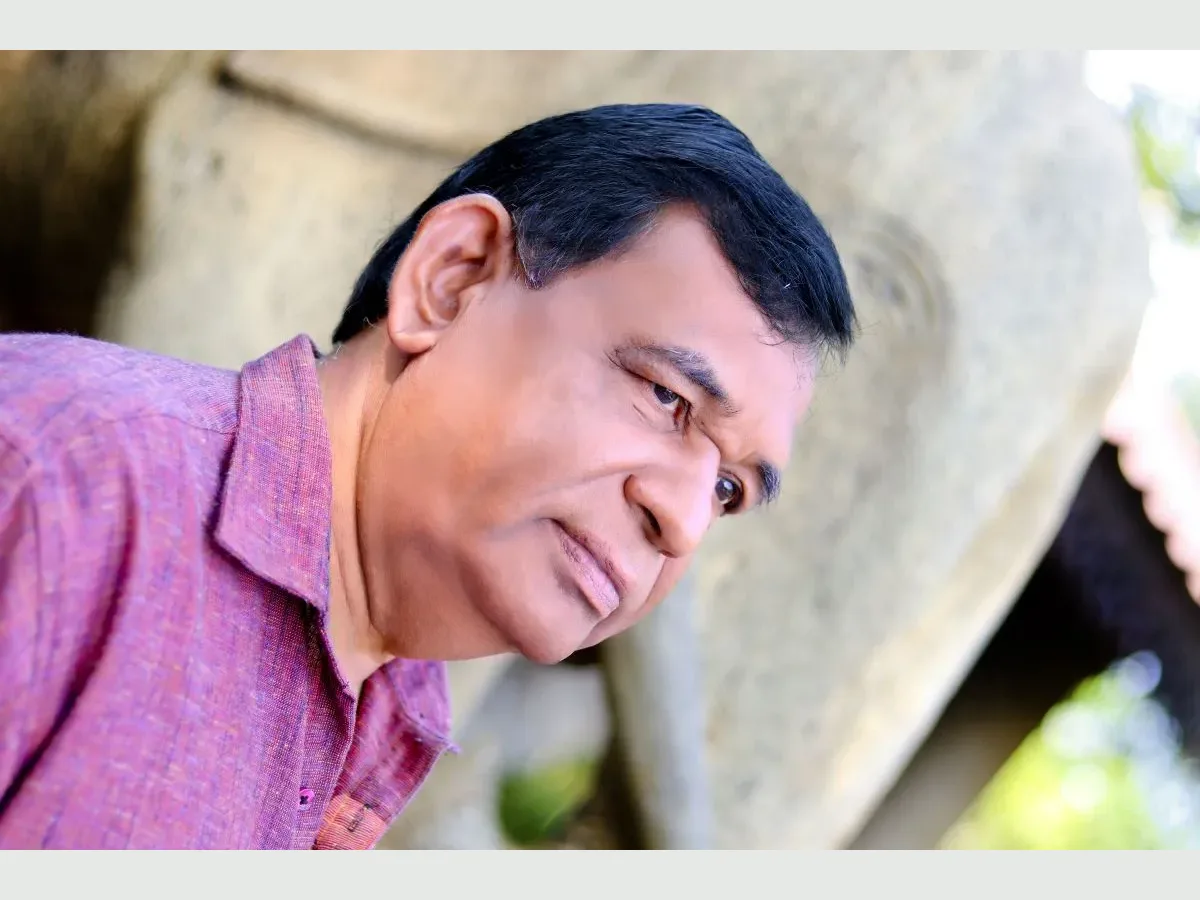
Every year on Teachers' Day, in school halls across Sri Lanka, somebody puts on a recording of පැන මඩ කඩිති Pena Mada Kadithi. Sunil Edirisinghe sings it; Rohana Weerasinghe set it. Children stand up. It has become the national teacher-appreciation song.
The man who wrote it says that is a misreading. Interviewed in Sinhala by Roar Media in 2017, Mahinda Chandrasekara explained that what he had been trying to say inside the song was that the teacher's life is in crisis and the education system has fallen into a far larger one — that he had wanted, rather than a tribute, to force that tragedy into public conversation. Read the words again and he is plainly right. The teacher wades through mud and over stiles in the rainy season of the tank country while the pupils he fed on the milk of learning sit upstairs in comfort, and he is still walking to school.
That gap — between what a song is heard as and what it was written to say — is more or less the whole of Chandrasekara's career.
The village and the poetry magazines
He was born in Muwa Etagama, a village on the edge of the Weddakanda range in the Medawachchiya division of the Anuradhapura district, the fifth of nine children in a farming family. His birth year is not recorded in any source reachable here. What he remembers is his mother: a village woman who carried a great stock of folk verse, folk stories and proverbs, and passed them to him before he could read.
At Kirigalwewa Maha Vidyalaya a teacher arrived from Ratnapura named Ranasinghe Sanghadasa — a Colombo-era poet and a good painter — who received the poetry magazines Dedunna and Meewadaya by post and let the boys read them, and who ran a literary society every other Friday. Chandrasekara wrote his first poem in grade five. By thirteen his verse was appearing in the poetry pages of Silumina, Mihira and Budusarana.
He entered the University of Colombo in 1975, at a time when the university did not yet offer Sinhala as an arts subject. He found the arts society and the Eastern music society instead, where visiting musicians — Amaradeva, Nanda Malini, Gunadasa Kapuge — came to work with students. He published a book of verse, Kamata Pan Amathakaya, jointly with the Venerable Muwaetagama Ananda. In 1976 he learned playwriting, directing and acting at Dhamma Jagoda's drama workshop at the Lionel Wendt, and got onto a stage himself in two roles in Athens Puraye Sita.
He also sent four lyrics to Gunadasa Kapuge, who was then producing a radio programme called Nawa Padamala that invited amateurs to submit words. Kapuge sang none of them. Chandrasekara's own explanation is blunt: they were not yet lyrics.
The overcoat called Rajarata Sevaya
On 12 April 1979 the SLBC opened Rajarata Sevaya — the first regional radio service established outside the capital. Its first director was the broadcaster Cyril Rajapakse, and he brought with him a remarkable roster: Swarna Sri Bandara, Wijayananda Jayaweera, Premakeerthi de Alwis, Sena Gunasekara, Newton Gunasekara, Kulasena Fonseka.
Because the station was far from Colombo, Colombo could not easily manage it, and the people who ran it used that freedom deliberately. Programmes were presented from threshing floors, from verandahs, from the market. Sanhinda, Nawarella, Pile Paduara, Nirmani, Pibidena Gayaka Parapura and Rajarata Mee Bindu were all made there. When listeners posted in requests for whatever was popular, the announcers would read out the names and then play what they themselves had chosen — what Chandrasekara calls, half admiringly, "a kind of benign dictatorship" exercised over the audience's taste. Swarna Sri Bandara's stated ambition was simpler: if we can turn a handful of Rajarata boys and girls with calloused hands into artists, that is enough.
Bandara became the teacher of a generation of new lyricists — the Venerable Pallegama Hemarathana, Mahinda Disanayake, Rohana Dandeniya, Karunaratne Jayathilaka, Podirathna Angamale, Seetha Ranjani, Ranjith Rupasinghe, K. M. I. Swarnasinghe and Chandrasekara among them. His first lesson was that you do not run off and write a song the moment you have an experience; you leave the field fallow, the way a farmer does, because a fallow field is what comes back fertile.
Chandrasekara's first song came out of that programme: Kusumalatha, sung by D. M. Rajaratne to a melody by Upali Jayalath. Then, in 1981, Gunadasa Kapuge arrived at Rajarata — on a punishment transfer, as it happens — and everything sped up. Kapuge set හාද වෙලා යමන් පනේ Hada Wela Yaman Pane, මරතෝණ්ඩි රටා ඇඳී Marathondi Rata Andi and උතුරින් එන දුම්රියෙ දේවී Uthurin Ena Dumriye Devi, all sung by Karunarathna Divulgane. Chandrasekara borrows Dostoevsky to describe what the station was: as the Russians said they had all come out of Gogol's overcoat, he says, all of them came out of the overcoat called Rajarata Sevaya.
Saroja
The song he is proudest of took years. මා තොටින් එන Ma Thotin Ena, sung by Deepika Priyadarshani to Rohana Weerasinghe's melody for the film Saroja, is written in the voice of a teacher to an orphaned Tamil girl in a refugee camp near the Madhu church. Its closing couplet runs, in translation:
Teacher, I am your pupil — and yet we are of the same class.
The Sinhala pun is exact and devastating: pantiya is both a classroom and a social class. Chandrasekara had taught in Panampattuwa in the Ampara district in the mid-1980s, in schools with Sinhala and Tamil children together, while armed groups were recruiting boys out of the villages; some of his pupils disappeared. Transferred to Anuradhapura, he found the mirror image — boys who had scraped a pass at O-Level joining the army, teachers writing their character certificates, and funerals to attend six months later. Over there Tamil children were dying, he says, and over here Sinhala children were dying, and for a teacher that is an impossible position, because to a teacher they are all children. The name Saroja, he points out, means the thing born in a lake: the lotus. He regards Sinhala, Tamil and Muslim children alike as lotus flowers.
He works this way habitually. රජ පෙරහැර මැද ඇතා නටනවා Raja Perahera Meda Etha Natanawa looks like a song about a procession and is a political allegory: every five or six years the people place the casket of their own sovereignty on the elephant's back, the elephant hears the cheering, decides the applause is for him, and starts to dance — and a dancing elephant in a procession is a terrifying thing to be standing next to. Other songs in the catalogue include ජයසිරි මා හාමුදුරුවනේ Jayasiri Ma Hamuduruwane and ප්රාණ සමානා Prana Samana, and the much-loved ගාලු කොටුවෙ නෝනච්චී Galu Kotuwe Nonachchi.
Teacher first
He has never been a full-time lyricist. After graduating he spent 1983 as an excavation inspector with the UNESCO-backed Cultural Triangle, and in 1984 went into teaching, starting at Panama Maha Vidyalaya in Ampara. By 2001 he was working as a teacher-adviser and lecturing at the National Youth Services academy and, as an external lecturer, at Rajarata University. He also wrote a good deal of radio — the folklore programme Sanhinda, radio plays for Rajarata Ranga Madala, the new-writers' slot Nirmani.
The output is small, and Sarasaviya said as much in a 2016 profile: not many songs, but scarcely a wasted one. In December 2017 a concert at Ananda College's Kularatne Hall in Colombo marked forty years of his writing, with a website, a CD and two books launched at it, appreciations from Rathna Sri Wijesinghe and Professor Sunil Ariyaratne, and a singers' list that ran from Victor Ratnayake and Sunil Edirisinghe to Edward Jayakody, Karunarathna Divulgane and Deepika Priyadarshani.
Asked what has gone wrong with the Sinhala song since, his answer is characteristically about schools rather than studios. Today's song, he says, is image and voice; nobody is thinking about words, music or lived experience. Language and literature have been turned into budget subjects. That, he says, is the point at which the country lost its capacity to take pleasure in anything.