
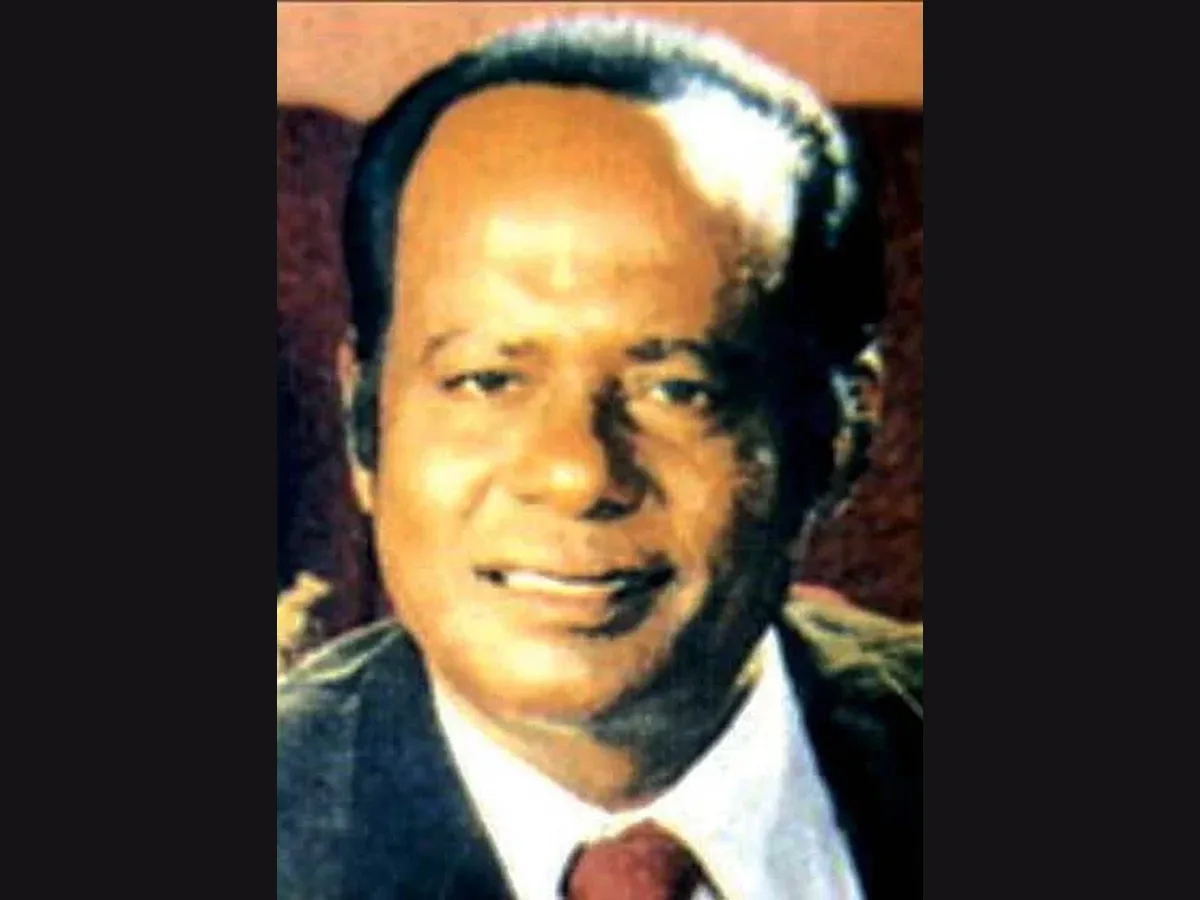
The people in his songs are a taxi driver, a man who has stolen a piece of cheese, a boy who has been thrown out of the house, someone flying to Dubai for work, and a man loitering outside a hotel in Mount Lavinia. මම ටැක්සි කාරයා Mama Taxi Karaya — "I am the taxi driver" — is not a metaphor for anything. This was the scandal of M. S. Fernando, as far as respectable Colombo was concerned: not that he sang badly, but that he sang about that.
Moratuwa, or Mount Lavinia
The eldest child of Laron Fernando and Lilee Gomes, he was born on the coast just south of Colombo — the Wikipedia entry says Moratuwa, the Sunday Observer's 2004 tribute says Mount Lavinia. His birth date is disputed in the same way: 4 March 1936 in most accounts, though the same Wikipedia infobox that gives 1936 in its text records 1931 in its dates, and the film database films.lk lists him as 1931–1994. He went to St. Anthony's College and to Christ Church College, Dehiwela, and studied music with the veteran J. A. Sathyadasa.
His way in was a duet. මලක් කඩා කොණ්ඩේ ගසාලා Malak Kada Konde Gasala, recorded with Pushparani Ariyaratne to words by Karunaratne Abeysekera, was popular enough to open the door to the film studios. For years afterwards he kept a middle-grade job at the Central Bank of Sri Lanka while singing at night — a detail worth holding on to when reading the accounts of him as a wild man of the stage.
The rhythm nobody actually banned
Baila's raw material arrived with the Africans brought to Ceylon from about 1630 as soldiers and slaves, and with the Portuguese-descended Burgher communities of the coast. Out of that came two named forms, chicote and kafrinha — described in 1894 by Advocate Charles Matthew Fernando as, respectively, "slow and stately" and "faster and more boisterous… with a peculiar jerky movement". In the mid-twentieth century a Galle-born traffic policeman, Wally Bastiansz, put Sinhala words to the 6/8 kafrinha rhythm and added the chorus, and is generally called the father of Sinhala baila.
What M. S. Fernando did was different in kind: he made it a mass commercial music with a national audience, a film-studio livelihood and a permanent place at every Sri Lankan wedding. His contemporaries called him බයිලා චක්රවර්ති Baila Chakrawarthi, the baila emperor, and the title stuck.
It should be said plainly, because the opposite is often repeated: baila was never formally banned in Sri Lanka. What it faced was condemnation — the Sinhala Vishwakoshaya could define it as a fast dance music that stimulates intoxicated men and women — and the quieter censorship of being kept off certain kinds of programme and out of certain kinds of hall. No gazette, no ban, no list. Just decades of being told it was not quite music.
A hundred and fifty films
His first film song, සිලි සිලියේ නව සුවඳක් Sili Siliye Nawa Suwandak, was written for Sasaraka Hati in 1964, and it was a hit. His family's count, given to the Sunday Observer, is that he recorded for more than 150 films; he also acted in over twenty-five, generally in small comic parts, and later in television, where his performance in Udagira was widely praised.
He was at his best in company. He made a long run of duets with Angeline Gunathilake across Geetha, Hathara Denama Surayo, Edath Adath Suraya, Sujeewa, Ava Soya Adare and Sergeant Nallathambi. He sang රෝස කැකුළ රෝසා Rosa Kekula Rosa with H. R. Jothipala for Lasanda in 1974, Dili Dili Dilisena Eliyak for Sikuru Liya in 1975 under Clarence Wijewardena's music direction, and A Rankanda Pemkanda with Latha Walpola for Nedeyo in 1976. He was on the roster of Gerald Wickremesooriya's Sooriya Records, alongside the Golden Chimes, Desmond de Silva and Milton Mallawarachchi.
One record shows better than any other how this music actually moves. Pissu Vikare, better known by its first line දාගෙන පොල්කටු මාලේ Dagena Polkatu Male, which he cut with Jothipala and Milton Perera, is a Sinhala version of the Tamil song Dingiri Dingale from the 1958 film Anbu Engey — and it was then absorbed back into Sinhala circulation a second time as an anonymous folk song under a different title. Nobody policed any of it, which is exactly why it spread.
Songs about ordinary trouble
The solo catalogue is a comic survey of Sri Lankan life in the 1960s, 70s and 80s: ගෙදර හිටිය රෝස කැකුළ Gedara Hitiya Rosa Kakula, ඉරටත් හොරෙන් වරෙන් Iratath Horen Waren, සයිමන් අයියයි Sayman Aiyai, සොරාගත්ත කේජු කෑල්ලක් Soragaththa Keju Kellak, ගල්කිස්සෙ හෝටලෙ ළඟ Galkisse Hotale Laga, මම එන්නේ ඩුබායි Mama Enne Dubai, බෝල බෝල මැටි Bola Bola Mati, කැකිරි පැලෙන Kakiri Palena. Migration, debt, drink, work, in-laws, the police — the things people actually talked about, sung fast enough that nobody had to admit they were listening to a social commentary.
He also sang straight love songs — මල් වයසේ මධු සිහිනේ Mal Wayase Madhu Sihine, නෙළුම් මලේ පෙති කඩලා Nelum Male Pethi Kadala — and the record of them tends to get lost behind the comedy.
Trophies, five languages, and a last morning
He collected prizes on a scale that is hard to check and easy to admire. President William Gopallawa gave him the Golden Lotus in 1973. The Sunday Observer, hedging carefully, reports that "according to information" he won 159 silver trophies in baila contests over his career; the same figure appears elsewhere, always without a source, so it is best read as the number his family and his fans have long given rather than as a verified tally. He sang in five languages, danced while he sang — an innovation in his corner of the business — and performed for Sri Lankan audiences in England, France, Australia, Canada, Singapore and the Middle East.
He died on 9 April 1994. He had been at a musical show in Jawatte, Colombo, that same morning. Nothing about his standing has settled since: he remains simultaneously the most reliably played singer at any Sri Lankan celebration and the one least likely to be studied.