
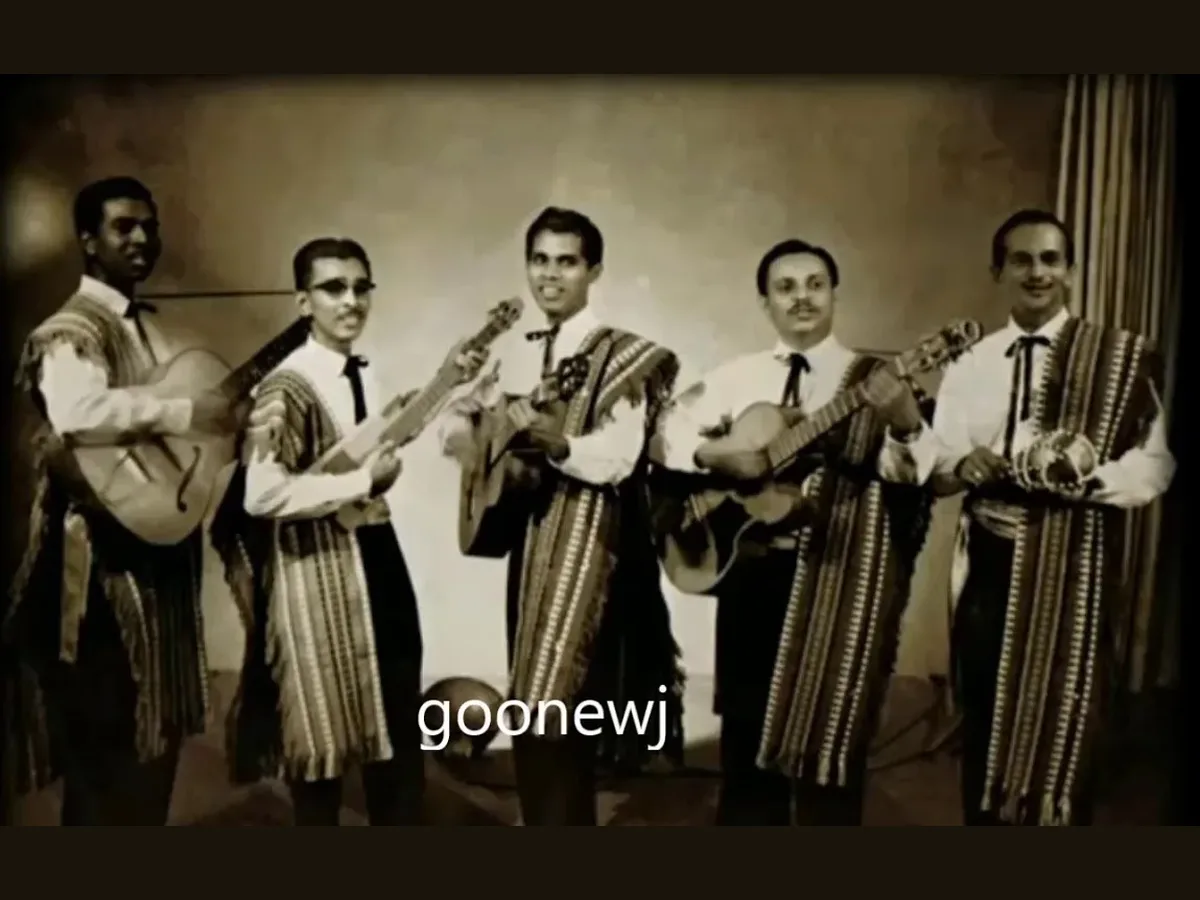
Two things were happening in Sinhala music in the early 1960s and both of them were being sneered at. Noel Ranasinghe and the La Ceylonians came onto stage barefoot, in batik sarongs and straw hats, and sang calypso; the crowds shouted malu karayo, fishermen. Neville Fernando and Los Caballeros came on with a classical guitar and Spanish and Paraguayan rhythms under Sinhala lyrics; officials at Radio Ceylon called it thuppahi sangeethaya, half-caste music, and kept it off the Sinhala service.
Between them they invented kandayam gee, the Sinhala group song — the thing that the Moonstones, the Golden Chimes, the Dharmaratne Brothers, La Bambas and everyone else after them was working inside. Annesley Malewana, who was there, put the division of labour in one sentence: "Neville was more into Spanish music while Noel was into vocal harmony. That was the turning point in group songs."
The voice and the classical guitar
Neville Fernando was a singer and a classical guitarist, and Los Caballeros was his band. Its Sinhala-language reach came out of live radio: the group's recitals went out over the Ceylon Broadcasting Corporation — as the SLBC then was — and the station's switchboard would light up after every one of them.
His brother Errol played in the group. His son Trevor and his granddaughter Tashiya are both singers.
The songs that stayed are a mixture of his own and other people's. He sang මල්බර හිමිදිරියේ Malbara Himidiriye, සඳක් නැගී සඳක් දිලේ Sandak Nagi Sandak Dile and ශෝභන සැන්දෑවේ Shobhana Sandawe — the first two of them also recorded with Rukmani Devi, the gramophone star of the 1930s, who walked into a calypso group in her forties and did not miss a step. Other titles that follow his name in tribute pieces are Gayana Gayum, Samudura Dewi, Mage Ran Maliya, Sataha Lasan and Malagerena Salarosa.
He moved into cinema quickly. A 2018 Sunday Observer tribute names Bandun Piri, for Lester James Peries's Ransalu (1967), as his first film song. The one everybody knows is මාස්ටර් සර් Master Sir, composed by Nimal Mendis and sung by Neville Fernando with Sandra Edema for the film Kalu Diya Dahara — a song that has since been recorded so many times, by singers so much more famous, that the original vocal is rarely credited.
1968
Neville Fernando died in April 1968, and the band did not survive him. That is the reason Los Caballeros are a footnote and the Moonstones are a legend: the Moonstones' leaders lived to tour for fifty years, and Los Caballeros' leader was gone before Sinhala pop had even acquired a name.
Fifty years later, in April 2018, Errol organised an evening at Sooriya Village to perform his brother's songs, with Trevor, Tashiya, Nadeeka Guruge's group and the Four Sisters. The Sunday Observer ended its report of it with a question rather than a conclusion: "We wonder when a successful group like Los Caballeros will catch the limelight in Sri Lanka."
Even the spelling is unsettled. The Sri Lankan press prints the name as often as "Los Cabelleros" as it does "Los Caballeros"; no Sinhala-script form of it is recorded in the sources reachable here, and no Wikipedia article exists in either language.
A mix-up worth correcting
One story about this band is told constantly and is wrong.
The Moonstones' first hit, Mango Nanda, was recorded in a Philips studio session that another bandleader had booked for himself and gave away to a group of unknowns. That bandleader was Noel Ranasinghe of the La Ceylonians, not Neville Fernando. Malewana has said so on the record, more than once: "Once when Noel had three recordings with the Philips label, he introduced us to the company and offered the third recording to us."
The two men have been conflated in retellings for decades, including in print. They were friends, contemporaries and rivals of a friendly kind, and both were generous to younger bands — La Bambas named both of them among the people who kept them going after their disastrous first night — but they led different groups and did different things, and the Philips session belongs to Noel.
What is not known
This is a thinly documented band, and it is worth saying so plainly rather than filling the gap.
No full line-up of Los Caballeros survives in any source reachable online beyond Neville and Errol Fernando. No formation date is recorded — the group is placed in "the 1960s" and no more precisely. There is no discography, no label history, and no Sinhala-script version of the band's name. Neville Fernando's birth year is not given anywhere accessible; only the month and year of his death.
The one substantial piece of research that exists is a Sinhala book on Neville Fernando and Noel Ranasinghe together, launched at the Mahaweli Centre in Colombo on 3 April 2013 — the only study of these two musicians ever attempted. Even its authorship is reported inconsistently: the Sunday Times credited it to the journalist and lyricist Shelton Weeraratne in March 2013 and to "Shelton Premaratne" in May of the same year. Anyone wanting to know more about Los Caballeros should start by finding that book.