
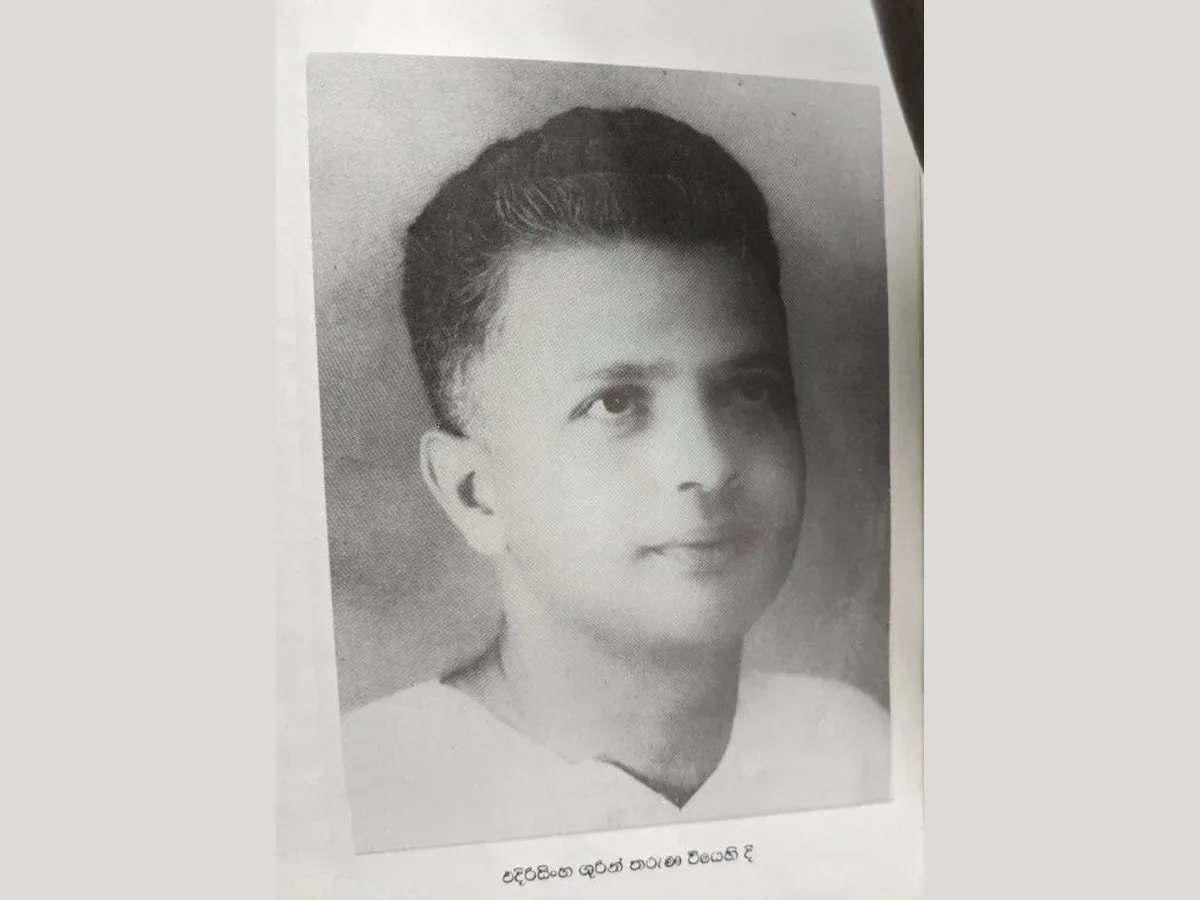
On the morning of 4 February 1948, the day Ceylon became independent, Radio Ceylon broadcast a national song. It was called ශ්රී ලංකා මාතා පල යස මහිම Sri Lanka Matha Pala Yasa Mahima, and it had just won the competition held to find the country's anthem. The words were by P. B. Illangasinghe. The music was by Lionel Edirisinghe. Both men had sat on the panel that chose it.
Later that day, at the official Freedom Day ceremony, the song was not sung. The protests had already started.
That episode has followed Edirisinghe's name for eighty years, and it is only fair to say up front that it is the least of what he did. He was the first musician from Sri Lanka to hold a Sangeet Visharada from Lucknow, the man who put music on the school timetable, and the founding principal of the institution that is now the University of the Visual & Performing Arts. Almost every formally trained Sri Lankan musician of the second half of the twentieth century passed through a system he built.
Baddegama to Lucknow
He was born on 17 January 1913 at Baddegama in the Galle district, and went to school at the Meepavala Buddhist School, then Richmond College and Mahinda College. At Mahinda he acted in the college's stage productions — Sakunthala, Ramayanaya, Wessanthara, Sri Wickrama — and was a leading voice in the choir. Nurthi-era school drama of that kind was where a great many Ceylonese musicians first met North Indian raga, second-hand and through the Parsi-theatre tradition.
He went to India for the real thing. First to Visva-Bharati at Santiniketan, Rabindranath Tagore's school — where, a Sri Lankan newspaper column has it, one of his classmates was Indira Nehru, later Indira Gandhi. Then to the Marris College of Music at Lucknow, since renamed the Bhatkhande Music Institute, where he became the first Sinhalese to graduate with the Visharada degree, a few months ahead of Sunil Santha. The musicologist Garrett Field records that Edirisinghe spent close to thirteen years in North India altogether, studying Hindustani classical music under Allauddin Khan — the same teacher who trained the sitarist Ravi Shankar.
He came home to a job with real leverage: Chief Inspector of Music at the Ministry of Education, at exactly the moment music was introduced as a school subject.
The anthem that won and lost
Before independence, the Lanka Gandharva Sabha — the national association of musicians — ran a competition to find an anthem for the country that was about to exist. The judging panel included Edirisinghe, Illangasinghe, S. L. B. Kapukotuwa, Dr O. H. D. Wijesekera, Mudliyar E. A. Abeysekera and L. L. K. Gunatunga. Among the entries were Ananda Samarakoon's Namo Namo Matha and the Illangasinghe–Edirisinghe Sri Lanka Matha Pala Yasa Mahima.
The Illangasinghe–Edirisinghe entry won. That two members of the panel had submitted the winning song produced, in the words of the account that has become standard, "widespread resentment and protests"; it was seen as plainly unfair. The song was broadcast on independence morning and dropped from the official ceremony. Nobody involved appears to have argued that the composition itself was weak — the criticism was of the process, not the piece — but the process was enough to sink it.
The sequel is less often told and worth stating precisely. Ceylon went on using God Save the King as its official anthem after independence. At the first Independence Day ceremony at the new Independence Memorial Hall in Torrington Square on 4 February 1949, both songs were performed, in Sinhala and in Tamil, as "national songs". Only in 1950 did J. R. Jayewardene move for official recognition of Samarakoon's song; a committee under Edwin Wijeyeratne heard several candidates and picked Namo Namo Matha, and the government endorsed the choice on 22 November 1951.
The auditions Sunil Santha would not sit
In 1949 Radio Ceylon brought S. N. Ratanjankar, principal of the Marris College at Lucknow, to Ceylon to audition and grade Sinhalese musicians for radio work. He heard 716 applicants and awarded the top A grade to five: Lionel Edirisinghe, Ananda Samarakoon, Devar Surya Sena, Sunil Santha and S. Amarasinghe.
In April 1952 the station's director general M. J. Perera invited Ratanjankar back to do it again. This time Sunil Santha boycotted the auditions and resigned his A grade, writing in Lankadipa on 5 May that he did not believe the country should want "a foreigner to come to Sri Lanka to advise us on how to create a national music." He was out of national radio until 1967.
Edirisinghe's name recurs in accounts of that affair — he was both a beneficiary of the 1949 grading and, by then, the senior figure in state music administration. What exactly he did or advised in 1952 is a different question, and one this article cannot answer: the fullest scholarly treatment of the boycott sits on a host that will not serve automated requests, and no source we could read sets out his role in detail. He is named in the story. The specifics are not established.
The college he built
In October 1953 Edirisinghe became the founding principal of the Government College of Fine Arts (Music). That institution ran on through its later names — the Government College of Music, the Institute of Aesthetic Studies — and became the University of the Visual & Performing Arts, the single channel through which formal music qualifications in Sri Lanka have passed ever since. Building it was the work of his life, and it is why so many later musicians describe themselves as having come up "through the Institute".
He composed as well as administered. In the late 1950s Radio Ceylon's writers invented a genre with no precedent and no stage: the gita natakaya, or radio opera, written to be heard only over the air. Chandrarathna Manawasinghe wrote the first libretto and Wimal Abeysundara the second, and Edirisinghe set Abeysundara's to raga. That second opera, නිෂාදී Nisadi, aired around 1958 and took music itself as its subject; its heroine is named after ni, the seventh note of the Indian scale, and Edirisinghe chose ragas that emphasise that note so the character was present in the harmony as well as the plot. He drew, Abeysundara said, on all eight melas — Yaman, Bilawal, Khamaj, Bhairava, Purvi, Marwa, Kafi and Asavari. It was deliberately elite music, made to raise standards rather than to sell, and it is now almost entirely forgotten.
What he is remembered for
He was awarded the honorary title Kalashoori in 1986 and died on 22 May 1988, at 75.
The obituary shape of his life is a paradox worth holding onto. Edirisinghe belonged to the generation that went to India to learn how to be a Sri Lankan musician — and the generation that came immediately after, Sunil Santha most loudly, defined itself by refusing exactly that. In 1948 he wrote a national anthem that lost on a technicality of fairness; in 1953 he built the machinery through which everyone else would be trained. Sri Lanka's music-education system, its degree structures and its examination grades all descend from decisions he made. The song is a footnote. The college is not.