
A girl in a schoolgirl's uniform and round spectacles, standing in a line of other girls, singing a song that was not yet a national anthem in a country that had been a country for a matter of weeks. She is the one wearing glasses; she pointed herself out in the photograph seventy years later, and by then almost nobody else in the frame could still be named.
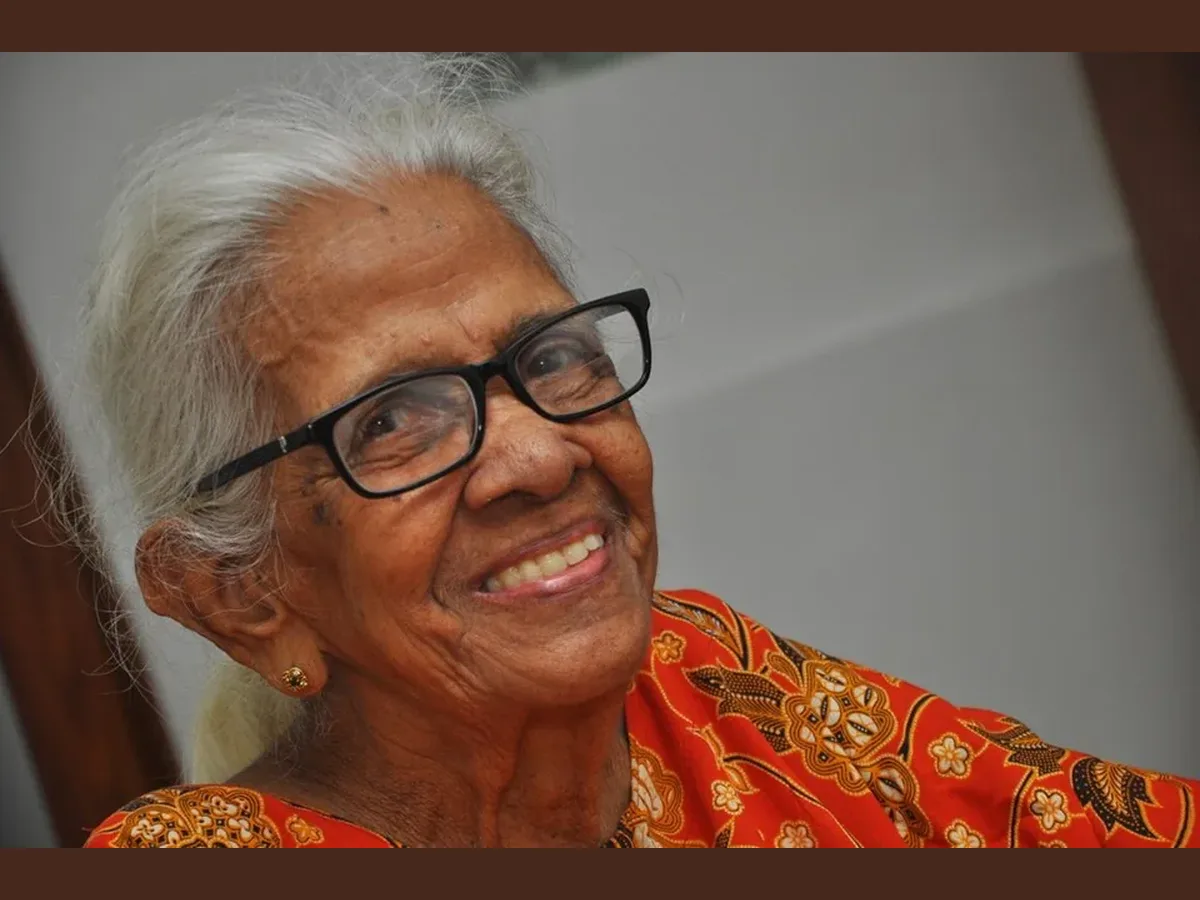
Her name at that moment was Hewa Geeganage Leelawathi. On the radio she was Leela Asoka. Later, after she married, she was Kamila Ismail — and the woman who had sung with Sunil Santha stopped singing altogether.
The house at Thimbirigasyaya
She was born on 7 July 1927 in Thimbirigasyaya, Colombo, the second child of eight and the only daughter — one elder brother, Sugathadasa, and six younger ones: Somapala, Newton, Winton, Linton, Shelton and Sarath. Her father died when she was young and her mother remarried. She was schooled at Musaeus College and then at Maradana Central College.
Music was in the house because the father had bought instruments for the children. The serpina — the pedal harmonium — belonged to Sugathadasa, the eldest; a tabla belonged to another brother; when Sugathadasa joined the army the harmonium passed down to the youngest, Sarath, who grew up to be the composer and music director Sarath de Alwis. A friend of their father's, M. K. Vincent Master, taught them to play. Leela sang, learned the ravikinnaya, and also drew — she would earn her living as an art teacher, not a singer.
Her uncle V. M. Perera was Secretary of the Hela Havula, the Sinhala language-purist movement, through the 1940s, and it was he who first put her in front of an audience, singing verse at Hela Havula functions. Sunil Santha was at one of those functions, and he heard her.
Singing with Sunil Santha
What followed is the part of her life that survives on record. She became the female voice on a large share of Sunil Santha's output: මෙවන් පිටිසරේ Mewan Pitisare, කිරිල්ල සහ කූඩුව Kirilla saha Kuduwa, හෙළ රටේ Hela Rate and රැල්ල නැඟෙන්නේ Rella Nagenne, and others besides. Mewan Pitisare was still the song she reached for at ninety-one, half-singing the words to an interviewer: in this remote place, in this poor hut where you live, you are the sweet one, my flower of the forest.
Her memory of the man himself is the most useful thing anyone has left about him from inside a rehearsal.
"He was a pleasant-looking man. He used to come to our house in Thimbirigasyaya to rehearse the songs. When his car stopped in front of our house everybody in the neighbourhood would come out to look at him. Sunil Santha was a very kind person. Even when we made mistakes in rehearsal, he never once got angry."
She was graded a B-class artist by Radio Ceylon, and she remembered exactly why Sunil Santha refused to take the grading test at all: "The people who came to grade the radio artists came from India. He did not want to go before people who had fewer qualifications than himself." That is the 1952 audition controversy from the other side of the microphone, and it matters, because the story is usually told as though he failed. He boycotted.
There was also a small boy in the room. Sarath de Alwis, decades later: "In the old days when my sister went to the radio, I was the one who went with her for company — like a bodyguard. I was very small then. Pandit Amaradeva used to be there too. I was so small that Amaradeva used to carry me around." At that time, Leela added, "he was still Albert Perera. He came to our house to rehearse sarala gee for the radio."
Getting to the studio had its own comedy. The station was then on Cotta Road. Some days she wore her mother's saris. "When I go off to the radio programmes, my mother says, 'there go my saris' — because I walk rather fast, and the hem catches on the stones and tears."
The anthem, and what exactly happened in 1948
Every obituary calls her one of the girls who sang the national anthem in public for the first time at the first Independence celebrations of 1948, and that is how she is remembered. The claim needs unpacking, because the history around it is genuinely tangled and the sources do not line up.
Ceylon became independent on 4 February 1948 with no national anthem of its own. A competition run before independence by the Lanka Gandharva Sabha had been won by "Sri Lanka Matha Pala Yasa Mahima" by P. B. Illangasinghe and Lionel Edirisinghe — a result made awkward by both men sitting on the judging panel — and that song was broadcast on independence morning but not sung at the official ceremony. Ananda Samarakoon's "Namo Namo Matha" was adopted by a government committee only in 1951, and was first sung as the official anthem at the 1952 independence parade.
What the Sri Lankan press records, consistently, is that Samarakoon's song was first sung in public by schoolgirls — by Mahinda College boys in Galle first, then by a choir from Musaeus College, Colombo — and that Leela Asoka was one of that group. Sarasaviya puts it exactly that way in 2019, and quotes her: "In those days I was studying at Musaeus College. I was about fourteen. I loved music from very small. That day, along with me, a group of other young women were chosen to sing the national anthem for the first time."
Fourteen would place that performance around 1941, not 1948 — long before independence, and consistent with the song's early life as a school song rather than an anthem. Whether she is describing the same occasion as the 1948 ceremony, or an earlier Musaeus performance that has been folded into it over seventy years, cannot be settled from the sources available. Wikipedia says she trained with three other girls under a school teacher named Karunaratne and the priest-poet Fr. Marcelline Jayakody, making four; Silumina says five young women; the Daily News obituary says only that she was a singer in the orchestra that performed the anthem at Independence Square in 1948. The accounts differ, and the honest position is to say so.
Her own claim, at any rate, is modest and specific, and it is backed by a photograph she could still read.
Kamila Ismail
She trained as an art teacher and taught art at a school in Dematagoda. There she fell in love with a young Muslim man, M. A. Kamaldeen, who worked for a government trading company. She married him and became Kamila Ismail.
"I stepped away from singing after my marriage," she said. "I married a Muslim. He told me not to broadcast my songs on the radio." Wikipedia, following the Sinhala press, records that she was asked to write to the broadcasting service herself and ask them to stop playing her records. She did. Her three sons — Hafeel, Reza and Fazal — grew up knowing her as a teacher.
On International Women's Day in March 2019 the Women's Front of the Sri Lanka Freedom Party gave her an award. She died on 22 April 2019 and was buried at Hokandara general cemetery two days later, with a public lying-in-repose at her home. Sources give her age variously as 91, 92 and "in her ninety-third year"; the 1927 birth date on which the first of those rests is the one Wikipedia and Silumina both use.
The Sinhala-language obituaries and the fullest interview with her are on Silumina and Sarasaviya, both of which now refuse automated requests; the versions cited here were recovered from the Internet Archive. Very little else about her survives online. A woman who sang duets with the most argued-over composer in Sinhala music gave one newspaper interview in her life, and it happened when she was ninety-one.