
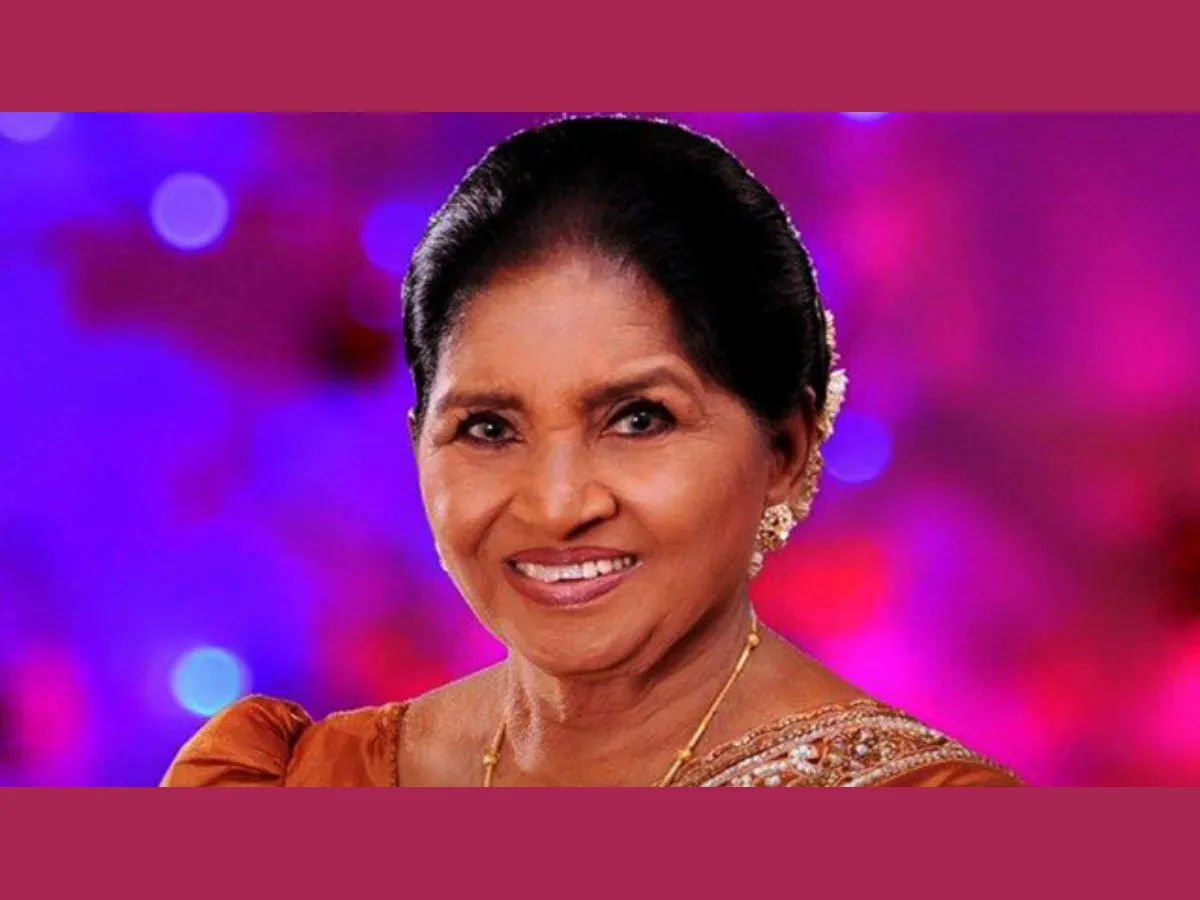
A Reverend Sister at St. Anthony's Convent in Mount Lavinia called the girl over and slapped her face, then asked whether she knew what the slap was for. She did not. "She told me it was for singing on the radio." A priest followed it up with a warning: if you sing like that, do not come back to school.
The girl was Rita Genevieve Fernando, and the school had been perfectly happy for her to sing at its own concerts and sports meets. Singing on Radio Ceylon was a different thing. It took the intervention of the playback singer P. L. A. Somapala, who took her to Father Marcelline Jayakody, who arranged an audience with Archbishop Thomas Cooray in Borella, before she was told she could carry on. She remembered it for the rest of her life as the turning point. She had perhaps seventy-five years of singing still ahead of her.
Dhawalagiriya
She was born on 11 November 1934 in a house called Dhawalagiriya in Bambalapitiya, to a Catholic family of modest means. Her father, Joseph Linus Fernando, worked at Cargills; her mother, Elizabeth Muriel, was a convent schoolteacher who sewed and knitted and who encouraged the singing. Accounts differ on where she came in the family — Wikipedia calls her the third child of five, while the Sunday Observer's obituary calls her the youngest, with an elder sister Winifreda and a brother Godfrey. The family later moved to Mount Lavinia.
Her first audience was a church choir, where she sang Latin hymns she had memorised without understanding a word. "I liked listening to the hymns as much as I liked singing them," she said. "I sang at home, and I even sang on the road while I was walking."
A neighbour named Wilman Silva took her to C. A. Fonseka, a radio dramatist and musician who had brought Rukmani Devi into playback singing. Fonseka put her on his sarala gee programme. She joined the Radio Ceylon choir at twelve, in 1946, and by fourteen was singing monthly with Fonseka's sons C. D. and Erwin. Her first recorded song was Kandulu Denethe Wehena, with words by Sarath Wimalaweera; accounts differ on whether it was a solo or a duet with the Radio Ceylon resident violinist Vincent de Alwis, and on whether de Alwis or Edward Perera set it. Her first solo recording for radio was the Catholic devotional නමෝ මරියනී Namo Mariyani, cut for the Columbia label, and she went on singing it for the rest of her life.
The name came later. At an audition she sang a Hindi song for the singer Susil Premaratne, who told her it was beautiful, "like Lata Mangeshkar", asked her name, and then said that Rita Genevieve Fernando would not do in the Sinhala music field. She became Latha.
Her father got very angry
In the early 1950s the recording studios for Sinhala films were not in Colombo. They were in Madras and Calcutta, and that fact quietly decided which Ceylonese women could have a film career. A respectable daughter did not sail to India.
K. Gunaratnam of Cinemas Ltd. invited Latha to sing playback for Sujatha in 1953 and her father refused permission. She did the next film anyway. Shanthi Kumar's Eda Rae (1953) carried three duets by her with Herbert M. Seneviratne, recorded without telling her father. When work on Ahankara Sthree required an actual trip to Madras, she went with her mother and again without telling him. Her father's reaction is one of the bluntest illustrations there is of what the stigma against women performers actually cost: he fought with her mother and set fire to things in the house, and her mother, brother and sister had to move to a relative's home. Her contemporary Vivienne de Silva Boralessa wanted playback work and never got it, for the same reason — her parents would not let her travel to India to record.
The voice that sent the Madras singers home
Prema Tharangaya (1953) was the breakthrough. She had six songs in it, two of them written as duets with the actor Aruna Shanthi, who could not manage the recording; the musician M. Ariyadasa brought in a young singer called Dharmadasa Walpola to sing them instead. Their first duet together, Honda Hondama Weya, set by R. Muttusamy, went everywhere.
What happened next changed the industry. Sinhala films had been importing playback voices from South India — Jikki, Jamuna Rani, K. Rani and others — on the assumption that the island did not have singers of its own. Latha, alongside Sujatha Attanayake, G. S. P. Rani, Mohideen Baig and A. R. B. A. Azeez, made that assumption untenable. The imported singers went home.
She then simply was Sinhala film music for a decade and a half. She sang for something over sixty actresses; she dubbed the Sinhala voices of Indian stars including Vyjayanthimala, Meena Kumari and Nimmi; she sang for Lester James Peiris's Rekhawa (1956). She won the Sarasaviya Award for best female singer at the second ceremony, in 1965, for Heena Hathak Mada from Getawarayo — Nanda Malini had taken the award at the first, in 1964 — and three more times afterwards, for Naarilatha, Okkoma Kanapita and Chitti. Beyond film she left standards that have nothing to do with cinema at all: සැළලිහිණි කොවුල් හඬ Salalihini Kowul, මල්බර හිමිදිරියේ පිපුණේ Malbara Himidiriye Pipune and ආදරයේ රන් විමනේ Adaraye Ran Wimane with C. T. Fernando, රොන් සොයා පියඹන Ron Soya Piyabana, දේදුන්නෙන් එන සමනලුනේ Dedunnen Ena Samanalune, and ගහ කොළ මල් Gaha Kola Mal with Victor Rathnayake. She had no formal classical training at all.
The Walpolas
On 7 April 1958 — the Sunday Observer says 1957; the wedding itself was at Sirikotha in Kollupitiya — she married Dharmadasa Walpola, and Latha Fernando became Latha Walpola. He was a flute, violin, tabla and harmonium player as well as the dominant male playback voice of the era, and the two of them recorded together for three decades and some thirty-five films. It is a connection that profiles of either singer routinely drop, and it should not be: for a long stretch of the 1950s and 60s, the sound of a Sinhala film romance was these two people singing at each other. He died on 25 December 1983.
Her children — among them Amith, Suneth, Chaminda and the singer Dhammika, who married the guitarist and composer Mahinda Bandara — carried the music on, and Dhammika and Mahinda kept her performing into her late eighties.
How many songs?
Nobody knows, and the sources do not even pretend to agree. A single paragraph of her English Wikipedia article credits her with about 6,750 songs for nearly 600 films and, a few lines later, with more than 10,000 songs overall. The Sunday Observer obituary says she lent her voice to twenty-two films. Latha herself, at a 2006 tribute concert for the lyricist Karunaratne Abeysekera, said she had sung about 550 film songs — and that more than half of them were his words. The honest statement is that she recorded on a scale nobody was counting at the time, across eight decades, for radio, film, album and television.
She was made Kalasuri in 2005 and Deshamanya in 2017. Her last concert, Pem Rajjaye, was staged in November 2025 to mark her ninety-first birthday. She told the hall, "I am not ninety-one, I am nineteen." She died six weeks later, on 27 December 2025, at the Sri Jayewardenepura Hospital, and was buried at Kanatte on 31 December with full state honours.