
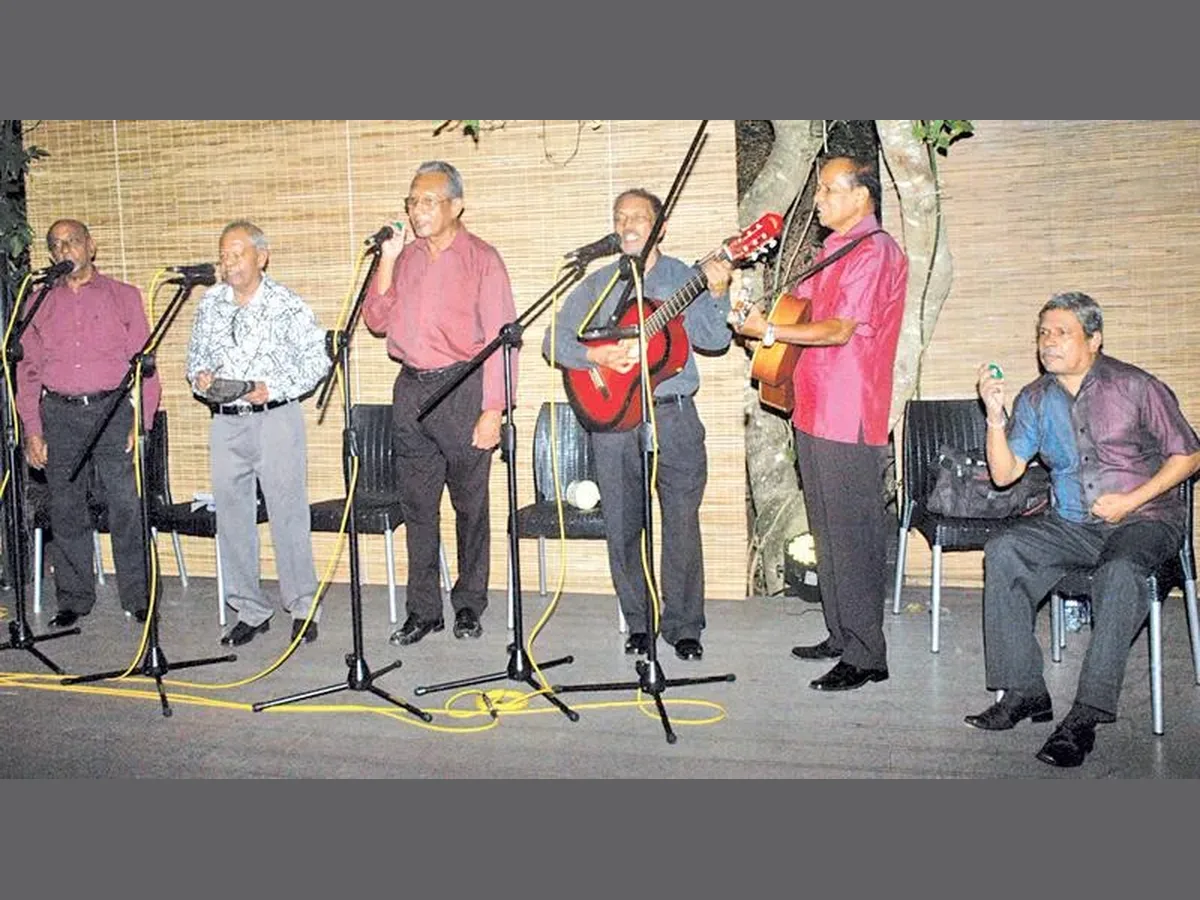
On 25 May 1966, six young men from Moratuwa walked onto the stage of the Coconut Grove, the nightclub inside the Galle Face Hotel, carrying gut-strung box guitars and a set of maracas. They had spent months getting there. The audience booed them off.
They had come for a talent quest. Brian Fernando had spotted the advertisement in the Ceylon Observer and rounded up three friends — Rollinson Ferdinando, Priya Peiris and Lasla Fernando — to sing with him, because he had wanted for a long time to build a group like the one Noel Ranasinghe had built with the La Ceylonians: barefoot, acoustic, Sinhala words over Latin American rhythms. The auditions were being run by Mignonne Fernando and the Jetliners, and the boys were called in to the Lewis Brown studio in February 1966. The Jetliners let them sing four lines of Sinhala harmony and stopped them there: they were in.
The crowd at the Coconut Grove, unfortunately, had come to hear western pop. Brian remembered the jeering for the rest of his life, and remembered the vow the six of them made afterwards — that one day the people who booed them would stand up and applaud.
Six from Moratuwa
The original 1966 line-up was Brian Fernando, Rollinson Ferdinando, Lasla Fernando, Erinton Perera, Priya Peiris and Sunil Perera. Sunil emigrated as early as 1968, and another close friend and neighbour, Malsiri Wijesuriya, took his place. That combination then held, essentially unbroken, for the rest of the band's life — which in a business built on line-up changes is the single most remarkable fact about them.
Moratuwa mattered to them, and they said so. "It is with great pride that La Bambas proclaim that everything we musically ventured was totally home spun and Moratuwa oriented," Priya Peiris told the Sunday Times in 2021. "All composing, melody making, musical and vocal arrangements were planned out by ourselves and never depended on any outside sources."
They were also, at the start, laughed at for it. Priya remembered the reaction of fashionable Colombo to the whole barefoot-and-sarong school of Sinhala group song: "It was radical, and I recall Colombo 7 socialites calling us godayas" — bumpkins.
What they refused to do
The sound was gut-strung classical box guitars, hand percussion and conga drums, and two-, three- and four-part vocal harmony. No amplifiers, no electric guitars, no drum kit.
That was a choice, and it was made at precisely the moment when everyone else was making the opposite one. The Moonstones plugged in around 1965 and invented Sinhala pop with electric instruments; Clarence Wijewardena's guitar rewired what a Sinhala band was supposed to sound like. La Bambas watched the entire scene electrify and did not move. Nearly half a century later they were still turning up with wooden instruments, which by then had become an unfamiliar sight rather than a normal one.
Their own songs came out of that constraint: හිමිදිරියේ Himidiriye (also known by its opening as Piyakaru Mala), Nuwara Menikela, Cock-a-doodle-do, Lak Nadee, Enna Yanna Nelum Wile, Kurulan Piyabaala, කලේ උකුලෙ තියාලා Kale Ukule Thiyala, Moratuwe Moratuwe, Samanmali, Handapaane, Bambaruge Gumu Gumu, Nelum Kadanna, Diya Daharin and Wala Kulen Ethera. There were English ones too, written to sell the country — an Ayubowan and a Welcome to Sunny Ceylon, plus a Cricket Lowey.
They were never a hits band in the way the Moonstones were. What they had instead was breadth. Their working repertoire covered English, Scottish, Welsh and Irish standards, American cowboy songs, plantation songs and Dixieland, and above all the Latin American songbook — which is the actual source material the whole kandayam gee, the Sinhala group-song movement, had been built out of.
The Oberoi years
The most durable thing in their career was not a record. Through the 1980s and into the 1990s they played three nights a week at the Hotel Lanka Oberoi, then the largest and most prestigious five-star hotel in the country, for fifteen years.
That is what an unplugged band could do that a beat group could not: fill a room every week for a decade and a half without needing a stage, a rig or a support act. The hotel circuit had opened up in the 1970s and it kept a whole generation of Colombo musicians alive.
They also did work nobody asked them to publicise. During the war years they ran more than fifteen music workshops for army musicians in towns across the Wanni at the army's request, and they were, by their own account and the Sunday Times', the first band to volunteer to play for wounded soldiers in the army hospital.
The CD, and the end
For their golden jubilee in 2016 La Bambas made one record that justifies the whole enterprise: a CD with Sooriya Records containing what the Sunday Times describes as the largest compilation of Latin American favourites ever recorded by anyone in Sri Lanka, alongside Caribbean calypso and their own English songs.
By then the band as a working unit was already finished. Brian Fernando — the boy who had seen the advertisement in the Observer fifty years earlier — died in 2013, and the surviving members decided to lie low rather than replace him. They did not, they were careful to say, quit music. Priya Peiris had been the one who represented the group at the nostalgia concerts of the early 2000s, when Annesley Malewana's Stars of the 70s shows brought the whole guitar generation back onto Colombo stages.
In May 2021 the remaining members marked fifty-five years since the Coconut Grove, quietly, because the country was in pandemic lockdown. English Wikipedia's article, written years ago, still gives their years active as "1966–Present"; the Sunday Times is clearer, and treats 2013 as the end.
The people they always credited were not producers or label owners but the men who told them to keep going when the jeering started: Vijaya Corea and Vernon Corea, who put Sinhala group song on the English service of Radio Ceylon when the Sinhala service would not touch it, and the two bandleaders they had been imitating in the first place — Noel Ranasinghe of the La Ceylonians and Neville Fernando of Los Caballeros.