
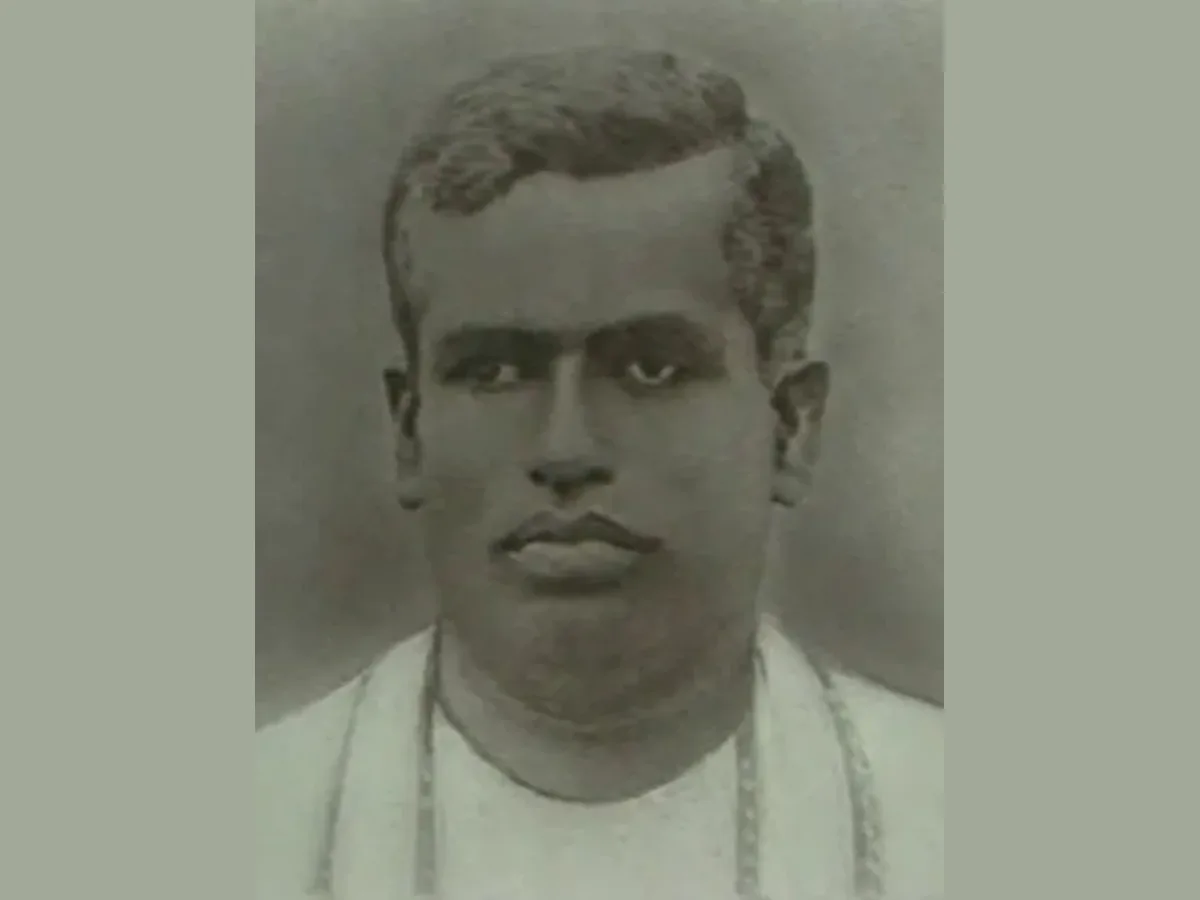
He had been dead a year, and the hall at the University of Ceylon was full of people who had come to remember a grammarian. Somebody had arranged music. A young man who had recently come home from five years of study in North India stood up and sang — his own words, his own tune, and a plainness of delivery nobody in Colombo had heard before. Within months Radio Ceylon would ask him to record, and the song that came out of that session, ඕලු පිපීලා Olu Pipila ("the lotus has bloomed"), is the first song the station ever cut to disc.
The singer was Sunil Santha. The dead grammarian was Kumaratunga Munidasa, and the reason a schoolteacher-turned-linguist gets an entry on a music site is simple: for a decisive generation of Sinhala songwriters, he supplied the rules. He did not compose. He did not sing. He counted syllables — obsessively, systematically, and in print — and the counting became a metre, and the metre became an idiom.
The schoolmaster from Idigasaara
He was born on 25 July 1887 at Idigasaara, near Dickwella in the Matara district, the second youngest of twelve children. His father was a physician of indigenous medicine whose house held Pali and Sanskrit manuscripts on ayurveda, astrology and Buddhism, which is a fair description of where the boy's education began. He went to Wewurukannala Pirivena intending to become a Buddhist monk; his family objected; he switched to the government teachers' college in Colombo and qualified in 1907.
His working life reads as ordinary as any civil servant's. Teacher at the bilingual school in Bomiriya, then principal of the bilingual school at Kadugannawa, then — after eleven years — inspector of schools, a post he held for four. Everything that made him famous he did on top of that job: grammars, commentaries, editions of classical texts, a stream of essays, and a running quarrel with almost every learned institution in the country.
His name is spelled several ways and given in both orders. Sinhala writes it කුමාරතුංග මුනිදාස, surname first; English sources give both "Kumaratunga Munidasa" and "Munidasa Cumaratunga", and academic writing generally prefers the latter. They are one man.
Hela: an argument about what Sinhala is
The word at the centre of everything he did is Hela — his term for Sinhala stripped of its Sanskrit and Pali borrowings and returned to what he held was its own older stock, the language classical grammarians called Elu. In 1941 he founded the Hela Havula ("the Hela fellowship") on 11 January to organise the campaign; he revived the newspaper Lakminipahana and started the magazines Subasa and Helio to run it.
The linguist Sandagomi Coperahewa, writing in Modern Asian Studies, makes the case that this was never simply love of a language. Kumaratunga's purism was "a revolt against the dominant language practices and ideologies of the colonial government, national political leadership, the pirivena and the contemporary literary elite," designed as a counter-discourse to the Indo-Aryan account of Sinhala that dominated the 1930s, and aimed at putting Hela at the top of the colonial language hierarchy rather than near its bottom.
His formula for what was worth defending was three words — language, nation, country — and he framed them deliberately as a tun sarana, a triple refuge, borrowing the shape of a Buddhist devotional phrase for a secular programme. It is the slogan that stands behind the Hela song movement, and behind Sunil Santha's insistence on pronouncing Sinhala words as Sinhala rather than in the Indian manner his own conservatoire had taught him.
Virith Vekiya: the rules that became a metre
His treatise on prosody, Virith Vekiya, is the book that matters here. It set out Sinhala metre as a system in its own right, on the language's own long and short syllables — the laghu-guru distinction — rather than by analogy with Sanskrit models. Characteristically, he refused even the borrowed vocabulary: where his other grammars use the Sanskrit-derived terms for noun, verb and gender, Virith Vekiya invents pure-Sinhala replacements.
Above all he wanted to revive the gee viritha, the old Sinhala lyric metre, which by the 1930s had fallen almost entirely out of use and which he regarded as the one verse form that was properly Sinhalese rather than imported. Subasa ran poetry competitions that specified the metre entrants had to use, so the discipline spread by practice as well as by precept.
That is the direct line to song. A metre defined by syllable length is a metre a composer can set: it tells you where the stresses fall before you have written a note. When a lyricist and a melodist working in the Hela idiom sat down together, they were working from a shared count. The result is the body of songs later called Hela Gee — plainer in melody, insistent on Sinhala vowels, and metrically strict in a way that film-song imitation never was.
Kumara Gee, and the songs that carried his lyrics
He wrote poetry himself, and two collections are still read: Piya Samara, an elegy for his father, and කුමාර ගී Kumara Gee ("songs for the young"), written for children. His prose fiction for young readers — Hath Pana, Heen Seraya, Magul Kema, Kiyawana Nuwana — is what most Sri Lankan schoolchildren meet first.
He also became, posthumously, a lyricist. Sunil Santha sang songs whose words were written by Kumaratunga himself, alongside lyrics by other Hela writers — Raipiyel Tennakoon, Arisen Ahubudu, Hubert Dissanayake — and, from outside the movement, Fr Marcelline Jayakody. Ahubudu, who was in the room at the Hela Havula's founding, went on to write for W. D. Amaradeva and to win a Sarasaviya award for film lyrics; Tennakoon's Vavuluwa is the most-studied crossing from a Hela poem into song. The movement's second generation is where the metrical theory turns into a repertoire.
Accounts of when Sunil Santha first sang at a Kumaratunga commemoration do not agree: the Hela Havula's own account puts his first public performance at the inaugural commemoration on 2 March 1945 at King George Hall, while the English article on Santha dates the recital that led to his Radio Ceylon contract to 2 March 1946. Both agree on the occasion — a memorial for Kumaratunga — and on what followed from it.
Death, and a long afterlife
He married Lilly Laviniya Peiris in 1921; they had six children. He died at Panadura on 2 March 1944, aged 56, three years after founding the movement that carried his name forward. In 1961 his ashes were placed in a memorial at the Gorakane cemetery in Panadura, and the 2 March commemoration has been a fixed date in the Hela Havula calendar ever since.
The afterlife is not simple, and it would be dishonest to make it so. Hela Havula pressed hard for Sinhala to be made the sole official language — it held a meeting at the Colombo Town Hall in April 1948 demanding exactly that, the first such public demand after independence — and got its way in 1956, with consequences for the island's Tamil-speaking minority that are still being lived with. A purist movement about vowels was never only about vowels; Coperahewa's phrase for what it produced is "the politicization of the Sinhala language."
What is beyond argument is the narrower musical claim. Before Kumaratunga, a Sinhala songwriter with ambitions mostly borrowed a Hindi melody and fitted approximate Sinhala words to its rhythm — a practice contemporaries mocked as vacana danava, "putting words," like a clumsy mason stacking bricks. After him there was an alternative: a metre native to the language, written down, teachable, and available to anyone who could count. Sunil Santha used it. So did the Hela lyricists who followed. It is the least musical thing a man can leave behind, and it changed how the island sang.