
On the morning of his Senior School Certificate examination, a schoolboy from Wadduwa had a problem. Radio Ceylon had called him to an audition and had scheduled it for the same day. He went into the examination hall, finished the paper well ahead of everybody else, walked out, travelled to Colombo, and played. He passed the audition and joined the station.
He never sat any music examination in his life. Premasiri Khemadasa was, and remained, entirely self-taught — which in a Sinhala music world dominated by Lucknow graduates with long titles in front of their names was less a gap in his education than the whole of his argument.
Talpitiya
He was born Guruge Premasiri Khemadasa Perera on 25 January 1937 in Talpitiya, Wadduwa, on the west coast, the youngest of thirteen children in a very poor family with no musical background whatever. When the other children went to school at six with their parents, he went alone. When he was seven his father — out tapping toddy — fell from a coconut tree and died, and the household passed onto the shoulders of his mother, Allen Perera, who kept them alive selling the milk of her cow to the village while his eldest sister wove mats and pan baskets.
He bought himself the cheapest instrument then available in Ceylon: a bamboo flute. He taught himself to play it. By his teens he was a genuinely good flautist, and that was what got him through the door at Radio Ceylon. He was educated at St John's College, Panadura, and Sri Sumangala College, Panadura — the same Panadura school that had taken in a young Amaradeva a decade earlier.
What he did to film music
Sri Lankan cinema in his early years ran on borrowed Indian tunes, and Khemadasa spent his career dragging its music home. The Sunday Times dates his real entry into the industry to K. A. W. Perera's Sanasuma Kothanada, for which he wrote "Sulang Kurullo" — a love song that carried its message quietly, in a decade of loud ones — although published filmographies list Sobana Sitha (1964) earlier still.
The turning point was Lester James Peries. Khemadasa's scores for Golu Hadawatha (ගොළු හදවත, 1968) and Nidhanaya (1972) did something Sinhala cinema had barely attempted: they convinced audiences that film music is not the same thing as film songs. What he wrote was a score — Western classical devices, folk material, chant, whatever the scene needed — engineered to raise the emotion already in the picture rather than to interrupt it. He is said to have gone through the script, the theme and the choice of singers before writing a note.
Then came Dharmasena Pathiraja, and a harder, angrier register. The music for Ahas Gawwa, Bambaru Avith (1978) and Para Dige is still regarded as the sound of the disaffected youth of the 1970s. He could be playful too: in Janaka saha Manju he used the voices of H. R. Jothipala and Clarence Wijewardena — a film playback star and a pop-band founder, from opposite ends of the music world — for a single actor in a single film, and made the join invisible.
And he could be very plain when plainness was right. "Ammawarune" in Yasa Isuru (1982) is built on a basic Western chord and does nothing clever at all; it is simply about a mother's love, and it does not stop. Songs like "Maala Pabalu Wel" and "Paloswaka Sanda" come straight out of folk patterns. He borrowed from wherever he liked — mantra, pirith chant, folk song, Verdi, Mozart — and made no apology for any of it.
The theme tune as an art form
Sri Lankan television arrived in 1982, and Khemadasa was one of the composers who decided that a teledrama theme could be a serious piece of music. His long collaboration with the director Jayantha Chandrasiri produced the themes for Dandubasnamanaya, which are still among the most recognisable pieces of music made in the country, as well as Weda Hamine and Akala Sandhya. He also scored Dharmasena Pathiraja's television work — Gangulen Egodata, Ella Langa Walawwa, Pura Sakmana — and Bandula Vithanage's Asalwesiyo, and wrote for the stage, including Chandrasiri's Mora and Dharmasiri Bandaranayake's Makarakshaya and Dhawala Bheeshana.
Alongside all of this he was writing concert music that had no obvious audience waiting for it: the symphonic works Muhuda (මුහුද, "The Sea"), Mage Kale Mavni and Sinhala Avurudda, and the cantata Pirinivan Mangalyaya (පිරිනිවන් මංගල්යය), built on the Buddha's passing away — very probably the only Buddhist cantata anyone has written.
Opera in Sinhala
Khemadasa is the only Sri Lankan composer to have practised and created opera, and he did it the hard way: he wrote the works, and then he trained the singers to perform them, most of them young people from rural districts with no conservatory anywhere near them. Manasa Vila (මානසවිල), Doramadalawa (දොරමඩලාව) and Sondura Varnadasi (සොඳුරු වර්ණදාසි) are all in Sinhala, which makes them, straightforwardly, Sinhala opera — a form that did not exist before he made it.
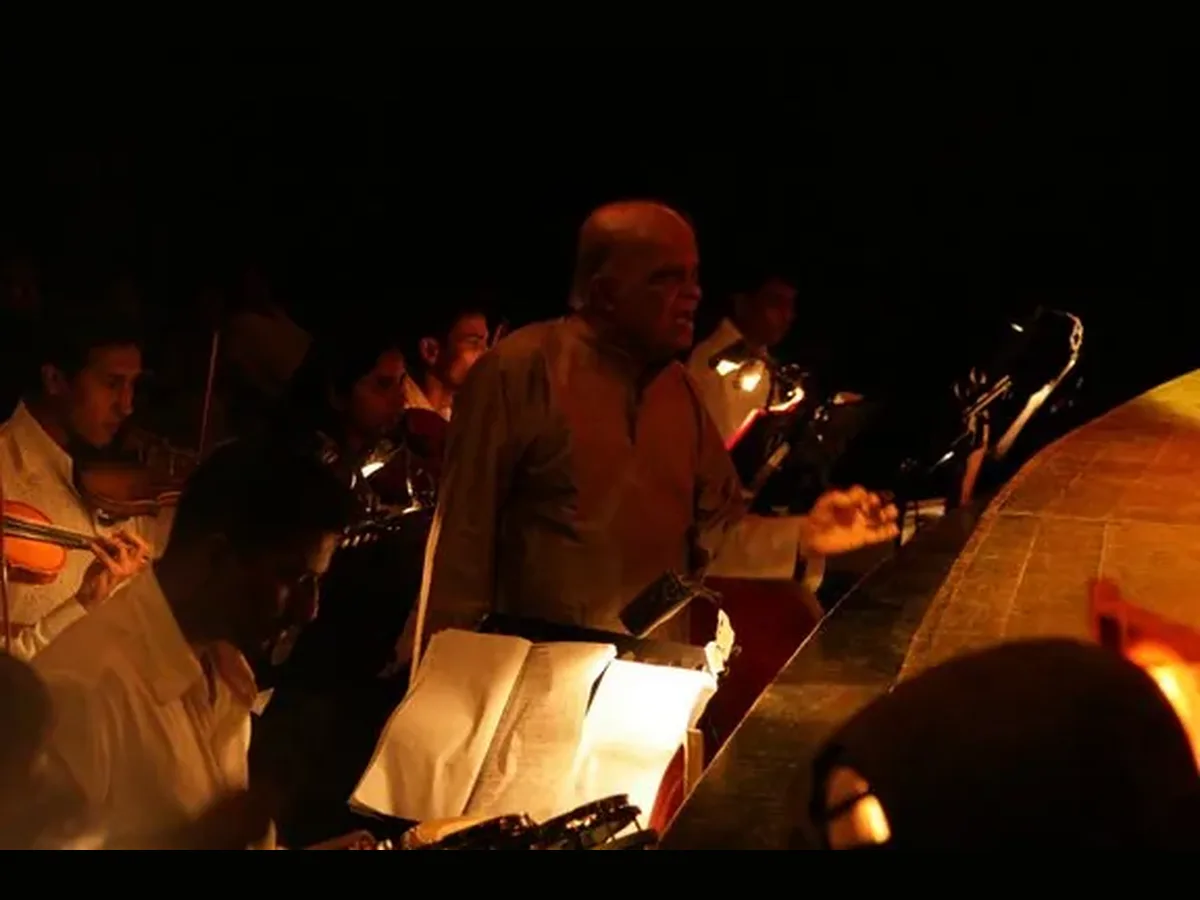
The last was Agni (අග්නි, "Fire"), staged from 2007, with a libretto by the poet Eric Illayapparachchi. It takes the Prometheus legend and sets it among ice-age humans who have no fire: a hunter named Soma sets out to find it, the goddess of fire comes down to earth carrying it, and the Olympian court punishes Prometheus for the theft. Twenty-five musicians played it, Western and Eastern instruments together, and the cast mixed established actors with singers the Khemadasa school had found.
The Foundation
That school became the Khemadasa Foundation, and it is arguably the most durable thing he built. Its students carried his methods into the wider industry: Amarasiri Peiris, Samantha Perera, Indika Upamali, Nadeeka Guruge and Kasun Kalhara all came up through his teaching. It was Nadeeka Guruge who supplied the line most often quoted about him — that Khemadasa was a giant of our times.
He kept working after a kidney transplant, still in his seventies, still trying to secure a future for Sri Lankan music. He was honoured as Kala Keerthi and Deshamanya, and the University of Ruhuna gave him an honorary doctorate. He died on 24 October 2008 in Colombo, aged 71. At his funeral, the students of his Foundation performed Pirinivan Mangalyaya, the cantata he had written about the death of the Buddha.
The country never called him by his qualifications, because he did not have any. It called him Master.