
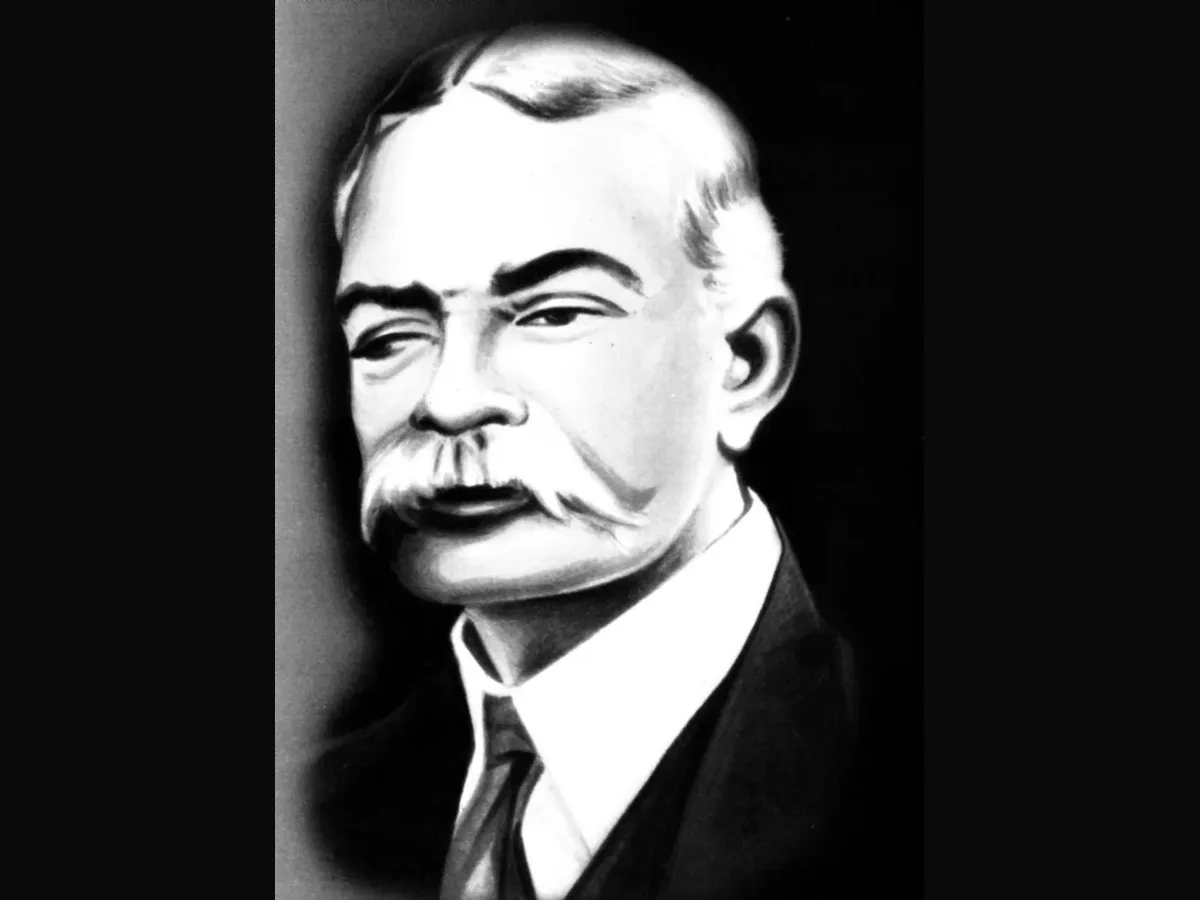
In a rented room in Colombo some time after 1903, two men sat trying to make a song without a shared language. One was a Sinhala playwright who could not compose a melody. The other was a musician from western India who could not read a word of Sinhala. So the playwright described the scene in English — three travellers cresting a bridge and seeing the holy city of Anuradhapura spread out below them — and the musician reached into his knowledge of North Indian raga and produced a tune. Then the playwright wrote Sinhala verse to fit its rhythm.
The song was දන්නෝ බුදුන්ගේ Danno Budunge, "those who abide by the Buddha's teaching". The musician was Visvanath Lawjee. The playwright was John de Silva, and this was how he worked for the best part of a decade — producing, almost as a by-product of writing plays, the melodies that a whole country would soon be humming.
A schoolmaster, a lawyer, and then the theatre
Makalandage John de Silva was born at Kotte on 13 January 1857, to Catholic parents. He was educated first at Christian College, Kotte, and then at the Colombo Academy, which later became Royal College. At twenty he was teaching at St. Joseph's College and afterwards at Wesley College, and while he was doing it he attached himself to oriental scholars — Pundit Batuwantudawa among them — until his command of literary Sinhala matched his English. Later he practised law.
Nothing in that sequence predicts a career in the theatre, and it did not become one until he was well into middle age. His first play, according to the Sinhala Wikipedia account of his life, was a satire aimed at the upper class. What followed was something else entirely.
What nurthi was, and where it came from
In 1877 a Parsi theatre company from Bombay — the Hindustan Dramatic Company — brought to Colombo a kind of show nobody in Ceylon had seen: European-style acts and scenes, painted backdrops, curtains that drew, glittering costumes, and songs built on the North Indian systems of raga and tala. Other troupes followed, returning repeatedly over the next thirty-five years. (Sources disagree about which company came first and when: Wikipedia often credits the Elphinstone Dramatic Company with the 1877 visit, while the peer-reviewed account places Elphinstone's visits from 1882 onwards.)
Sinhala playwrights began writing scripts in the same shape, with songs set to melodies lifted from the Parsi stage. The form was named nurthi, from the Sanskrit nritya. Its first practitioner was C. Don Bastian of Dehiwala, whose Rolina went up in 1877. De Silva went to Bastian's shows as a spectator, and at the start he did what Bastian did: he wrote Sinhala words onto borrowed Indian tunes.
What separated him was the purpose he attached to it. De Silva believed Sinhala Buddhist culture was dissolving under colonial rule and that the theatre could be used to reverse it. His audiences were the Buddhist middle class of Colombo, though the list of donors he kept in his diary shows Christians supported his productions too.
The society, and an argument about metre
In 1902 he founded the Arya Subodha Drama Society to put the stage to work for the Buddhist revival. In the printed preface to Sri Vikrama Rajasinghe (1906) — a play about the last Sinhala king before the British — he set out what he wanted the society to do: loosen the hold of Western habits, display traditional dress and custom, attack bad character, foster love of the Sinhala language, and reacquaint the Sinhalese with their own music.
Then he made an argument that is worth pausing on, because it explains everything he did afterwards. He claimed that classical Sinhala poetic metres were themselves derived from North Indian raga and tala — that the eighteen syllabic instants of the samudraghosa metre came from an eighteen-beat North Indian rhythmic cycle. If that were true, then using Hindustani music was not borrowing from India at all. It was going home. Whether or not the musicology holds, the argument let him treat North Indian classical music as authentically Sinhala, and he built his theatre on it.
Later in his career he turned against the songwriters who simply copied Parsi melodies, and came to insist that nurthi songs should be original compositions grounded in Indian classical music. That is why he paid Visvanath Lawjee — a well-known musician from western India — to come to Ceylon and stay.
The plays, and the songs inside them
Lawjee composed the music for de Silva's most famous musicals, which were staged between 1903 and 1909. The best known are Sirisangabo Charitaya (1903), Sri Vikrama Rajasinghe (1906), Devanampiyatissa (1914) and Viharamahadevi (1916), along with Dutugemunu; he also adapted the Ramayana, Sakuntala, Vessantara, Uttara Rama Charitaya, Rathnavali and Nagananda. One account in the Sunday Times dates his Ramayanaya to 1886, which would put his theatrical work much earlier than the 1903 burst; no other source found here confirms that date.
Danno Budunge belongs to Sirisangabo Charitaya, and comes from the thirty-sixth chapter of the Mahavamsa: Sirisanghabo and his friends Sanghatissa and Gothabhaya arriving at Anuradhapura. Its three verses are three men's reactions to the sight — a town like a great mansion full of monks keeping the precepts; heaven on earth, the monks' shade blocking the hot sun; ducks wading in deep ponds where lotus stems rise to the surface. It is a song about a city, written by a Catholic-born lawyer for a patriotic history play, that the country later made into a sacred song by using it as one. Its full story, including the argument it caused in 2016, is told separately on this site.
After Sirisangabo, his company turned professional under the name Arya Subodha Natya Sabha and played more or less every night. There were no actresses — women did not act then, and men took the female parts — and regular theatregoers would not miss a John de Silva play.
How stage songs became records
Within a few years of Danno Budunge reaching the stage, talent scouts from His Master's Voice, Odeon and Parlophone were knocking on de Silva's door. They had worked out that nurthi songs were the most saleable music in the island. The result is a fact that still surprises people: nearly every record released in Ceylon between 1906 and 1930 was a song from the nurthi theatre. The earliest Sinhala disc named by Sinhala sources is දේවනේ ලෝකපති Devane Lokapathi from the Othello nurthi — not one of de Silva's, but the same trade.
A claim circulates that a 1903 album called Nurthi was Sri Lanka's first record and that it was released through Radio Ceylon. It cannot be true: Radio Ceylon did not exist until the 1920s. The story appears to have entered circulation through an old encyclopedia edit and then been copied into places that now look like independent confirmation. What is defensible is the larger point — that for a quarter of a century, "Sinhala song" on a gramophone record meant a song from a play, and more often than not a song John de Silva had written the words for.
The Tower, and afterwards
The Tower Hall opened on Panchikawatta Road on the morning of 6 December 1911, and that same evening staged Pandukabhaya, written and produced by Charles Dias — a rival dramatist whose plays drew crowds as large as de Silva's, and who happened to be the son-in-law of the man who built the theatre. In the years that followed the Tower's bill was dominated by Dias's work. It is often told that de Silva's plays were deliberately kept off that stage for years, even while the phrase "Tower Hall play" hardened into a synonym for his kind of drama. The exclusion is folklore rather than documented fact; what the theatre's own chroniclers say is only that de Silva's plays came to the Tower later than Dias's.
De Silva died on 28 January 1922. The Sri Lankan government later built the John de Silva Memorial Theatre on Ananda Coomaraswamy Mawatha in Colombo, and a commemorative stamp was issued on 31 January 1987. In 2000 the pop duo Bathiya and Santhush rebuilt the theme song of his Sirisangabodhi as a chart record, which is a strange kind of immortality and also exactly the kind he had — his melodies keep arriving in forms he could not have imagined, still being sung by people who could not name him.