
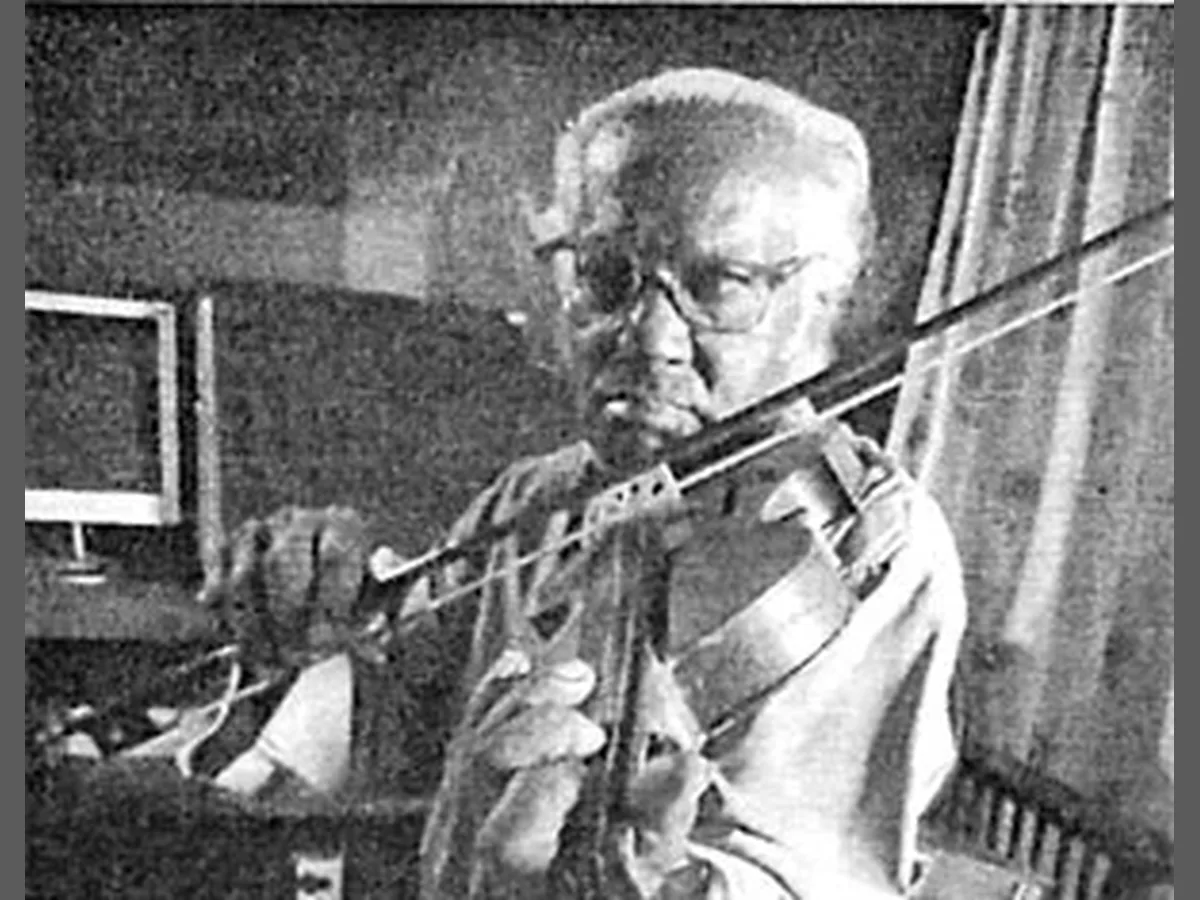
The house he grew up in stood next door to the New Olympia Cinema on Daly Road, Maradana. His father, Alahakoonge Don Martin Perera, was a Tower Hall man — a playwright and a singer on the nurthi stage, and later a small-part actor in early Sinhala films including Podi Putha and Rekava. A boy in that house heard the theatre from both sides: the recorded music going into the cinema next door, and the live stage music coming home with his father. When Martin Perera noticed that his son could not leave musical instruments alone, he did not discourage him. He found him teachers.
The teachers
He was born on 6 May 1932 at Nittambuwa, in Attanagalla, and schooled at Sri Sangharaja Central College in Maradana. (English Wikipedia's own infobox is internally inconsistent here: the birth date is given as 1932 while the death template computes from 1933. The Sinhala accounts say 1932.)
His father sent him first to H. W. Rupasinghe, one of the giants of Ceylonese music at the time and the teacher who had trained Rukmani Devi, for the theory and practice of the notes. Afterwards he studied further with Romulus Silva, T. D. Edwin Perera and W. Sylvester, and took up the violin under W. D. Amaradeva and the musician B. Victor Perera. He sat the central examination of the Bhatkhande Music Institute in Lucknow — English Wikipedia dates this to 1968, while the Sinhala biographical sketch places it earlier, before he began teaching — passed it, and was appointed a government music teacher, starting at the Maradana school he had himself attended.
That combination, a Tower Hall childhood plus a Bhatkhande certificate plus a violin, made him exactly the kind of musician the new Sinhala theatre of the 1950s needed, and he spent years in the pit before he ever wrote a score.
In the orchestra
He played violin in the ensembles for Ananda Samarakoon's Kalu Ethana, for Ediriweera Sarachchandra's Maname and Kada Walalu, for Gunasena Galappaththi's Sanda Kinduru, Muduputtu, Devatha Eli and Thaththa, for Dharmadasa Kuruppu's Senaka Nadagama and for M. H. Gunathilaka's Sakkaya Ditti. On the Tower Hall stage itself he played in the nurthi repertoire his father had belonged to: Wessanthara, Sirisangabo, Shakuntala, Vidura, Dharmasoka, Padmawathi and Sri Wickrama.
One detail from those years is worth keeping. In 1961, putting together an orchestra for the play Sakkarawattama, he picked three young players: Sarath Dassanayake on sitar, Victor Rathnayake on violin, and Wijeratne Ranatunga on tabla. All three became major figures. A pit orchestra in Colombo in 1961 was, among other things, a place where the next twenty years of Sinhala music was being assembled.
G. D. L. Perera, and the film work
His long working friendship was with the director G. D. L. Perera and the artists' circle around him, Kalapela. He first shared music direction on the stage play Thammenna in 1958, and in 1960 became music director for G. D. L.'s play Saama.
When Saama was made into a film — released in 1965 — the music came with it, and that was his first film score. For it he set වනන්තරේ ගල් අරණේ Wananthare Gal Arane, a lyric by Sugathapala Senarath Yapa, sung by Mallika Perera, written for the scene in which a young woman leaves her village by cart. He arranged the notes to bring out the grief in the scene rather than to decorate it, which is a fair description of most of what he did afterwards.
Three years later came the film he is best remembered for. G. D. L. Perera's Dahasak Sithuvili (1968) carried සතුට විලයි සැපත මලයි Sathuta Wilai Sapatha Malai — "happiness is the lake, contentment the flower; if you do not pluck it, flower and hand are one; delay too long and the flower fades; under the sun and under the moon, time runs on." The words were by Nimal Wickramasekara, and Alahakoon's setting borrowed from the calypso and Latin-American idiom that had been in fashion since the early 1960s — a party scene in a Sinhala film, scored the way a party scene deserved. It is still on the radio.
He also composed for Hora Police (1968) and, much later, Chakrayudha (2000). In 1976 he took the lead role in Sirisena Saha Violinaya, a short made under the State Film Corporation's first short-film programme, and wrote its music too.
The stage work never stopped, and it ranged across every kind of Sinhala play then being written — stylised drama, realist drama, song-drama, children's work. He scored G. D. L. Perera's Magul Mathe and Mehew Lokeka, Chandi Kannangara's Hevayo, S. Karunaratne's Buhuman Soya, Wetta Pittala, Erabadu Mal and Mala Kolan, Sugathapala Senarath Yapa's Mati Balallu and Hiru Nonagina Rajaya, Gunasena Galappaththi's Mahene Ririyaka, Namel Weeramuni's Hatharaweni Thattuwa and Madyawediyakuge Asipatha, Mudalinayake Somaratne's Gini Kandu and Suneth Gokula's Ran Pihatu. He painted stage sets as well.
Songs off the screen
Away from film he wrote for singers directly. Two of the best known went to Nanda Malini: කප් සුවහස් කල් Kap Suwahas Kal ("having fulfilled the perfections for a hundred thousand aeons, having borne endless obstacles and pain, seeing the signposts of birth after birth, I came looking for you"), to a lyric by Ratna Dissanayake, and Kuravi Kevillan, to words by Sunil Ariyaratne. He composed Ai Thavamath Mula Wenna and Minimuthu Nehe Mata for Wijeratne Warakagoda, and Galak Pala Galak Dutimi and Amma Amma for Mallika Perera. Through the 1970s he had a regular platform on national radio.
Alongside all of it he kept the day job, teaching music at Sanghabodhi Vidyalaya in Maradana and Vidyawardana Vidyalaya in Borella. He married Anula Dissanayake of Peradeniya — the Sinhala account dates the marriage to 1972 — and they had six children. He retired from government service in 1995.
The silent musician
Sarasaviya's tribute called him nihanda miyesi minisa, the silent musician, and the phrase stuck because it was accurate. He worked for six decades on stages and film sets where the credit went to the playwright or the director, in a corner of the industry that produces no celebrities. In 2014 the writer Lal Ananda Abeydheera devoted a chapter of his book Miyesi Harasara to him, one of five musicians profiled — the others being Sisira Senaratne, Victor Dalugama, Sarath Balasooriya and Chandradasa Bogoda — which is roughly the level of recognition a career like his usually reaches. In 2017 he received the Suwada Padma award for his contribution to Sinhala song.
He died in Colombo on 23 January 2019.