
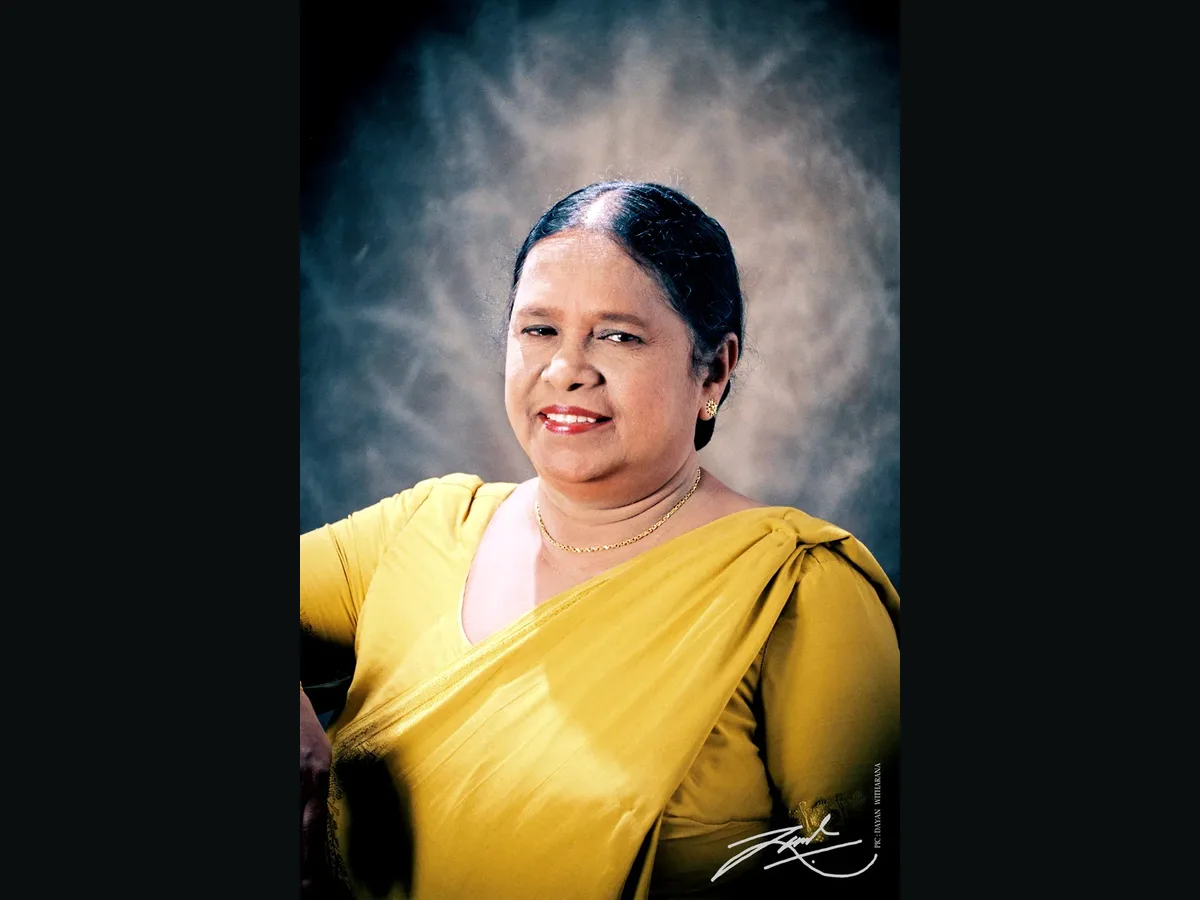
In 1956 Lester James Peries took a film crew out of the studio and into a village, and Sinhala cinema stopped imitating Madras. Rekava needed songs that sounded as if they had grown where the film was shot, and two of them went to a twenty-one-year-old singer: වෙසක් කැකුළු Vesak Kekulu ("Vesak buds") and සුදු සඳ එළියේ Sudu Sanda Eliye ("in the white moonlight"). Seventy years on, Sri Lankan children still learn both. The singer was Indrani Wijebandara, and she had already been on the radio for the better part of a decade.
A child on Radio Ceylon
She was born on 15 July 1935 in Borella, the eldest of five children of M. M. W. Wijayabandara, who worked in the Department of Health, and his wife Lilian. Her primary school music teacher, Eva Perera, was the first to notice her voice. Musaeus College entered her in a Kokila poetry competition organised by the Young Men's Buddhist Association and she came first in the island.
At twelve she was introduced to Sunil Santha by Father Marcelline Jayakody — the Catholic priest who wrote some of the best-loved Sinhala lyrics of the century — and through him joined the special programmes marking the twenty-fifth anniversary of broadcasting in Ceylon. She sang in Sri Chandraratne Manawasinghe's radio dramas, and she joined Sarasavati Mandapaya, the Radio Ceylon programme run by the announcer Karunaratne Abeysekera that trained a generation of child artists. Her first recorded song was Thun Loka Guru Budu Sasi Piya; the one that made her known was Somnasa Ho Santhapaya, sung with Susil Premaratne, and it was under Premaratne and Sarath Wimalaweera that she was first put in front of a Columbia Records microphone. On another Columbia record she sang Ayubowan Vasanawan to Abeysekera's words. She later studied at Devi Balika Vidyalaya, and by then the film studios were asking for her.
She was also on stage as a schoolgirl, in a production of Sakunthala and then as lead singer of the chorus in Sirisangabo, and her voice first went out over the air in a radio play, Esala Sanda, written by a family friend called K. A. W. Perera who would later become one of the busiest directors in Sinhala cinema. The company she kept while still a teenager is a fair index of where Sinhala song was at that moment: the lyricists around her included Dunston de Silva, Edwin Samaradiwakara, Sri Chandraratne Manawasinghe and Mahagama Sekera, and the musicians included W. D. Amaradeva.
Rekava and after
Rekava was the start of a film career that ran, on and off, for forty years — Sooraya (1957), Deyyange Rate and Daskama (1958), Sirimali and Purusha Rathnaya (1959), on through Sansare (1962), Mangalika (1963), Handapana (1965), Praveshamwanna (1969), Aasha (1976), Deepanjali (1978) and as late as Punaruthpaththiya in 1997.
The Rekava songs were popular enough that K. Gunaratnam of Cinemas took her to the Modern Studio at Salem in South India to record Hithannako Ayye for Sooraya — the standard practice at the time, when Ceylon had no film-recording facility of its own. It is worth remembering how few women were making records in Ceylon at all when she started. Rukmani Devi's HMV session of 1938 is the earliest documented Sinhala recording by a woman, and the field was still small and closely policed by the radio grading panels when Wijebandara walked into it as a child artist. Out of that decade came ඕලු නෙළුම් නෙරිය Olu Nelum Neriya, බුදු සාමිනේ Budu Samine, දඟකාරී මං Dangakari Man ("mischievous me"), ගයා ගීතයන් ගමේ වෙල් එලියේ Gaya Geethayan Game Wel Eliye, Sal Sapu Mal, Nilmini Dese and මල් සූටික්කෝ Mal Sutikko.
Sisira and Indrani
She met Sisira Senaratne on an Air Ceylon flight to Madras — both were travelling to record the music for Rekava. They married on 31 May 1962, after a courtship of seven years, and from 1957 onwards he composed the melody for essentially everything she sang.
What the two of them did together matters more than the marriage. Sinhala popular song in the early 1950s was largely built on borrowed melodies, most of them lifted from Hindi film music, with Sinhala words fitted over the top. Senaratne wrote original tunes instead, in a plain, singable, recognisably local idiom, and Indrani sang them. Sri Lankan writers describe the pair as having ushered in a new era in Sinhala music in the 1950s, and songs such as Olu Nelum Neriya are the usual evidence. The other half of the achievement is the children's repertoire: Vesak Kekulu, Sudu Sanda Eliye, Mal Sutikko, රතු පාට මල් Rathu Pata Mal ("red-coloured flowers"), හඳපානේ මල් පිපුණා Handapane Mal Pipuna. Before the two of them, the body of Sinhala song written specifically for children was thin; afterwards it was a school-curriculum staple, and it still is.
They toured the diaspora together for decades with a concert programme called Sisindra — Canada, Britain, the United States, Dubai, Australia, Germany, Switzerland, Italy — and launched its Sri Lankan edition at the Kularatne Hall of Ananda College in Colombo alongside her autobiography, Ranpiyawara, and an album of their duets called Iresha. The book covers fifty-five years of a working life in music. Sisira Senaratne died on 4 February 2015, aged 79.
Honours and last years
She won the Deepashika award in 1959. In 2000 she received a Pioneering Award at the thirteenth Presidential Awards; in 2001 an OCIC award; in 2007 the Rana Thisara award at the Sarasaviya festival. She went on performing into the middle of the 2010s, a career spanning more than six decades.
She was admitted to the National Hospital of Sri Lanka with breathing difficulty on 21 June 2019 and died there two days later, on 23 June, aged 83. The funeral was held at Borella cemetery on 27 June.
Two names, and two Indranis
Anyone searching Sinhala-language sources for her will run into the fact that the press almost always called her by her married name: ඉන්ද්රාණි සේනාරත්න, Indrani Senaratne. Her death was reported under that name by Ada Derana, Siyatha, the SLBC and most of the Sinhala papers, while English-language reports used ඉන්ද්රානි විජේබණ්ඩාර, Indrani Wijebandara. Song databases carry her under both, sometimes as two separate artists with the catalogue split between them.
The second confusion is with a different woman entirely. Indrani Perera, born in the 1950s, is the band-era singer who joined the Moonstones to sing Dilhani and became the third member of the Clarence Wijewardena–Annesley Malewana pop trio; she is alive and still performing, and she has her own article here. Indrani Wijebandara belongs to the generation before — radio drama, Columbia 78s, Rekava, and the children's songs. They are not related and their careers barely overlap.