
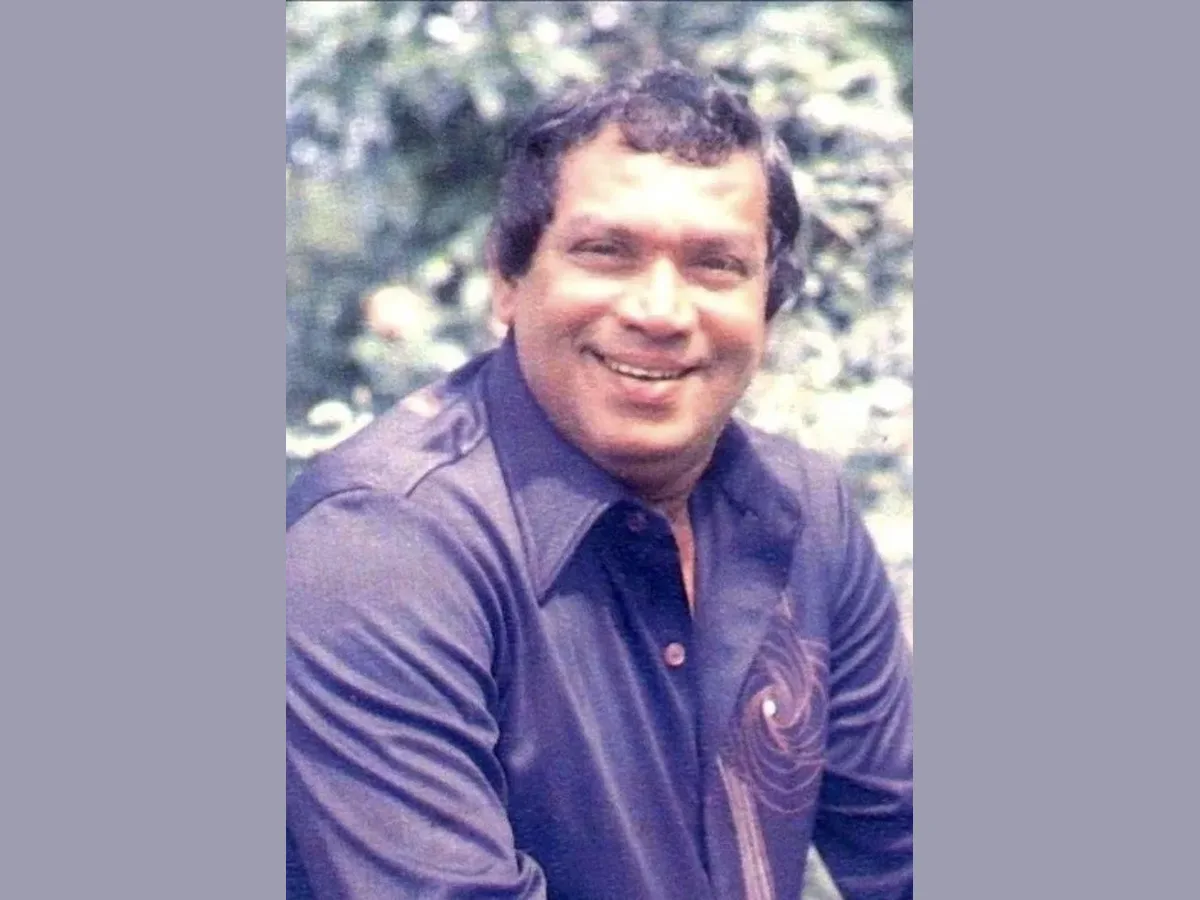
There was no radio in the house. So the boy walked to the tea kiosks in the neighbourhood, where there was one, and stood outside listening. That is roughly the whole of his musical education, and it is the reason that half a century later people still argue about him: H. R. Jothipala learned to sing the way most Sri Lankans learned to listen, from a loudspeaker in a shop, and he never entirely stopped sounding like the street he came from.
Dematagoda
Hettiarachchige Reginald Jothipala was born on 12 February 1936 in Dematagoda, Colombo, the eldest of six children. The family's roots were in Matara; his father, H. R. James, was a tailor and his mother, Podinona Perera, a nurse. He went to St. Lawrence College, Maradana, and St. John's College, Dematagoda, and then to work — cleaning medicine bottles at the Sulaiman Hospital on Armour Street, and afterwards as a peon at the booksellers M. D. Gunasena.
A tabla player named Nadarajah, who lived at Kosgas Junction in Grandpass and was among the best radio percussionists in the country, heard him singing and picked him up to sing Hindi songs at Colombo weddings. B. S. Perera, the film music director who then headed the radio orchestra, was the first professional to say the boy had something. In 1952 Jothipala went in for Adhunika Peya, an amateur talent programme on the radio sponsored by the Queen Sweets company, and won it; then he won first place on Jayagrahi Pelapaliya as well.
Three doors that closed in 1955
Then came a year that would have finished most people. Sources record three separate rejections in 1955. He went to the music director known as Wimalaweera Master for the film Podi Putha, and was told his voice trembled and was not sweet. He and a friend travelled to Negombo to see B. A. W. Jayamanne and Rukmani Devi, who liked the voice — but the recording would have to be made in India and Jothipala had no passport. Third, A. B. Raj, directing Perakadoru Bena, turned him down for a rough voice.
He has said that when he went with friends to watch Podi Putha and found his song was not in it, he thought about ending his life.
Siriyame Sara
The break came in 1956. Jabir A. Cader, producing Cyril P. Abeyratne's Surathalee, wanted to hear a recording before deciding. Jothipala did not have the money to cut one; the musician Stanley Omar advanced him thirty-five rupees, which was a great deal at the time. The song was සිරියා මේ සාරා Siriyame Sara, recorded under the direction of T. R. Papa at Vahini Studio in India, and it is still sung today. (Sinhala Jukebox's tribute page records an earlier recording still, Mage Ran Rajini, made in the early 1950s.)
Four years later he sang for Lester James Peries: Puruthugeesi Karaya in Sandeshaya, to a tune by Sunil Santha, words by Arisen Ahubudu and music direction by R. Muthuswamy. It is worth pausing on that credit list, because it disposes of a lazy idea about him. The singer who is remembered as the voice of commercial cinema also sang, early and well, for the most serious film-maker and one of the most serious composers the country had.
From the late 1960s through the 1970s he was simply the default. He gave his voice to actors from Eddie Jayamanne's generation to Ranjan Ramanayake's, sang under P. V. Nandasiri, Premasiri Khemadasa, Sarath Dassanayake and Milton Mallawarachchi, and recorded duets with Sujatha Attanayake, Latha Walpola and — most often — Angeline Gunathilake. He acted in about thirty-five films himself, from a crowd part in Daskama in 1958 to leading and villainous roles later, and produced two, Sumithuro and Obai Mamai. His closest friend was the singer J. A. Milton Perera; with Perera and M. S. Fernando he recorded the baila Pissu Vikare, itself a version of the Tamil song Dingiri Dingale from the 1958 film Anbu Engey.
How many songs he recorded is genuinely unknown. Published figures run from a few thousand to well over ten thousand, and none of them is traceable to a count anyone actually made. The honest answer is that nobody knows, and that the number is very large.
The Rafi question
The criticism followed him all his life and follows him still: that he sang Sinhala words to tunes lifted from Hindi film songs, above all from Mohammed Rafi. The charge is true as a description of a great deal of the repertoire. What it leaves out is that the entire commercial Sinhala film industry of the period worked that way, and that the practice was an industry economics problem before it was a singer's moral one.
It also leaves out the reason he was loved. He was called හදවත රත්තරං ජෝති Hadawatha Raththaran Jothi — golden-hearted Jothi — and the name attached to him because of how he treated people, across every community and class, not because of how he sang. When his awards came, they came for songs of some weight: Best Singer for Mee Jeevanaye from the 1974 film Onna Babo Billo Enawa, and Sarasaviya awards for සරා සඳේ Sara Sande from Meedum Sihina and for Paalu Susane from the 1986 film Obata Divura Kiyannam.
Kataragama, July 1987
On 5 July 1987 he sang at a Gam Udawa event, the rural development festival associated with Ranasinghe Premadasa. Accounts say he felt pain while performing and finished the set anyway. It was his last open stage. He was admitted to hospital the following day and died at Ratnam's Private Hospital on 7 July 1987, aged fifty-one. Sources disagree about what killed him: some reports say cardiac arrest, others liver failure, and this article does not choose between them.
When the news spread, crowds filled Union Square outside the hospital, and some climbed the gates to see him one last time. It is a scene that says most of what needs saying about the difference between critical standing and public love. Nearly forty years on, commemorations are still held for him somewhere in the country every July.