
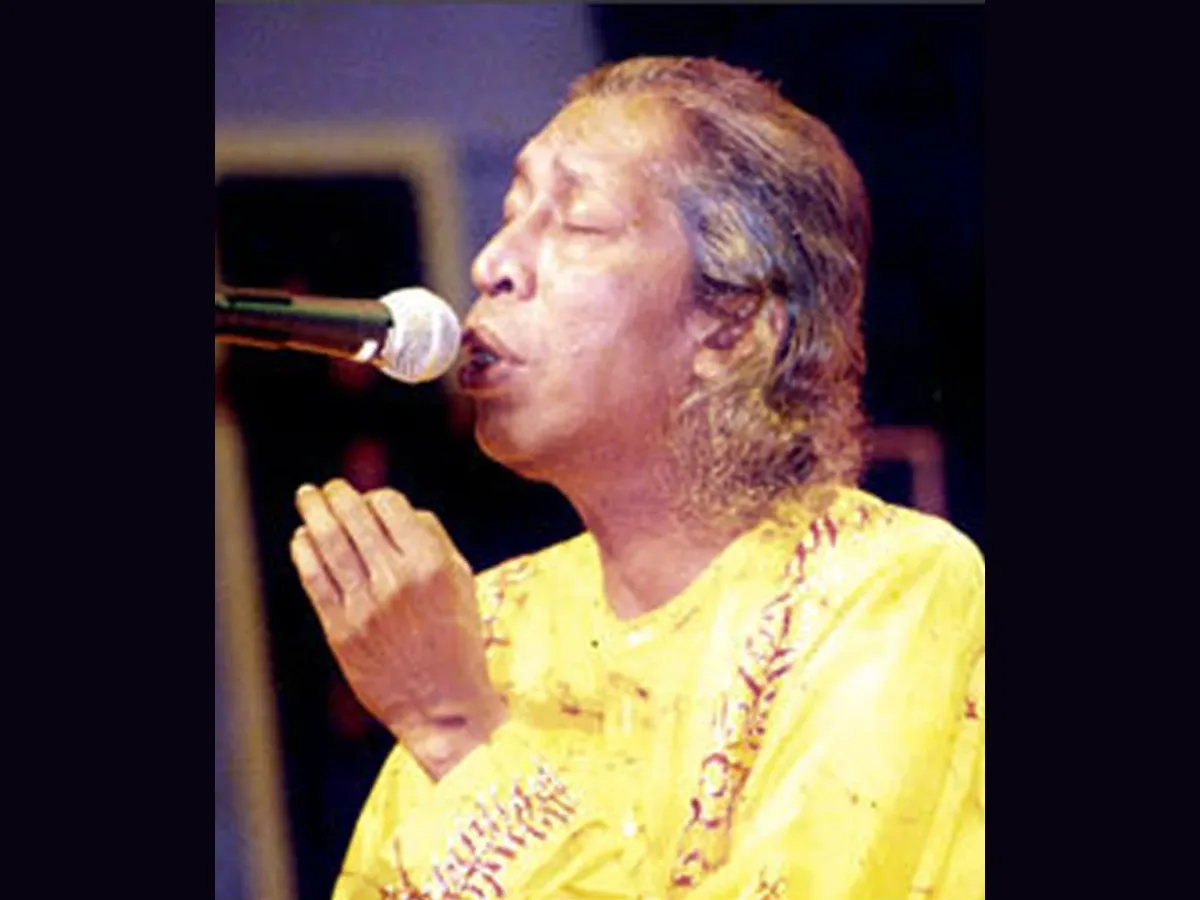
He came down the aircraft steps at Katunayake in the summer of 1978 and someone from his own office was waiting for him on the tarmac with an envelope. Inside was a letter from the Sri Lanka Broadcasting Corporation informing Gunadasa Kapuge that he had left the service. He had not resigned. He had gone to a youth conference in Havana after his application for leave was turned down, and the state had decided that going was the same thing as quitting.
That letter is the hinge of his life. What follows it — reinstatement, arrest, expulsion, reinstatement, banishment to a regional service, and finally compulsory leave — reads less like a career than a slow argument between a singer and the institution that employed him. He lost the argument on paper every time. He won it in the only place that mattered, which was in front of an audience.
A boy from Thanabaddegama
Ellamulla Kapuge Gunadasa was born on 7 August 1945 in Thanabaddegama, a small village in the Elpitiya area of the southern Galle District, the second of eight children of Ellalamulla Kapuge Francis and Dona Alice Nona Siribaddana. He was schooled at Karandeniya Central College up to grade five and then at Dharmasoka College in Ambalangoda, where he started out in the science stream and switched to music. His elder brother Premawardhana Kapuge also became a singer.
In 1963 he was studying at the Heywood College of Music in Colombo — the institution that grew into the University of the Visual and Performing Arts — and left it to take up a course in India, at the Bhatkhande Music Institute in Lucknow. He played tabla and sitar as well as singing. By the end of the decade he was inside the state broadcaster: an operational assistant by 1969, a programme producer by 1975. This matters to everything that came after. Kapuge was not a freelancer the state could ignore. He was a public servant with a voice, and the two were never going to sit comfortably together.
දෑස නිලුපුල් තෙමා
His first release came in 1973, a song recorded for a cultural programme on the SLBC: දෑස නිලුපුල් තෙමා Daasa Nilupul Thema ("eyes wet as blue water lilies"), with words by the lyricist Priyananda Wijesundara. It was an immediate hit and it settled the question of what his voice was for. Radio Ceylon graded him an A-class vocalist, and for the next thirty years that hoarse, unpolished, slightly grainy sound — a voice more spoken than sung, with the grain left in — carried some of the most argumentative lyrics in the language.
The songs are not love songs, or not only. සබඳ අපි කඳු නොවෙමු Sabanda Api Kandu Nowemu ("friend, we are not mountains"), බිම්බරක් සෙනඟ Bimbarak Senaga ("a multitude of people") — which reaches back to the Uva-Wellassa rising against the British — and උතුරු කොනේ Uthuru Kone ("in the northern corner"), an appeal for the Tamil north and the Sinhala south to look at each other as neighbours, all belong to a repertoire that treats a three-minute song as a place to think out loud. He also had a strange and lovely habit of reusing a melody: සොඳුර නුඹ ලිහිණියක Sonduru Numba Lihiniyaka, set by Ratna Sri Wijesinghe, shares its tune with Sabanda Api Kandu Nowemu and with රාත්රිය මම වෙමි ය Rathriya Mama Wemi ("I am the night"), three different lyrics living inside one line of music.
Alongside these came the cassettes that sold: Dampatin La Sanda Basa Yanawa (1980), his first, with Malani Bulathsinhala; සීතල සඳ එළියේ Seethala Sanda Eliye ("in the cool moonlight", 1981); උන්මාද සිතුවම් Unmada Sithuwam ("frenzied paintings", 1983); Piya Satahan (1990); Irabatu Tharuwa (1999) and Sanda Ra Sihine (2000). He wrote music for the stage from Sugathapala de Silva's Thuranga Sanniya onward, for Lucien Bulathsinhala's Tharawo Igilethi, and scored films including Sanda, Madduma Bandara, Bawa Duka and Bawa Karma.
The long quarrel
The sequence of his troubles with the SLBC is unusually well documented, act by act, in Sri Lankan features written after his death.
He was invited to an international youth conference in Havana and applied for leave. The application was refused. He went anyway, in July 1978, and received the letter at Bandaranaike International Airport on his return telling him he was out of the service. He got the job back in 1979 and was arrested the same year on a charge of insulting Ranasinghe Premadasa, then Prime Minister; he was released while the allegation was still being investigated. He was expelled from the Corporation again, and re-employed again through the intervention of its chairman, Eman Kariyakarawana — this time transferred out of Colombo to the Rajarata Service, the regional station serving the north-central dry zone. He made the best of the exile: by 1981 he was head of its music division and later head of the service itself. Then came the bheeshanaya, the terror of 1988–89, and a singer whose repertoire was full of arguments about power was not a comfortable employee. On 29 January 1990 he was sent on compulsory leave.
The Sinhala-language accounts of the period place his songs squarely within vimukthi gee, the liberation-song repertoire associated with the Janatha Vimukthi Peramuna from its earliest years, and Sinhala Wikipedia describes him as one of the singers at those concerts. What is beyond argument is the state's own conduct: over twelve years it dismissed him twice, arrested him once, posted him out of the capital and finally shelved him.
කම්පනය
Six months after the compulsory leave, on 25 August 1990, Kapuge walked onto the stage of the Lumbini Theatre in Colombo with a show called කම්පනය Kampana ("tremor"). One man, one programme, no institution behind him. It was released as a cassette and later a CD under the same name.
In roughly two years he performed Kampana close to a thousand times across the country. Audiences would not let him leave: a two-hour concert routinely stretched to three because the hall asked for more. It is worth being precise about what this meant in 1990. The state had removed his platform, and he replaced it with village halls and school grounds, one night at a time, and reached more people that way than the Rajarata Service ever would have. Victor Rathnayake's Sa had shown in 1973 that a Sinhala singer could hold a stage alone; Kapuge showed that a singer could use one to survive being unemployed.
The airport again
On 3 April 2003 he died at the National Hospital in Colombo, aged fifty-seven. He had returned from a tour in Dubai and fallen while getting off the shuttle bus at Bandaranaike International Airport, injuring the back of his head. He was taken to the airport medical centre at about 4.30 in the morning and given saline; the plan was to move him to Colombo. The inquest reporting afterwards turned on who had and had not been on duty at that medical centre in the small hours. He had walked out of that airport twenty-five years earlier holding a letter that told him he no longer had a job.
His songs did not need the Corporation. The Gunadasa Kapuge Foundation has marked his birthday every August since; his son Mithra Kapuge and his brother Premawardhana sing the repertoire; and Sabanda Api Kandu Nowemu is still, decades on, the song people reach for when they want to say something in Sinhala that is difficult to say plainly.