
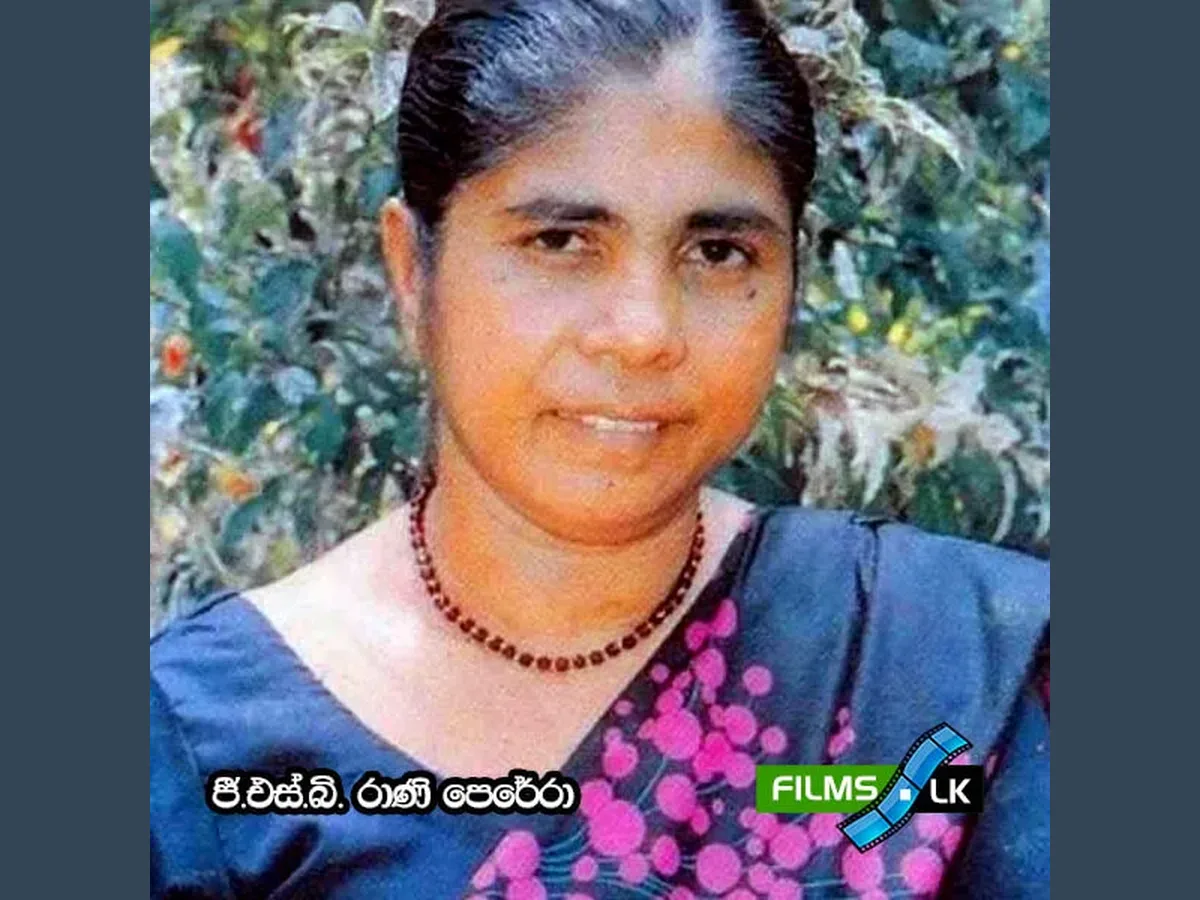
In 1944 a schoolgirl went along to the Columbia recording studios in Colombo to keep her cousin Ahmed company at an audition. She was there to watch. By the end of the session the men running it — U. D. Perera and the composer Mohammad Ghouse — had put her in front of the microphone instead, and she left with two records to her name: Samagi Bale Pame and Siri Sara Bhavane, the second a duet with Mohideen Baig.
Then came the hard part, which was her father. A police sergeant did not want his only daughter's name on a gramophone label. The compromise reached between him and the record company was to reduce her name to initials. Gnai Seenar Bangsajayah became ජී. එස්. බී. රාණි — G. S. B. Rani — and stayed that way for sixty years.
Guruwatta
She was born in the village of Guruwatta near Badulla, the only daughter of a Sri Lankan Malay family. Her father, Nusammeen Bangsajayah, was a police sergeant who later made sub-inspector; her mother was Chintha Nona. She finished school at Clifton Balika Vidyalaya in Colombo.
Her dates are genuinely unsettled. Both the English and Sinhala Wikipedia articles open by giving her birth as 18 October 1934, and then contradict themselves a paragraph later with 20 August 1930 — which is also the date in an appreciation published in the week she died, alongside the statement that she was seventy-four. The 1930 date is the one that fits the rest of the story, since every account has her recording at fourteen in 1944. Her name is spelled differently across the two Wikipedias too: ජී. එස්. බී. රාණි in Sinhala, ජී. ඇස්. බී. රාණි in English.
The most-recorded woman of the first film generation
Two years after the Columbia session she was invited to sing playback for Asokamala. She could not go: both her parents died in that period, she was unable to travel to India for the recording, and the Indian playback singer Bhagyarathi sang the songs instead. It is a small, brutal illustration of how the industry then worked — the recording was being made in India, and if you could not get on a boat you did not sing.
She was brought into Radio Ceylon for an audition under P. L. A. Somapala, and graded an A-class artiste in the round of auditions conducted by the Indian musicologist S. N. Ratanjankar — the same grading system whose 1952 sequel Sunil Santha boycotted, and which decided who could and could not work in Sinhala music for a generation.
From there she sang for very nearly every Sinhala film of the 1950s and 1960s, most often in duet, with Mohideen Baig, Dharmadasa Walpola, H. R. Jothipala, Sisira Senaratne, N. Karunaratne and W. Prematilleka. Her entry into cinema proper came in 1955 with Asoka, directed by Sirisena Wimalaweera, where she and Mohideen Baig sang පෙම් පහන නිවී Pem Pahana Nivi ("the lamp of love gone out"), which was a large hit. Then came Surangani with Dharmadasa Walpola. Her best-remembered songs include පරම රමණී අපේ ආලේ Parama Ramani Ape Ale ("our love, most lovely") and සැංගී සැංගී Sangi Sangi; a surviving discography also lists වලාකුලක් මෙන් ඈතට පාවුනා Walakulak Men Athata Pawuna ("drifting away like a cloud") and සඳෙහි සඳුන් වනේ Sandehi Sandun Wane. She sang in Hindi and Urdu as well as Sinhala.
She acted, too, on stage before the screen: Mandri Devi in J. D. A. Perera's Wessanthara, Queen Premila in Upali Wanasinghe's Daskon, and the lead in Rodi Kella. On film she appeared as an aunt in Surangani (1955) and as a garment-factory supervisor in Duppathage Duka (1956) — small parts alongside a very large singing career.
In 1953 she married Ranawaka Arachchige Anton Perera, an employee of the Steel Corporation, and became G. S. B. Rani Perera. She was Malay, he was a Sinhala Catholic, and the family later became Buddhist. They had three children.
The producer's chair
The most consequential part of her career was not sung at all. From 1970 to 1977 she worked as a music programme producer for the Sinhala service of the state broadcaster, running programmes including Jana Prasangani, Geetha Tharangani and Prabuddha Gee.
She arrived in the job at exactly the moment the Corporation decided to stop broadcasting Sinhala songs built on borrowed Hindi and Tamil film tunes — the practice known contemptuously as vacana danava, "putting words". Enforcing that policy, and finding original material to fill the hole it left, fell to her. Over those seven years she brought into the studio a list of singers who between them defined the next thirty years of Sinhala music: Nanda Malini, Victor Rathnayake, Edward Jayakody, T. M. Jayaratne, Priya Suriyasena, Malani Bulathsinhala, Abeywardhana Balasooriya, and H. R. Jothipala. Accounts credit her tenure with more than 7,000 new original Sinhala recordings, a figure that should be read as the scale of an archive rather than an audited count.
She also put a young Buddhist monk on air for a programme called Dhamma Chinthawak, said to have been the first Buddhist sermon broadcast on Sri Lankan radio. The monk was later ordained as Panadure Ariyadhamma Thera.
Punished, and reinstated
Rani was a lifelong Sri Lanka Freedom Party activist — all-island organiser of the party's women's wing, encouraged into politics by her brother-in-law, the politician R. S. Perera. In 1967 she contested the Milagiriya ward in the municipal elections and lost by 448 votes. She stayed in party politics for forty-five years.
It cost her. After the change of government in 1977 she was frozen out of the Sri Lanka Broadcasting Corporation as a singer for fifteen years; one account says the building itself was closed to her, and blames an anonymous poison-pen letter from a jealous colleague as the immediate trigger. Whatever set it off, the effect was that one of the country's most-recorded women simply stopped being recorded, at the height of her powers, for a decade and a half.
She came back in 1994, appointed a director of the Independent Television Network by President Chandrika Kumaratunga, a post she held until 2001. In 1995 the Sarasaviya Awards gave her the Rana Thisara for her service to cinema and music; she also held the state titles Kala Suri and Wishva Prasadini.
Sixty years, and one last duet
In February 2004 she marked sixty years of singing with a concert at the BMICH, named Parama Ramani after her own song. The next month she travelled to London for the first time, to sing at a Swarna Gee concert organised by the Hela Sarana charity, and found Camden Town Hall packed. "I feel like I have come to see my own children in London after so long," she said. She told the audience she considered her second career to be starting there, at seventy-four.
At that concert she sang a duet with Ishaq Baig, the son of Mohideen Baig — with whom she had cut her first record sixty years earlier. It made her, as far as anyone has recorded, the only Sri Lankan woman to have sung with both a father and his son. She died on 7 September 2004, six months later.