
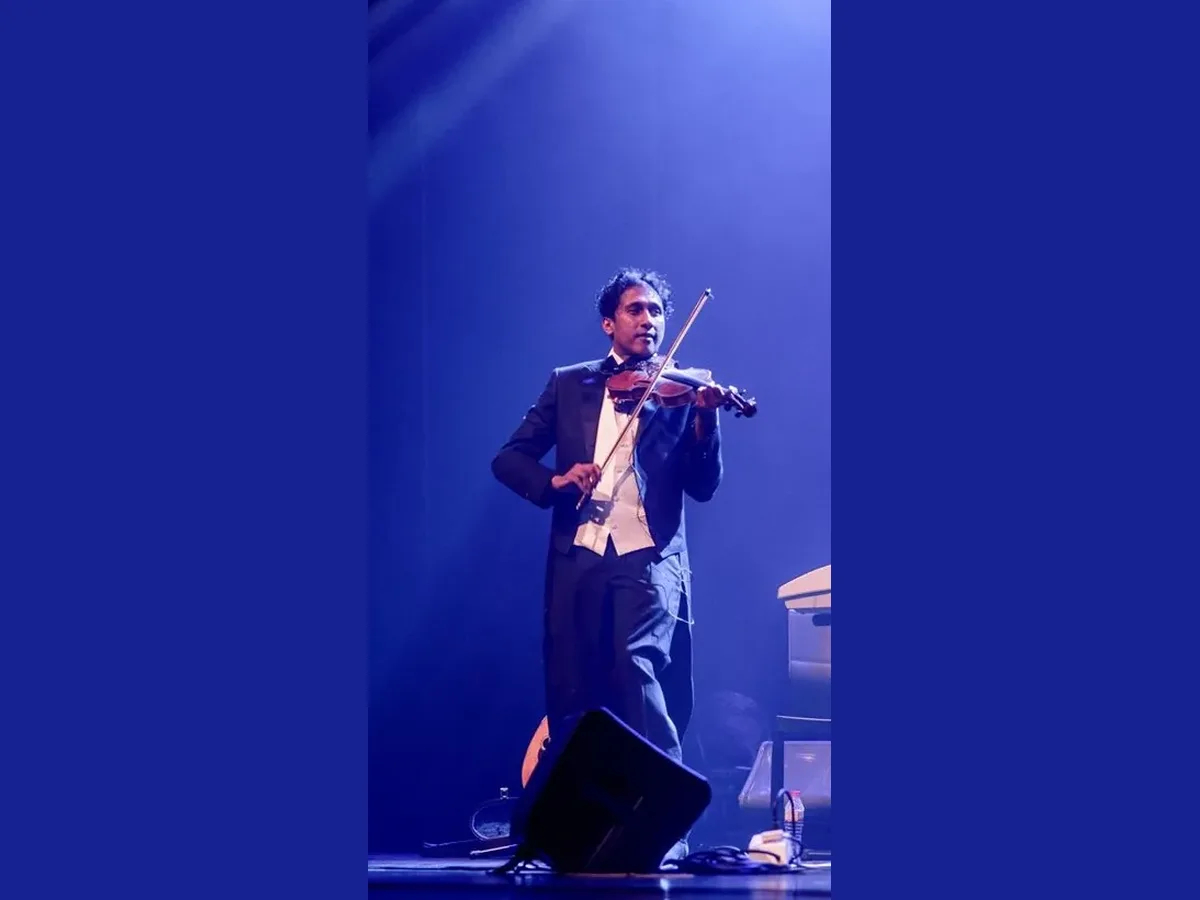
There is an instrument in Sri Lankan legend called the ravanahatha, said to have been played by King Ravana himself: a bowed fiddle with a coconut-shell body, a bamboo neck and a horsehair bow, which survives as a living folk instrument in Rajasthan but which nobody in Sri Lanka still played. In the mid-2000s a violinist in his twenties decided that this was an unacceptable state of affairs, had one built, taught himself to play it, and in 2007 recorded an album on it.
Dinesh Subasinghe was born in Colombo on 10 July 1979. He was schooled at St. Peter's College, Colombo and Maris Stella College, Negombo, and started young, learning from a long list of Colombo teachers — Samantha Amarajeewa, Janaki Disanayaka, B. Victor Perera, V. Hemapala Perera and others. In 2001 he began studying Western classical music under Ashoka Jayawardhana, Hasini Helpe and Annada Dabare, who helped him into the country's symphony orchestra; he played violin for the Symphony Orchestra of Sri Lanka from 2003 to 2005.
Two apprenticeships
The two men whose orchestras shaped him were Stanley Peiris, the saxophonist and composer whose instrumental record had been a landmark of Sinhala pop, and Premasiri Khemadasa. Subasinghe worked under Khemadasa for eight years — the last eight of Khemadasa's life — and led the orchestra for the opera Agni in 2007 and 2008. That is an unusual education for a Sri Lankan musician of his generation: the commercial studio discipline of one master, and the stubborn, argumentative art-music ambition of the other.
He began composing on his own account in 2004, when the director Chandrathna Mapitigama asked him to score a television series called Hummane. In 2009 he received a presidential scholarship to study at the KM Music Conservatory in Chennai under A. R. Rahman, where he won the institution's best student award for violin. While in India he played sessions for South Indian and Hindi film scores as a temporary member of the South Indian Cine Musicians Union, and worked with Rahman on the children's album Rhyme Skool with Katrina Kaif.
Bringing back the ravanahatha
The album was called Rawan Nada — twelve instrumental tracks with background vocals, released on Vijay Ramanayaka's Tharanga label. It is described as the first recording to feature music actually played on the ravanahatha; the instrument had appeared in Sinhala films as a prop, seen but not heard. His own version of it is slightly modified from the folk original.
What happened next surprised everyone, including the record shops. Rawan Nada became the highest-selling instrumental CD in Sri Lankan history, the Sunday Times reporting in March 2015 that it had sold sixteen thousand copies over six years — a figure that means very little in a global market and a great deal in a country where instrumental albums normally sell in the hundreds. Subasinghe went on to use the instrument in film and television scores rather than treating it as a museum piece, and has since worked on reviving another bowed instrument, the kingiri.
He has also argued, publicly and repeatedly, that the ravanahatha's history deserves proper research and that Sri Lanka should claim it. He is not alone: Sir Christopher Ondaatje, writing in the Sunday Times in 2013, made the case that the instrument is the ancestor of the modern violin. That claim is contested by instrument historians and should be read as advocacy rather than settled fact — but the underlying point, that a living tradition was allowed to die unstudied, is hard to dispute.
Karuna Nadee and the concert music
In 2010 Subasinghe wrote Karuna Nadee — "river of kindness" — an oratorio for chorus and orchestra based on the life of the Buddha, in twelve movements. Sri Lankan papers described it as the first Buddhist oratorio ever written, drawing on Far Eastern, Sri Lankan, Indian and Western classical styles, with Buddhist chant, Tibetan elements and folk material worked into the texture. It won a special jury award at the Light of Asia Foundation's Buddhist film festival in 2011.
Around it sits a body of concert music unusual for a composer who earns his living from screen work: a symphony, a string quartet, a trio, a sonata, a trumpet concerto, and The Dance of Salome for viola. His quartet Night Before the Battle was one of the works chosen by Joel Thome's Orchestra of Our Time from an international call for scores. He was also the first Sri Lankan to write a cappella pieces on Sri Lankan themes for SATB choirs, including "The Princes of the Lost Tribe" and "Ancient Queen of Somawathee".
Screens, bands and a viral song
The bulk of his working life, though, is film and television. He has scored dozens of Sinhala teledramas — the counts given in the press climb from seventy-five to a hundred depending on when the piece was written — along with feature films and stage plays. His best-known score is for හෝ ගානා පොකුණ Ho Gaana Pokuna (2015), Indika Ferdinando's film about village children and a pond, which swept the Derana, Hiru and Presidential film awards in 2016 and won him a merit award at the Sarasaviya awards. Earlier he had won SIGNIS best music score in 2009 for the series Siri Sirimal, an adaptation of Tom Sawyer, and a Sumathi award in 2012 for Pinsara Dosthara.
He fronted the alternative rock band Dee R Cee and pushed rock textures into television scoring, and in 2013 released "E Kale: The One" with Charmika Sirimanne and Ranushka Fernando, which became the most-viewed Sri Lankan music video on YouTube at the time. He has toured with the Marians and the Gypsies, played at the O'Connor Method summer camp in New York with the violinist Mark O'Connor, and contributed to T(H)REE, a collaboration album linking Portuguese and Asian musicians. In 2016 he was named one of the Ten Outstanding Young Persons of Sri Lanka.
What holds all of this together is not a style — the styles are all over the place — but a habit. Subasinghe keeps going back to instruments and forms that Sri Lanka had stopped using, and finding out whether they still work. Usually they do.