
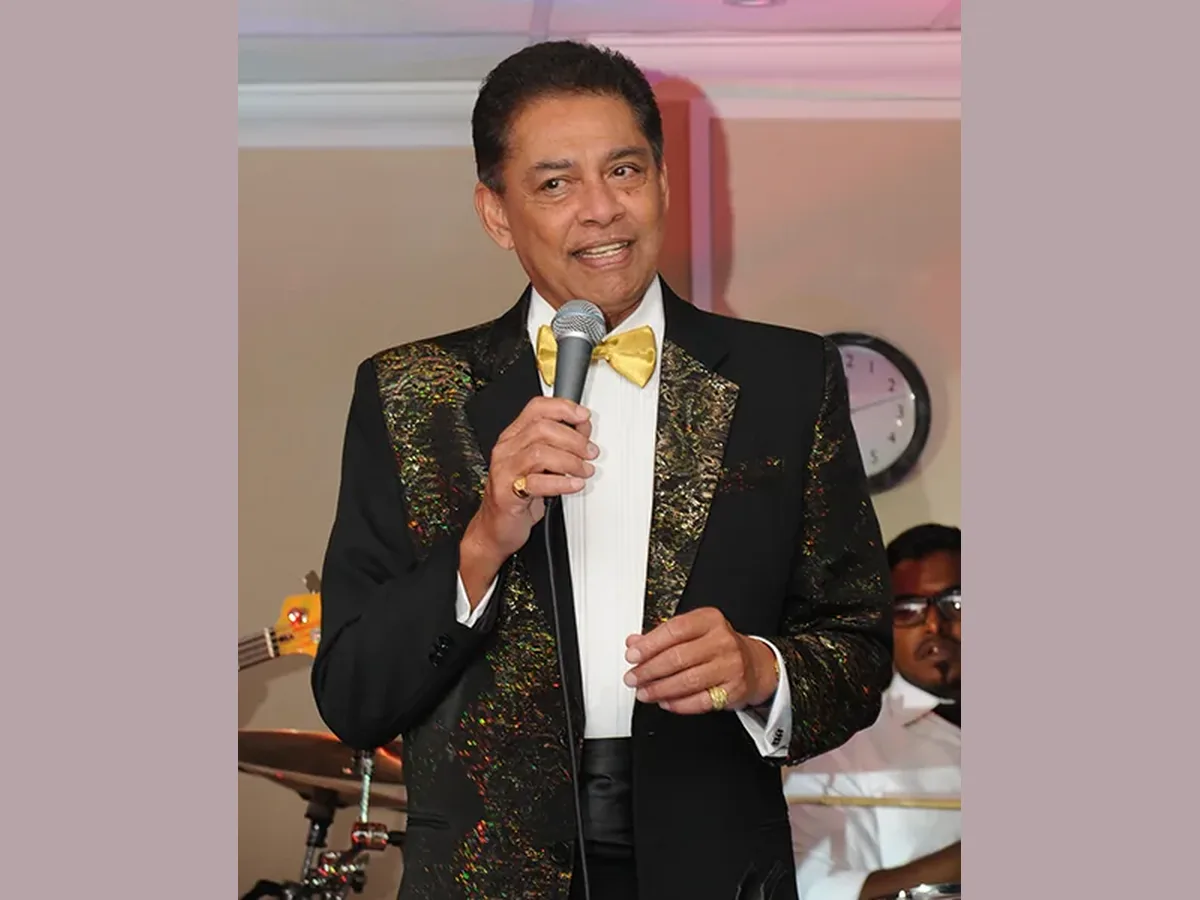
On the last night of 2021 a seventy-seven-year-old man walked onto a stage in Melbourne to sing at a New Year's Eve dance. His diary for the coming year was full — bookings across Australia and beyond, running to the end of October. Nine days later he was dead of a heart attack. What made the news in Colombo, Sydney and London on 9 January 2022 was not that a singer had died old, but that a voice which had refused to age for six decades had stopped mid-sentence.
Desmond Anaclitus Rajiva de Silva was born in Matara on 13 July 1944, the eldest of three children of Clement Arnold de Silva, a public health inspector, and Olga Correa, a teacher from Chilaw. The family moved to Bambalapitiya; he was sent to St. Peter's College, Colombo, boarded for a time at St. Aloysius, and finished his schooling at St. Thomas' College, Matara. He did not go on to higher studies. He came to Colombo, tried the armed services, could not settle, and ended up digging foundations at a bank construction site for five rupees a day.
The band years
He became a singer, by his own telling, because a friend asked him to. In 1963 he took the microphone as lead vocalist of the Fire-Flies, and the Colombo pop circuit of that decade — nightclubs, hotel ballrooms, the new long-playing records — carried him along. He sang with the Spitfires, with Gabo and the Breakaways, and with the Jetliners, the most polished outfit of the lot; his recording of ඔබ නිසා Oba Nisa with Mignonne Fernando and the Jetliners is still the piece connoisseurs of that era name first. His work went out on Radio Ceylon and then on the Sri Lanka Broadcasting Corporation, which was how anyone outside Colombo heard him at all.
In 1976 he formed his own band, Desmond and the Clan, and took it around South and South-East Asia. Accounts of what followed differ in their detail: some say a Kathmandu residency led to a Scandinavian touring contract lasting years, others simply list an itinerary. Sri Lankan press profiles also credit him with representing the country at a song olympiad in Athens in 1979 and at the Yamaha Festival of Song in Tokyo, though the placings reported for these vary from source to source and are worth treating with care.
Why baila mattered
The music Desmond de Silva is remembered for is far older than he was. Africans were brought to Ceylon from about 1630 as slaves and soldiers, and out of the communities they founded came two named musical forms — chicote, described by Advocate Charles Matthew Fernando in 1894 as "slow and stately", and kafrinha, which he called "faster and more boisterous" and possessed of "a peculiar jerky movement". From the 6/8 kaffrinha rhythm, in the hands of the Galle-born traffic policeman Wally Bastiansz, came Sinhala-language baila with a chorus, and from there a national dance music.
It was not a respectable one. For decades the island's music establishment treated baila with what one writer called implied condemnation; the Sinhala Vishwakoshaya, the national encyclopaedia, defined it as a fast dance music that stimulated intoxicated men and women. It is important to be precise about this: baila was never banned, and no censorship order against it has ever been produced. What it faced was contempt from people who thought Sinhala music should sound Indian and serious. The peace was made slowly, and one of the moments usually credited with making it is the scholarly book on baila by Sunil Ariyaratne, which won a State Literary Award and made the subject academically legitimate.
Desmond de Silva sang on the other side of that argument for his whole career, and won.
The songs
The hits are a catalogue of Sri Lankan party music: පොල් කටු හැන්දෙ Pol Katu Hande, චූඩා මාණිකේ Chuda Manike, Mamma No Pappa No, Miss Sri Lanka, Rajasangabo and Komali Pane. Alongside them sit the songs that are simply part of the language now — සුමිහිරි පානේ Sumihiri Pane, කුරුඳු වත්තේ මනෝරි Kurunduwatte Manori, යන්න රට වටේ Yanna Rata Wate, පරසිඳු කොලොම්පුරේ Parasidu Kolompure — and the cricket songs that turn up at every big match.
His debt to Wally Bastiansz was one he never hid. It is often told that as a young admirer he invited Bastiansz to his house, sat him down with a guitar and captured him on a home tape recorder; whatever the truth of the tape, he carried the older man's repertoire forward, and යමං බණ්ඩො Yaman Bando and Hai Hui Baby Achchi survive in Desmond's versions more than in anyone else's. He also recorded nadagam-derived material such as Raja Sangabo Hisa De Dugiyata and Muni Nandana Siripada, and sang playback in films including Seetha Devi, Samanmalee and Mage Amma. The "Party Time" non-stop baila sets he built — long unbroken medleys designed for dancing rather than listening — became a format of their own.
London, Sydney, and the diaspora circuit
In 1986 he moved to England, working with a London backing group called Foreign Affairs, and later settled in Australia. This is the part of the story that most Sri Lankan musicians of his generation share and that few articles explain: from the mid-1980s a Sinhala entertainer could make a better living touring expatriate communities in Britain, the Gulf, Australia and North America than staying home, and Desmond built a forty-year second career doing exactly that. He came back for the big shows — Desmond Live in Concert filled the BMICH on 7 June 2003 — but his working life was airports.
He also used the platform for something other than himself. In August 2005 he became the first Sri Lankan musician to speak publicly on behalf of autistic children in Sri Lanka, urging his audience to "speak up for those who cannot speak up for themselves", and in March 2006 he staged a Concert for Autism in Sydney.
Afterwards
He married three times: to Deanna de Zilwa, to Lilamani Wijeratne, and to Phyllis Van Houten, with whom he lived in Sydney. His elder son Steve de Silva, a singer and dancer who had led his own band Go Public, died of cancer in Colombo in February 2011.
The obituaries all reached for the same title — King of Baila — and it fits, though it undersells him. He was a band vocalist of real technical quality who chose to spend his career on music the critics had spent a century sneering at, and he outlasted the sneering. The voice on the records still sounds about twenty-five years old, which was the joke of his lifetime and is now the point.