
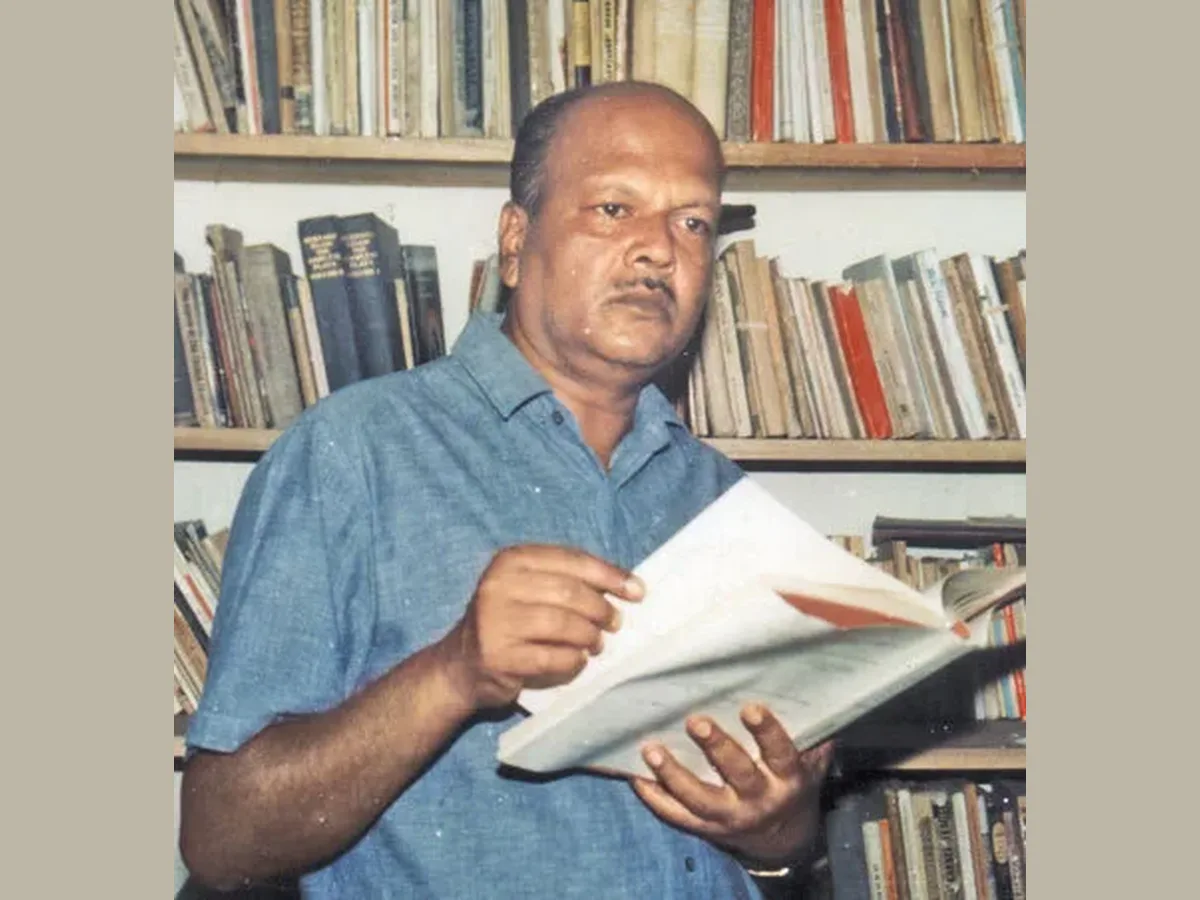
The story is a village joke that everybody's grandmother knew: a jackal marries into a human family and has to be introduced to the in-laws. In 1960 a teacher at Thurstan College in Colombo put it on a school stage as Nari Bena — "the jackal son-in-law" — and did something with it that Sinhala theatre had not quite done before. He did not write a play with songs stuck in it. He built the whole thing out of the melodies villagers already sang, so that the audience arrived knowing the tunes without ever having heard the play. It ran, in one production or another, for forty years.
The teacher was Dayananda Gunawardena, and it is fair to say that the Sinhala stage never got the sound of Nari Bena out of its ear.
Halgampitiya to Ananda
He was born on 15 October 1934 at Halgampitiya in Udugampola, north of Colombo, the son of Don Simon, an English teacher. He went to the Udugampola government school from 1943 to 1946, then to the government secondary school at Weyangoda, and in 1951 to Ananda College in Colombo — the school that produced a striking proportion of the writers and broadcasters of his generation. He ran with the drama society, served as vice-president of the geography society, took the trophy for best cadet, and collected the school's D. B. Jayatilleke literary prize and its Amarasena art award.
In 1957 he went to the university at Peradeniya. Accounts of what he came away with differ: the biography maintained on his memorial site records a BA special degree in geography that year, while Wikipedia says only that he completed the General Arts Qualifying Examination. The same year he was in Moscow for the International Student and Youth Festival, which for a village boy from Udugampola was a considerable distance to have travelled by twenty-three.
He married Irangani Ranatunga of Gampaha on 28 September 1967. They had three children.
Making a stage sound like a village
Nari Bena is dated 1960 or 1961 depending on which list you read — his own works list gives 1960 for the first Thurstan College production and 1961 for a second staging by the Amateur Drama Society. What is not in dispute is the method. Working with the popular musician Lionel Algama, he set the play to melodies drawn from folk song, and two of its numbers left the theatre altogether and became songs in their own right: ඇහැළ මලින් ගස් පිරිලා Ahala malin gas pirila — the trees are full of ehela blossom, and how lovely it is to look at — and කුමටද සොබනියේ Kumatada sobaniye, why are you shedding tears.
He kept going. Kamare Pore, an adaptation of John Maddison Morton's English farce Box and Cox, was first staged without any songs at all. Bakmaha Akunu, from Beaumarchais's The Marriage of Figaro, followed in 1962 or 1963 — sources give both — and introduced the revolving stage to Sri Lanka for the first time. It was successful enough to be turned into a film, Bak Maha Deege, in 1969. Along the way came Emathi Pattama from the Bulgarian Golemanov, Pinguththara for the Sinhala Society of the University of Colombo, Jasaya saha Lenchina, Jeevana Vanchawa hewath Ibikatta, Vikaraye Akaraya, Kabaye Habe, and Padmawathi, made with Lakshman Jayakody out of a Charles Dias original. Sixteen plays in all.
Two of the later ones matter most. Gajaman Puwatha (1975) took the life of the poet Gajaman Nona and is credited as the first Sinhala play in the documentary-drama form — a genre he is generally said to have brought into Sinhala theatre. Its song සසදර මන නන්ද Sasadara mana nanda, sung on stage by Nishshanka Diddeniya, still circulates independently of the play. Madhura Javanika (1983) was more ambitious still: a chronicle that moves from the war of Rama and Ravana through the arrival of the Western invaders and ends with Sri Lankan women leaving to work as housemaids in Dubai. It won a Peace Award for drama in 1984. ගම්වල සැමතැන Gamwala samathana, with music by Rohana Beddage and sung by Nishshanka Diddeniya and Jayalath Manorathne, is another of his stage numbers that outlived the production it came from.
Ananda Javanika (1986) took the award for best direction and a special award for its script at the 1987 State Drama Festival, along with certificates for music, stage management and acting. In the 1970s he founded his own company, the Nalu Kirthi Sabha theatre group, which outlived him.
Twenty-eight years at the SLBC
The theatre was the visible half. The other half was radio. From 1961 to 1989 he was a programme producer at the Sri Lanka Broadcasting Corporation, then directed programmes for its audio research unit (1989–90) and its English Service (1990–92) before retiring.
That is the period in which Sinhala radio drama became something other than a stage play read into a microphone, and Gunawardena's contribution was to treat it as a musical form — to think about what a listener who cannot see anything can be made to feel by a song arriving at the right moment. The Corporation sent him abroad to learn the craft properly: he represented Sri Lanka at the International Drama Federation and studied drama in Romania, Bulgaria, Czechoslovakia and Russia in 1962, and in 1966 won a Commonwealth Scholarship to study radio and television at the BBC. He was Sri Lanka's representative at the first Television Festival of the Non-Aligned in 1979, and in 1991 held a South Korean scholarship to research Buddhism and Korean theatre.
He acted in films as well — Kurulu Bedda, Ran Salu and Wesathuru Siritha — and published around a dozen books of drama and poetry. Among his lyrics outside the plays are කන්ද උඩින් Kanda Udin, sung by Amitha Wadisinghe to music by Somadasa Alvitigala, and පුංචි රුවන් Punchi Ruwan, sung by Jayalath Manorathne and Thisagothami Sarachchandra.
Jubal
Colleagues called him Jubal — in Genesis, the ancestor of everyone who plays the harp and pipe — though no source explains how the name attached to him. He died on 24 June 1993 at the General Hospital in Colombo, following an accident at the Elphinstone Theatre; he was fifty-eight. He was buried at Ehelagahahena in Udugampola, a few miles from where he was born.
The afterlife of the work has been uneven. In 2007 a group revived Gajaman Puwatha at the John de Silva Theatre — Rathmalie Gunasekera as Gajaman Nona, Nissanka Diddeniya as Elapatha Mudali, music and dance by Rohana Beddage — with the explicit aim of raising money to bring back the plays that were no longer being produced at all. Nari Bena, Jasaya saha Lenchina, Kamare Pore and Madhura Javanika were then still in the repertoire; much of the rest was not.
What has proved harder to kill is the songs. A folk melody set to a stage lyric, carried out of the theatre by an audience, played on the radio by a producer who happened to be the same man — that circuit is the thing Dayananda Gunawardena built, and it is why a listener who has never seen a play of his can still sing two lines of one.