
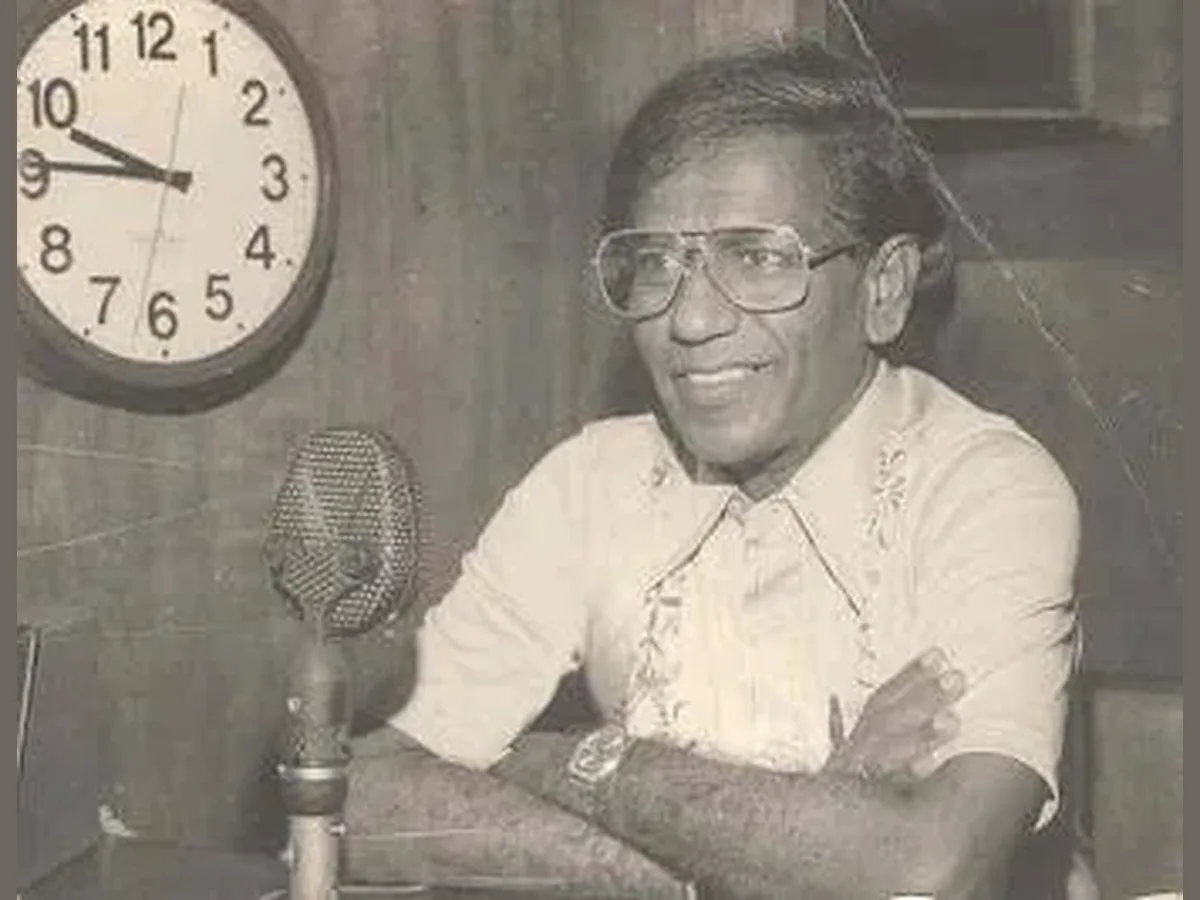
On 12 May 1954 a young man stood up in front of Prime Minister Sir John Kotelawala and made up verse on the spot. The competition was for hitivana kavi — impromptu poetry, composed aloud, to order, on any subject an audience threw at you. He won the gold medal, all island. Nearly forty years later, describing that afternoon to a radio programme in December 1991, he still called it unforgettable.
He would spend the rest of his working life on the other side of that microphone, and end up in the single most consequential job in Sinhala music that nobody thinks of as a music job: Director of Sinhala Services at the Sri Lanka Broadcasting Corporation. Between 1977 and 1989, if a Sinhala song was going to be recorded, graded and broadcast, it passed through his department.
The horoscope at Kosgoda
Agampodi Harindranath Chitrananda Mendis Abeysekera was born on 7 March 1930 at Kosgoda, on the coast in Galle District, the only child of Agampodi Louis Mendis Abeysekera, the village headman, and Degiri Roslin Henry de Zoysa. It is told in his family that the poet Ananda Rajakaruna, a relative, read the newborn's horoscope and predicted that the country would one day honour him and that he would bring glory to his home town. The name Chitrananda was chosen by an uncle.
He started at Kosgoda Sinhala School, and at nine was sent to Nalanda College, Colombo. He debated, joined the culture club, served as a corporal in the senior cadet corps — and published his first book of poems, Sarasavi Gitaya, while still a schoolboy, with the help of his teacher U. A. S. Perera. Two of his classmates would run Sinhala broadcasting alongside him: Ridgeway Tilakaratne, later Director General of the SLBC, and the lyricist-announcer Karunaratne Abeysekara.
He taught English briefly in a village school at Menikkadawara in 1949, then moved through the Registrar General's Department, the Official Languages Commission and the Official Languages Bureau — while, from about 1950, producing poetry, drama and feature programmes for Radio Ceylon as a guest.
Up through the building
On 6 August 1956 he joined the permanent staff as a programme compiler. The room he walked into contained Madawala S. Ratnayake, Mahagama Sekera, K. A. W. Perera and P. Welikala — a group that between them would rewrite what a Sinhala song was.
He rose through the least glamorous and most useful part of the service. Producer in the Rural Service from January 1958; executive producer from July 1962; head of the Educational Service; then, from October 1963, head of the Rural Service. There he ran Govi Jaya Handa ("the sound of the farmer's victory"), a programme for the countryside under Prime Minister Dudley Senanayake that became genuinely popular in rural Ceylon — Abeysekera also acting as master of ceremonies at its award events. After a Colombo Plan training visit to the Australian Broadcasting Commission in 1960, he proposed in 1961 that Ceylon start regional broadcasting centres; the Raja Rata, Maha Nuwara and Ruhunu services later grew out of that idea. He was a live commentator too, and older listeners remember his voice carrying the Kandy Esala Perahera.
Then, for three years, nothing. The foundation's own account of his career records that he was out of the corporation from about 1972 to 1975 through political victimisation, and was brought back on 4 May 1975 as head of the Publications Division. It is a bare sentence, and it is the only place his career break appears — but it puts him among the broadcasters of his generation who lost their posts when a government changed.
Director of Sinhala Services
On 5 October 1977 he was promoted to Director of Sinhala Services, and held the post until his retirement on 5 August 1989.
This was the job that shaped the sound of the country. The Music Department and the Hindi Service both sat under the Director of Sinhala Services, which meant the machinery for auditioning and grading artists, commissioning songs and deciding what was broadcast ran through one office. Sri Lanka's light-song repertoire — sarala gee — was not assembled by a market. It was assembled by a state broadcaster, by committee, and Abeysekera chaired the end of that process for twelve years. Colleagues remember the department in those years as a golden run, with names like Saman Athaudahetti, K. D. K. Dharmawardena, Palitha Samarasinghe and Ariyadasa Peiris on the staff, and a director whose stated policy was that the doors should stay open for anyone with ability.
His own songs
The unusual part is that the man grading the songs was also writing them.
His best-known lyric is කොතැනක සිටියත් ඔබ මෙලොවේ Kothanaka Sitiyath Oba Melowe ("wherever in this world you may be"), sung by H. R. Jothipala for the film Samiya Birindage Deviyaya; the title is also seen as Kothanaka Hitiyath. Jothipala also recorded his කිරි ඉතිරේවා නව වසරේ Kiri Ithirewa Nawa Wasare, a New Year song, and කීවෙමි ඔබහට Keewemi Obahata. Milton Mallawarachchi sang ඔබ දැන් කීවත් Oba Dan Keewath Kandulu Sala and Sinarella Sisi Kirane, both set by Sarath Dassanayake. Kanthi Wakwella recorded සිහිල් සුළං රැල්ල Sihil Sulan Rella and the devotional සුගත තථාගත Sugatha Thathgatha.
His religious writing found its widest audience through Jaya Siri Maha Bodhi, sung by Dayaratne Ranatunge — the title piece of a 1982 collection of a hundred of his lyrics. Neela Wickramasinghe and T. M. Jayaratne sang Vilwala Mal Pokuru Pokuru; Edward Jayakody sang Ma Ipaduna Mage Ratata Sewaya Karala and Nidahasa Gena Kavi Liyanna; Latha Walpola, Mohideen Baig and Amara Ranatunge all recorded his words. He wrote for cinema from the late 1950s — songs for Sirimali (1959), Nalangana (1960), Pirimiyek Nisa (1960), Suvineetha Lalini (1961), Sudo Sudu (1965) — and wrote screenplays and dialogue for several films besides.
ATHAKASA, and the end
Poetry was the constant. In 1935 seven young men sitting under a tree in Victoria Park, Colombo — P. B. Alwis Perera among them — founded what became the Aganuwara Tharuna Kavi Samajaya, the Colombo Young Poets' Association, known by the acronym ATHAKASA. It championed the Colombo school of Sinhala verse: plain, metrical, flowery language, and above all the public art of hitivana kavi.
Abeysekera became its president and stayed until his death; accounts differ on the start date, with English Wikipedia giving 1979 and the foundation's own history giving twelve years from 1980. Under him ATHAKASA opened district branches from Matale to Embilipitiya, was declared a public charity by Parliament, and marked its fiftieth anniversary at Embilipitiya on 25 June 1985 with a commemorative stamp. In 1984 he restarted Kavi Suwanda, a newspaper for poets.
The honours came steadily. He was made a Justice of the Peace in 1982, at a felicitation his home village organised for his thirty-fifth year of creative work. The Ministry of Cultural Affairs gave State Literary Awards to Kavya Pushpanjali and to Samanala Mahima — the foundation dates the two prizes to 1984 and 1987, while Wikipedia's booklist attaches the awards to the 1983 and 1986 publication years. In August 1984 he read a paper on poetry and time at the Struga Poetry Festival in Yugoslavia, and in February 1991 Prime Minister D. B. Wijetunga conferred on him the title Kivipathi, lord of poets.
He died in 1992, three years after leaving the corporation. No source consulted gives the day or month. What he left behind is harder to see than a song catalogue, because it is a system: the shape of the Sinhala repertoire that the SLBC broadcast to a whole country, decided in an office by a man who could still, if asked, make up a verse on the spot.