
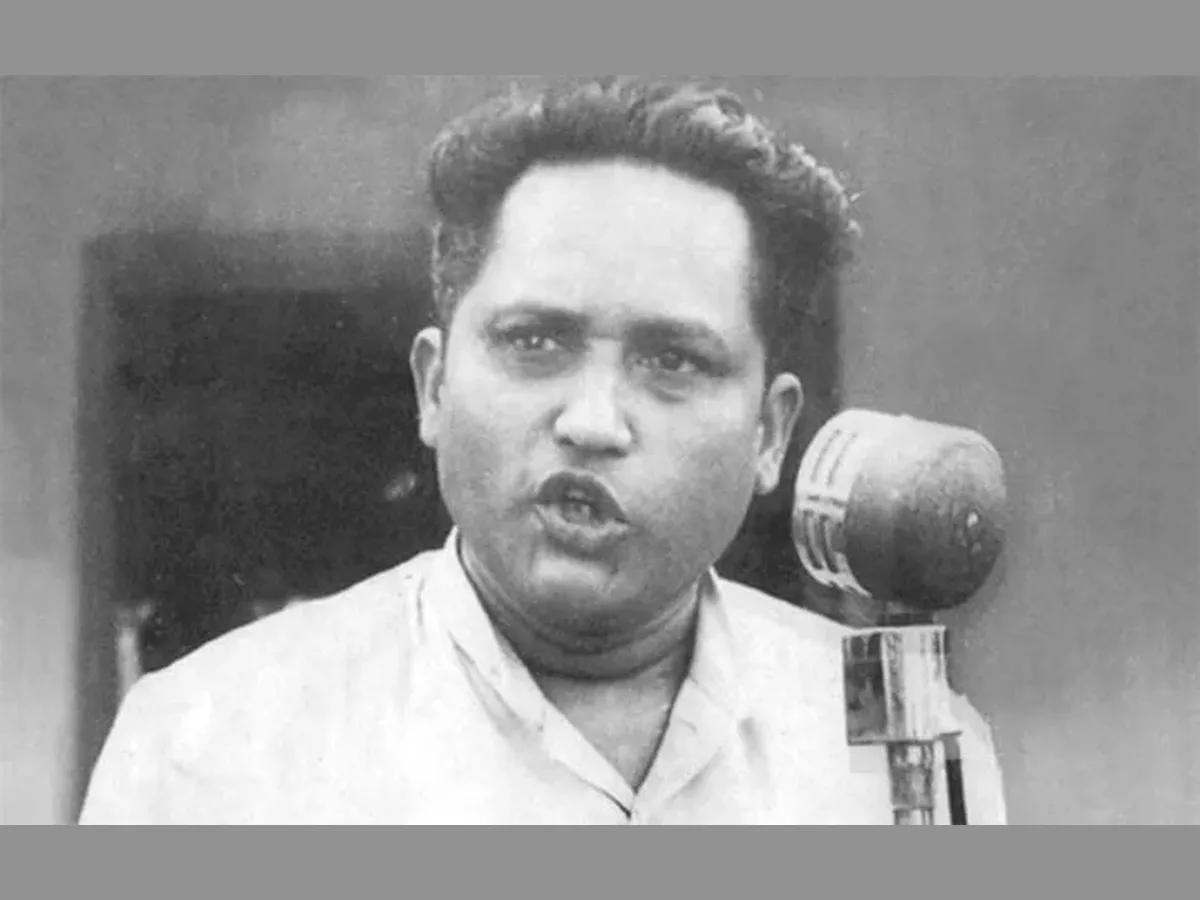
Somewhere in the forest around Kataragama in the 1930s, a young Buddhist monk who could not settle to monastic life used to walk along the riverbank away from anyone. One day he found a Bengali woman sitting there with a sitar, singing verses from Jayadeva's twelfth-century Gitagovinda.
"I closed my eyes," he wrote later, "and devoted my full attention to experiencing the rasa of the Sanskrit verses she sang."
He disrobed not long afterwards. Thirty years on, that same man had written the first radio opera in Sinhala, invented a poetic metre nobody had used before, given the language a scornful word for lazy songwriting, and — perhaps most consequentially of all — put song lyrics into a printed book so that people would read them as poems.
The novice who kept leaving
Chandraratne Dios Sooriyarachchi Mohotti was born on 19 June 1913, the son of a farmer. Sources place his birth variously at Beliatta and at the neighbouring village of Puwakdandawa in the deep south. In 1924, aged eleven, he was ordained a novice at the village's Panchathuparamaya temple as Puwakdandawe Sri Chandaratana.
The temple gave him the education that shaped everything he wrote. He read the medieval Sinhala poets — Totagamuwe Sri Rahula, Vidagama Maitreya, Alagiyavanna Mukaveti — and later described the place as a hub where Sinhala poetry was studied and argued over. He learned Sanskrit and Pali, Sinhala astrology and the composition of verse.
It did not hold him. At a temple near Kirivehera a dispute over ownership turned dangerous enough that he fled into the jungle and left the order. He drifted to Dambulla, then Colombo, then Negombo, where at the Angurukaramulla temple he was ordained a second time — and left the order again.
Those Negombo years produced a strange sideline. He read widely in Ayurvedic medicine and the occult uses of Sinhala mantra, and became known as a writer of set kavi, verses meant to produce well-being, and vas kavi, verses meant to curse — forms governed by rules about which letters belong to hell, to the human realm and to the divine. His patrons believed they took effect the moment they were recited. Worth remembering when reading his song lyrics: this was a man paid to believe that a single syllable changes the world.
Lankadeepa, and an auspicious hour
At twenty-two, still robed, he began writing letters to Lakmini Pahana, edited by the language reformer Kumaratunga Munidasa. He was remanded in custody for allegedly abusing the imperialists at a meeting, went to India to study Bengali, Hindi and Indian culture, and on returning joined the editorial board of Heladiva, where he wrote a column called "Charumanda".
Then came the job that made him a household name outside music entirely. When Lankadeepa was founded on 27 October 1947 it was launched at an auspicious hour Manawasinghe had calculated, and he was handed the paper's astrology pages; from 1955 he wrote a column called "Waga Thuga". He stayed there until his death — a full-time newspaperman who wrote songs on the side, which is exactly the sort of career the radio-song era ran on.
Mandhari, and the invention of the radio opera
In 1955 the head of Radio Ceylon's Sinhala service, Tewis "Meghaduta" Guruge, and the station's music director P. Dunstan de Silva conceived a new form: an operatic libretto set to North Indian ragas, written to be heard only over the air. Guruge called it gita natakaya, "song drama", and asked Manawasinghe to write the first one.
Mandhari was broadcast on 8 December 1955. It was a deva kata, a mythological tale in the Sanskrit manner, in which every character stood for a force of nature: Princess Mandhari was universal beauty, King Jagatpati the universe, Soma Kumaru the moon, Divapati the sun. When the moon and the sun quarrelled over the princess, an educated listener heard both a love triangle and the passage from night to day. De Silva — the third Sri Lankan to take a Sangeet Visharada at the Marris College of Music in Lucknow — set it to raga.
It was unapologetically elite. Manawasinghe and his successor Wimal Abeysundara were not writing for the market; they wrote, in their own phrase, to raise the standards. The genre they invented is now almost entirely forgotten.
Vacana danava
The other half of his project was destructive, and it is the half that changed Sinhala song for good.
Through the 1950s the ordinary way to make a Sinhala record was to take a Hindi film melody and fit Sinhala words to its pattern of long and short matra. The practice had a contemptuous name, and Manawasinghe is the man most associated with it: vacana danava, "putting words" — as though a Sinhalese songwriter merely had to lay words onto an Indian tune "like an unskilled mason clumsily puts one brick on top of another."
In the preface to his 1957 collection Komala Rekha he went after his colleagues with relish. A lyricist, he wrote, "cannot create a powerful song just by playing around with stock words like 'gentle,' 'shiny,' 'moon,' 'sky,' 'beautiful'... Words like this are just decorative material like shiny metal foil. We import brass" — the Indian melodies — "and apply our shiny foil to it." Such songs, he said, were "a nuisance to the ear like the scare-away clappers that drive birds out from lands that farmers cultivate." And nobody, he complained, checked whether the words fitted the mood of the tune: "Sinhalese lyricists put sad words to a happy melody."
Print, and the Mahabo Vannama
Because song was thought of that way, it was not thought of as literature. Manawasinghe's answer was print. Komala Rekha (Colombo: New Lila Mudranalaya, 1957) collected his radio-song texts as a book — leaving the words on a page to be read silently, like poems. The ethnomusicologist Garrett Field puts the significance plainly: print gave the ephemeral language of song a literary fixity, and gave the writer authorship at a time when record labels did not print lyricists' names on their discs at all.
Page 21 of that book carries the song that proves the case. වැලිතල අතරේ Wali Thala Athare — known as the "Mahabo Vannama", the vannama of the great Bodhi tree — describes the Neranjana river flowing slowly across the sand on the day the Buddha reached enlightenment, and ends with the leaves of the Bodhi tree in Mahamevuna Park dancing as if there were such a thing as a Mahabo Vannama. There was not. Manawasinghe invented it, and to do so he invented a metre: instead of the conventional four lines of equal matra, his stanzas run in phrases of eight, eight and ten; then five and ten; then five, ten, five and five. Amaradeva composed the music and sang it.
Nine years later, giving a lecture on what makes a good song, Mahagama Sekera proposed a test — take the music away and see whether the lyric stands on its own as literature — and the song he read out as passing it was Manawasinghe's.
The last four months
His catalogue is smaller than those of the lyricists who came after him, and much of it is now inseparable from Amaradeva's voice: ජගන් මෝහිණී මධුර භාෂිණී Jagan Mohini Madhura Bhashini, සීතල වතුර ගලයි Seethala Wathura Galayi, ප්රේම තටාකේ Prema Thatake. Others went elsewhere — දොයි දොයිය පුතා Doi Doiya Putha and හද ගිලෙයි Hada Gilei to Rukmani Devi, the second as a duet with Mohideen Baig; මොනවද අම්මේ අකුරු ජාතියක් Monawada Amme Akuru Jathiyak, a child asking her mother what on earth letters are for, into the schoolroom repertoire.
In 1962 he wrote his first lyric for the cinema. The film was Ranmuthu Duwa, the first full-length Sinhala colour feature, and the song was ගලන ගඟකි ජීවිතේ Galana Gangaki Jeewithe — "life is a flowing river" — sung by Nanda Malini and Narada Disasekara to Amaradeva's music. Accounts differ over whether the recording belongs to 1962 or 1963; the film opened in August 1962.
On 9 May 1964, at the Asoka Cinema in Colombo, the Sarasaviya newspaper held the first film awards ceremony in Sri Lankan history, judging four years of cinema at once. Gamperaliya swept nine prizes. Three of the music awards went to Ranmuthu Duwa: best male playback singer to Narada Disasekara, best female playback singer to Nanda Malini, and best lyricist to Chandraratne Manawasinghe.
He died in Colombo on 4 September 1964, aged fifty-one, four months after collecting it.