
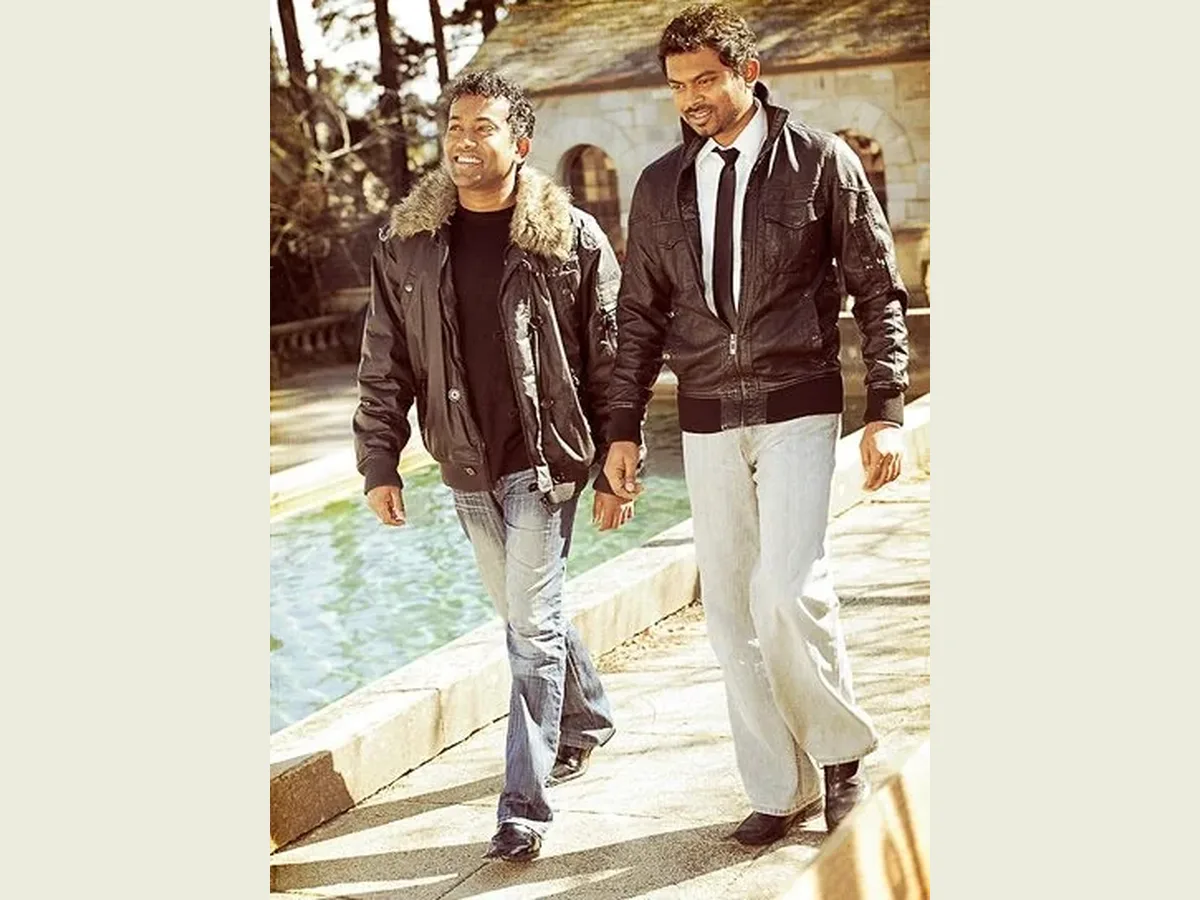
In July 2000, two years into their career, a Sunday Times reporter put the awkward question to Bathiya Jayakody directly: people are accusing you of taking old songs. What about "Siri Sangabodhi"?
The answer was not defensive. "Siri Sangabodhi was the pop song of the thirties and forties," he said. "We know certain people make statements without knowing the history of songs. The best option is to keep quiet — music will speak, but statements don't."
It is a good place to start, because the argument that opened around Bathiya and Santhush in 1998 never really closed. They were accused of vandalising the Sinhala song; they replied that they were extending it. Twenty-five years later they were coaching The Voice Sri Lanka on national television, and the argument had been decided by sheer volume of listening.
Two schoolboys, two schools
Bathiya Jayakody was born on 22 December 1976 and Santhush Weeraman on 5 September 1977, both in Colombo. Bathiya went to Ananda College — with a stint at Isipathana, and, earlier still, a primary school in India — and Santhush to Royal College. That pairing, an Anandian and a Royalist, is the first thing any Sri Lankan notices about them, because the two schools sit on opposite sides of the country's oldest cultural divide: Sinhala-medium and English-medium, temple and club.
Accounts of how they actually met differ. The 2000 Sunday Times interview has Bathiya recalling their first meeting at a Scout jamboree at Viharamahadevi Park in 1992, both boys being Scouts. Wikipedia says instead that they met while studying at the Mary Anne David School of Vocal Music in Colombo. Both may be true in sequence; the vocal school is where they certainly overlapped, training in classical and show-tune singing, opera, jazz and Broadway.
Bathiya had played piano from the age of six, studied both Eastern and Western music at school, played alto saxophone in Ananda's first senior brass band and sang lead in the school band. The nudge that turned all that into something new came from the musician and producer Dilup Gabadamudalige, with whom he studied music technology. "It was Dilup Gabadamudalige who influenced me into this kind of novel experimental music," Bathiya said in 2000. "He said a lot that made sense and really motivated us."
Santhush came from a musical family; his brother Dushyanth Weeraman is also a well-known singer.
They chose to work under their own first names rather than invent a band name, and Bathiya explained why with a clear eye on how Sri Lankan groups tend to end. "We have seen many groups here that have dried up or split after they are formed, except for a handful. Some members crossover from one group to another, and it's not easy to identify individuals by their groups."
Filling a void
The duo's own account of why they started is consistent across two decades of interviews: there was a hole where music for their generation should have been. "As young people, we understood that there was kind of a void that we needed to fill," Bathiya told Khaleej Times in 2023. "Drawing on the inspiration from what we saw around the world, we thought of creating something that would cater to our own void."
Santhush put the ambition the other way round — not importing a sound but exporting one. "We wanted to create a Sri Lankan sound which was international, a global sound with Sri Lankan elements in it for people to connect with."
They had also spotted a specific social fracture and aimed at it. "There had always been a visible gap between the English speaking and the Sinhala speaking youth in our country," they said in 2000. "This begins at education levels in schools. We are happy that our attempts of re-mixing and rapping in both languages have helped to bridge this gap to a certain extent." Mixing Sinhala, Tamil and English verses in the same track was not a gimmick; it was the point.
The name they eventually attached to the result was folkhop — Sinhala folk and film melody carried on hip hop production — and it stuck well enough that they were billed as its ambassadors when they performed at the opening ceremony of the 2011 ICC Cricket World Cup.
The records
The debut album Vasanthaye ~ A New Beginning came out on Torana Music in 1998, followed by Life in 2000, Tharunyaye in 2002, Neththara in 2005, Ayubowan on Universal Music in 2007, Shaheena in 2008, Sara Sihina in 2010, Resvihidena in 2014 and Oba Nisa in 2019, alongside soundtracks for films including Hiripoda Wassa, Asai Man Piyabanna and Pravegaya.
The songs people sing back at them are නේත්තරා Neththara, ෂහීනා Shaheena, රූ සරා Roo Sara, කිරි කෝඩු හිතට Kiri Kodu Hithata, රැස් විහිදෙන සමනලියකගෙන් Ras Wihidena Samanaliyakagen, මුමුණනවා Mumunanawa and ආදරය ඇයයි Adaraya Ayai. Two are national in a more literal sense: අප ජාතියේ නාමයෙන් Apa Jathiye Namayen, written and performed as the official Sri Lanka Cricket anthem in 2002, and ලංකා මාතා Lanka Matha.
One thing the sceptics of 1998 tend to miss is who was writing those lyrics. The words to their biggest hits came from established Sinhala lyricists — Nilar N. Cassim wrote Shaheena, Dedunna Sedi and Adaraya Ayai; Wasantha Dukgannarala wrote Neththara and Mumunanawa; Shehan Galahitiyawa wrote Roo Sara and Lanka Matha; Sunil Ariyaratne, Upul Shantha Sannasgala and Chamitha Cooray all appear in the credits. Whatever the beats were doing, the texts came out of the Sinhala lyric tradition.
Beyond the island
They were the first Sri Lankan artists to sign a publishing contract with Universal Music Publishing and a recording contract with Sony BMG, both in 2002, and the only Sri Lankan act to have albums under both labels. They brought Indian playback voices onto Sri Lankan records — Hariharan on "Yalpaname", Asha Bhosle on දේදුන්න සේදී Dedunna Sedi, and Sonu Nigam on "Aa Chale", which they composed for the Hindi dub of a Japanese animated film.
They performed at the opening of the IIFA Awards in 2010 and co-wrote its opening music track, composed the theme for the 2012 ICC World Twenty20, and performed and co-directed the official theme for the Commonwealth Heads of Government Meeting hosted by Sri Lanka in 2013. From 2020 they sat as coaches on both seasons of The Voice Sri Lanka — including, in a neat closing of the circle, a televised cover of Amaradeva's නිම් හිම් සෙව්වා Nim Him Sewwa with their fellow coaches.
The figures usually quoted for them — more than fifty number-one singles, six platinum albums, over two thousand concerts, five hundred commercial productions — come from the duo's own promotional material and are repeated by the press rather than independently audited, so they are best read as a claim rather than a count. What is not in dispute is the shape of the thing: two schoolboys from opposite sides of Colombo, who decided the Sinhala song could carry a drum machine, and were proved right.